God's declaration of Truth

GOD HAS SHOWN MERCY. FOR THOSE WHO REJECT THAT, THERE IS ONLY THE JUSTICE AND VENGEANCE OF GOD WHICH IS ETERNAL DAMNATION.

Luke Chapter 19

The words of Our Only Lord and Saviour Jesus Christ in red.

19:10 "For the Son of man is come to seek and to save that which was lost."
19:11 As they were hearing these things, he added and spoke a parable, because he was nigh to Jerusalem and because they thought that the kingdom of God should immediately be manifested.
19:12 He said therefore: "a certain nobleman went into a far country, to receive for himself a kingdom and to return.
19:13 And calling his ten servants, he gave them ten pounds and said to them: Trade till I come.
19:14 But his citizens hated him and they sent an delegation after him, saying: 'We will not have this man to reign over us.'
19:15 And it came to pass that he returned, having received the kingdom: and he commanded his servants to be called, to whom he had given the money, that he might know how much every man had gained by trading,
19:16 And the first came saying: 'Lord, thy pound hath gained ten pounds.'
19:17 And he said to him: 'Well done, thou good servant, because thou hast been faithful in a little, thou shalt have power over ten cities.'
19:18 And the second came, saying: 'Lord, thy pound hath gained five pounds.'
19:19 And he said to him: 'Be thou also over five cities.'
19:20 And another came, saying: ' Lord, behold here is thy pound, which I have kept laid up in a napkin.
19:21 For I feared thee, because thou art an austere man: thou takest up what thou didst not lay down: and thou reapest that which thou didst not sow.'
19:22 He saith to him: 'Out of thy own mouth I judge thee, thou wicked servant. Thou knewest that I was an austere man, taking up what I laid not down and reaping that which I did not sow.
19:23 And why then didst thou not give my money into the bank, that at my coming I might have exacted it with usury?'
19:24 And he said to them that stood by: 'Take the pound away from him and give it to him that hath ten pounds.'
19:25 And they said to him: 'Lord, he hath ten pounds.'
19:26 But I say to you that to every one that hath shall be given, and he shall abound: and from him that hath not, even that which he hath shall be taken from him.
19:27 But as for those my enemies, who would not have me reign over them, bring them hither and slay them in my presence."
19:28 And having said these things, he went before, going up to Jerusalem.
19:29 And it came to pass, when he was come nigh to Bethphage and Bethania, unto the mount called Olivet, he sent two of his disciples,
19:30 Saying: "Go into the town which is over against you, at your entering into which you shall find the colt of an ass tied, on which no man ever hath sitten: loose it and bring it.
19:31 And if any man shall ask you: 'Why are you loosing it?' You shall say thus unto him: Because the Lord hath need of it.' "
19:32 And they that were sent went their way and found the colt standing, as he said unto them.
19:33 And as they were loosing the colt, the owners thereof said to them: "Why are you loosing it?
19:34 But they said: "Because the Lord has need of it."
19:35 And they brought it to Jesus. And casting their cloaks over the colt, they set Jesus on it.
19:36 And as he went, they spread their cloaks upon the road.
19:37 And when he was drawing near, being now at the descent of the Mount of Olives, the whole company of his disciples began to rejoice and to praise God with a loud voice, for all the miracles that they had seen,
19:38 Saying: "Blessed is he who comes as king, in the name of the Lord! Peace in heaven and glory in the highest!"
19:39 And some of the Pharisees, from the crowds, said to him: "Master, rebuke thy disciples."
19:40 He said to them: "I tell you that if these keep silence, the stones will cry out."
19:41 And when he drew near, seeing the city, he wept over it, saying:
19:42 "If thou also hadst known, and that in this thy day, the things that are to thy peace: but now they are hidden from thy eyes.
19:43 For the days shall come upon thee: and thy enemies shall cast a trench about thee and compass thee round and straiten thee on every side,
19:44 And beat thee flat to the ground, and thy children who are in thee. And they shall not leave in thee a stone upon a stone: because thou hast not known the time of thy visitation."
19:45 And entering into the temple, he began to cast out them that sold therein and them that bought.
19:46 Saying to them: "It is written: My house is the house of prayer. But you have made it a den of thieves."
19:47 And he was teaching daily in the temple. And the chief priests and the scribes and the rulers of the people sought to destroy him.
19:48 And they found not what to do to him: for all the people were very attentive to hear him.

The Second Epistle of St. Paul to the Thessalonians

The day of the Lord is not to come till the man of sin be revealed. The apostle's teachings are to be observed.

2:1 And we beseech you, brethren, by the coming of our Lord Jesus Christ and of our gathering together unto him:
2:2 That you be not easily moved from your sense nor be terrified, neither by spirit nor by word nor by epistle. as sent from us, as if the day of the Lord were at hand.

Chap. 2. Ver. 2. Spirit . . . utterance. . . letter indicate three possible sources of their belief that the parousia is imminent. Spirit refers to some falsely claimed revelation, utterance may be a statement of Paul’s which was misunderstood, or wrongly attributed to him, the letter seems to be one forged in Paul’s name.

2:3 Let no man deceive you by any means: for unless there come a revolt first, and the man of sin be revealed, the son of perdition

Ver. 3. . . The parousia must be preceded by a great apostasy, i.e., a great religious revolt, and the advent of the man of sin, i.e., Antichrist. Son of perdition, one entirely deserving of eternal punishment.

Ver. 3. The day of the Lord will not come. These words have been inserted to complete the sentence, which in the original is elliptical. The expanded reads "Let no man deceive you by any means: for the day of the Lord will not come unless there come a revolt first, and the man of sin be revealed, the son of perdition"

2:4 Who opposeth and is lifted up above all that is called God or that is worshipped, so that he sitteth in the temple of God, shewing himself as if he were God.

Ver. 4. In the temple, that of Apostate Jerusalem which the full consensus of the Church Fathers declare he will rebuild - i.e. the Temple of Remphan; and in the Apostate shell of the former Christian church, which he perverts to his own worship: as the Freemasons have done to the Vatican.

Ver. 4. Antichrist will be characterized by great impiety and pride. He sits in the temple of God, etc. He will aspire to be treated as God and proclaim that he is really God.

2:5 Remember you not that, when I was yet with you, I told you these things?
2:6 And now you know what restrains him, that he may be revealed in his proper time.

Ver. 6. What restrains him. The Thessalonians knew the obstacle. We also know that it is Jesus Christ.

2:7 For the mystery of iniquity is already at work: only that he who is at present restraining it, does still restrain, until he is gotten out of the way.

Ver. 7. Mystery of iniquity, the evil power of Satan’s threefold prevarication and total Apostasy from God, of which Antichrist is to be the public exponent and champion. He who is at present restraining it. The obstacle is now spoken of as a person. Some point out that Michael the archangel and his heavenly army are obstacles, and this is true, which now prevent the appearance of Antichrist – but the primary obstacle is, as St. Justin Martyr teaches: Jesus Christ Himself; when the great Apostasy is complete, then in effect, Christ is “gotten out of the way.”

2:8 And then that wicked one shall be revealed: whom the Lord Jesus shall kill with the spirit of his mouth and shall destroy with the brightness of his coming: him

Ver. 8. When Christ appears in glory, He will inflict defeat and death on Antichrist by a mere word of command.
2:9 Whose coming is according to the working of Satan, in all power and signs and lying wonders:

Ver. 9 – 10. By the aid of Satan Antichrist will perform prodigies which men will falsely regard as miracles, and by means of which they will be led to adopt sinful practices.

2:10 And with all wicked deception to those who are perishing. For they have not received the love of truth that they might be saved.
2:11 Therefore God shall send them the operation of error, to believe lying:

Ver. 11. God shall send. . .That is God shall suffer them to be deceived by lying wonders, and false miracles, in punishment of their not entertaining the love of truth.
Ver. 11. 'God sends.' God will allow their willful rejection of truth to have its natural results of spiritual blindness, impenitence and damnation. A misleading influence, or, “a delusion.” The operation of error - the Greek reads: "energian planes" or literally the energy of delusion, which is exactly and actually the fallen spirits of the devils and demons conjured by pagan religion, especially by idolatry. NOW, currently, the Assisi delusion of the Apostates, Ratzinger and Wojtyla and many others present with them, is a very real and prime example. To give oneself over to this is to invite utter and complete damnation of oneself by God.
2:12 That all may be judged who have not believed the truth but have consented to iniquity.

2:13 But we ought to give thanks to God always for you, brethren, beloved of God, for that God hath chosen you firstfruits unto salvation, in sanctification of the spirit and faith of the truth:
Ver. 13. First-fruits, i.e., earliest believers in the gospel. Some manuscripts read: “from the beginning.” That is, God called them from all eternity.
2:14 Whereunto also he hath called you by our gospel, unto the purchasing of the glory of our Lord Jesus Christ.

2:15 Therefore, brethren, stand fast: and hold the teachings, which you have learned, whether by word or by our epistle.
Ver. 15. Teachings, i.e., his teachings whether given orally or in writing. Concerning Apostolic teaching – the oral is included in the written at the point we have the whole New Testament complete, i.e. with the completion of St. John’s Gospel.
2:16 Now our Lord Jesus Christ himself, and God and our Father, who hath loved us and hath given us everlasting consolation and good hope in grace,

2:17 Exhort your hearts and confirm you in every good work and word.

St. Irenaeus

St. Irenaeus
St. Irenaeus Against Heresies and the warning against the Antichrist - click on picture

Blog List

A few words

The articles posted in the main here are from a variety of sources and perspectives, but all based on the unchangeable truth that all law comes from God, or if it is something that pretends a legalism but does not agree with God's law, then it is nothing lawful at all; the Noachide nonsense is the prime example of that which is not at all lawful. See the right side pane and below the posts at the bottom of the page for a number of sources that help shed light on this. All copyrighted sources are quoted and used for comment and education in accord with the nonprofit provisions of: Title 17 U.S.C., Section 107.

By Command of God

Eucharist in house churches Commanded by God - HE COMMANDS TO NOT HAVE ANYTHING TO DO WITH THE VATICAN WHICH HAS ALREADY BECOME TOTALLY APOSTATE AND DIABOLIC AT THIS POINT.

GO HERE: Traditional Catholic Prayers: Eucharist in house churches Commanded by God. To rise above the concerns of the world to the service of God.


Traditional Catholic Prayers: Office of the Hours for the Week


Go Here: The Return of Christ

And here:
Parousia of Jesus Christ Our Lord

The Promise of His coming. His commands to prepare and be worthy.

Statement of what is happening in the world in connection with the Second Coming of Our Lord and Saviour Jesus Christ.

Nuzul i Isa and Qiyamah, the Parousia of Jesus Christ Our Lord and His judgement of all men that have ever lived.

Rv:22:7 Behold I come quickly. Blessed is he that keepeth the words of the prophecy of this book.
Showing posts with label Desaparecido. Show all posts

Monday, August 24, 2015

The Justice of God: US foreign policy in Guatemala | Mexican Desaparecidos | Saint Romero


Bonjour,

The US foreign policy in Guatemala was a prime example of the Death Squads (Scroll Back using Older Posts link at bottom right hand of page) and Desaparecido (Scroll Back using Older Posts link at bottom right hand of page) {the disappeared} (Scroll Back using Older Posts link at bottom right hand of page) that have predominated all post World War II American overseas policy on a global scale unprecedented before. It has provided the pragmatic FALSE raison d'être for the tyrannical colonizing invasion of Palestine and the ongoing killing fields there and many other of the killing fields of a world gone made with bloodlust for no sane reason at all. In all of these abominations there have been quislings who bow at the altar of a false peace and a false symbol of justice. Those who mislead people in this way are as guilty of the genocides just the same as the direct perpetrators.

Adieu,

Etienne


Meanwhile in Mexico -

Families of ‘Desaparecidos’ Take Search into Their Own Hands | Inter Press Service

Families of ‘Desaparecidos’ Take Search into Their Own Hands
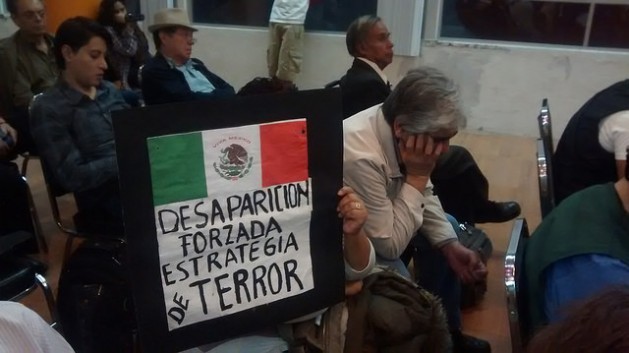
“Forced disappearance, a strategy of terror” reads a sign with the Mexican flag, held by a family member during a Feb. 19 ceremony to celebrate the 15th year anniversary of HIJOS, one of the first organisations created by the families of ‘desaparecidos’ to search for their loved ones and fight for justice. Credit: Emilio Godoy/IPS
MEXICO CITY, Feb 26 2015 (IPS) - Carlos Trujillo refuses to give up, after years of tirelessly searching hospitals, morgues, prisons, cemeteries and clandestine graves in Mexico, looking for his four missing brothers.
The local shopkeeper has left no stone unturned and no clue unfollowed since his brothers Jesús, Raúl, Luís and Gustavo Trujillo vanished – the first two on Aug. 28, 2008 in the southern state of Guerrero and the last two on Sep. 22, 2010 on a highway that joins the southern states of Puebla and Veracruz.
“The case has gone nowhere; four agents were assigned to it, but there’s still nothing concrete, so I’m forging ahead and I won’t stop until I find them,” Trujillo told IPS.
On Feb. 18, Trujillo and other relatives of “desaparecidos” or victims of enforced disappearance founded the group Familiares en Búsqueda María Herrera – named after his mother – as part of the growing efforts by tormented family members to secure institutional support for the investigations they themselves carry out.
“We want to create a network of organisations of victims’ families,” the activist explained. “One of the priorities is to strengthen links and networking, to ensure clarity in the search process, and to share tools. The aim is for the families themselves to carry the investigations forward.”
The group is investigating the disappearance of 18 people. Prior to the creation of the organisation, some of the members found six people alive, in the last two years.
“Each one of us started with our own particular case. We didn’t understand what disappearance was; we had to learn. We didn’t know we had a right to demand things. The search started off with problems, no one knew how to work collectively, and we gradually came up with how to do things.” -- Diana García
With determination and courage, the family members visit morgues, police stations, prisons, courtrooms, cemeteries and mass graves, trying to find their lost loved ones, or at least some clue that could lead them in the right direction.
The group grew out of the Movement for Peace with Justice and Dignity, which in 2011 brought together the families of victims of the wave of violence in Mexico, and held peace caravans throughout the country and even parts of the United States, where the movement protested that country’s anti-drug policy.
Enforced disappearance became a widespread phenomenon since the government of conservative Felipe Calderón (2006-2012) declared the “war on drug trafficking.” His successor, the conservative Enrique Peña Nieto, has not resolved the problem, which has become one of the worst tragedies in Latin America’s recent history.
But the phenomenon has only drawn international attention since the disappearance of 43 students of the Ayotzinapa rural teachers’ college, which exposed a cocktail of complicity and corruption between the police and the mayor of the town of Iguala and a violent drug cartel operating in Guerrero.
Thursday marks the five month anniversary of their disappearance.
The families have not stopped their indefatigable search for the students, even though the attorney general’s office announced a month ago that they were killed by the organised crime group “Guerreros Unidos” and their bodies were burnt.
The humanitarian crisis prompted the United Nations Committee on Enforced Disappearances to demand on Feb. 13 that Mexico pass specific laws to combat the problem, create a registry of victims, carry out proper investigations, and provide justice and reparations to the victims’ families.
Mexico’s office on human rights, crime prevention and community service has reported that in this country of 120 million people, 23,271 people went missing between 2007 and October 2014. However, the office does not specifically indicate how many of these people were victims of enforced disappearance, as opposed to simply missing. Human rights organisations put the figure at 22,600 for that period.
Most enforced disappearances are blamed on drug cartels, which dispute smuggling routes to the lucrative U.S. market, in some cases with the participation of corrupt local or national police. The victims are mainly men from different socioeconomic strata, between the ages of 20 and 36.
“Each one of us started with our own particular case,” Diana García, whose son was disappeared, told IPS. “We didn’t understand what disappearance was; we had to learn. We didn’t know we had a right to demand things. The search started off with problems, no one knew how to work collectively, and we gradually came up with how to do things.”
Her son, Daniel Cantú, disappeared on Feb. 21, 2007 in the city of Ramos Arizpe in the northern state of Coahuila.
García, who has two other children and belongs to the group Fuerzas Unidas por Nuestros Desaparecidos en Coahuila, is convinced that only by working together can people exert enough pressure on the government to get it to search for their missing loved ones.
With the support of the Centro Diocesano para los Derechos Humanos Fray Juan de Larios, a church-based human rights organisation, a group of family members of victims came together and founded Fuerzas Unidas in 2009, which is searching for a total of 344 people.
The organisation successfully advocated the creation of a new local law on the declaration of absence of persons due to disappearance, in effect since May 2014, as well as the classification of enforced disappearance as a specific crime in the state of Coahuila.
Other groups have emerged, such as Ciencia Forense Ciudadana (Citizen Forensic Science), founded in September to create a forensic and DNA database.
“The initiative is aimed at a massive identification drive,” one of the founders of the organisation, Sara López, told IPS. “To do this we need a registry of victims of disappearance, a genetic database, and a databank for what has been found in clandestine graves.”
The project plans to cover 450 families affected by enforced disappearance and to reach 1,500 DNA samples. So far it has gathered 550, and it has representatives – victims’ relatives – in 10 of the country’s 33 states.
On Feb. 16, Ciencia Forense identified the remains of Brenda González, who went missing on Jul. 31, 2011 in Santa Catarina, in the northern state of Nuevo León, with the support of an independent forensic investigation carried out by the Peruvian Forensic Anthropology Team.
“With the organisation that we just created, we will also try to provide a broad assessment of the question of enforced disappearances,” Trujillo said.
Human rights organisations say that until the case of the missing Ayotzinapa rural teachers’ college students erupted, the authorities did very little to combat the phenomenon, and failed to adopt measures to comply withsentences handed down by the Inter-American Court on Human Rights.
The plight of the families is described in the song “Desaparecido” by French-Spanish singer-songwriter Manu Chao, dedicated to the thousands of victims of enforced disappearance in Latin America and their families: “I carry in my body a pain that doesn’t let me breathe, I carry in my body a doom that forces me to keep moving.”
And their lives are put on hold while they visit registries, fill out paperwork, lobby, take innumerable risks, and rack up expenses as they search for their loved ones and other desaparecidos.
“For now, I’m not interested in justice or reparations,” said García. “What I want is to know the truth, what happened, where he is. I’m looking for him alive but I know that in the context we’re living in there may be a different outcome. It’ll probably take me many years and I am desperate, but I continue the struggle.”
Her organisation, Fuerzas Unidas, drew up a plan that includes the analysis of crime maps, a genetic registry, awareness-raising campaigns, and proposed measures to hold those responsible for botched investigations accountable.
“The families are more familiar with the situation than anyone else, they know what has to be done. The problem is that we are overwhelmed by the magnitude of the phenomenon in Mexico,” said López.
Edited by Estrella Gutiérrez/Translated by Stephanie Wildes

_____________________________________________________________________________________________

The Justice of God: Tech_Journal: Kidnapping and Torture

Tech_Journal: Kidnapping and Torture


Saint Romero pray for us


I was a member of AAAS, Engineering Division, long time ago, back in the time when I was working in High Tech. They are basically a benign organization dedicated to Science. At the time I was a member, I ordered from them and still have my copy of 'The Breaking of Bodies and Minds - Torture, Psychiatric Abuse, and the Health Professions - Edited by Eric Stover and Elena O. Nightingale, M.D., Foreword by David A. Hamburg, M.D. - American Association for the Advancement of Science.'

It is a timeless indictment of False Imprisonment and Torture by Medical and any other authority and person and persons for any reason, especially political suppression of peoples.

Where you find political suppression, you will always find religious suppression with it. Archbishop Romero of El Salvador was assassinated for his profession of Jesus Christ and stance against persecution of the faith and oppression of the poor people by neo-fascist United States sponsored (read Heinz [a.k.a. Henry] Kissinger's Operation Condor and related Vatican Ratlines, Granta, ODESSA, Nazi/Neo-Nazi South American CIA insurgencies and murder) paramilitary right-wing groups and the government. Saint Romero did not then align himself with the Marxists, instead, he aligned himself with Jesus Christ and His kingdom as he had always done.

From WikipediaÓscar Arnulfo Romero y Galdámez (15 August 1917 – 24 March 1980)[1] was a bishop of the Roman Catholic Church in El Salvador. He became the fourth Archbishop of San Salvador, succeeding Luis Chávez. He was assassinated on 24 March 1980.

In less than three years, more than fifty priests have been attacked, threatened and slandered. Six of them are martyrs, having been assassinated; various others have been tortured, and others expelled from the country. Religious women have also been the object of persecution. The archdiocesan radio station, Catholic educational institutions and Christian religious institutions have been constantly attacked, menaced, threatened with bombs. Various parish convents have been sacked.[7]
— Oscar Romero


For a prime and always pertinent medical indictment of kidnapping ('desaparecido' - disappearance) and torture go to this source -

Link: AAAS Scientific Responsibility, Human Rights and Law Program

Title:The Breaking of Bodies and Minds: Torture, Psychiatric Abuse, and the Health Professions
Price:$11.95 ($9.50 for AAAS members)
Author(s):Elena O. Nightingale
Eric Stover
Year:1985
Language(s):English
Distributor:AAAS Science and Human Rights Program
1200 New York Avenue, NW
Washington DC, 20005
Tel: 202 326 6600
Fax: 202 289 4950
E-mail: shrp@aaas.org
Cost of shipping and handling will be added to the invoice. Please indicate if you need rush delivery.

Title: The Breaking of Bodies and Minds: Torture, Psychiatric Abuse, and the Health Professions
Price: $11.95 ($9.50 for AAAS members)
Year: 1985
Language(s): English
Distributor: AAAS Science and Human Rights Program
1200 New York Avenue, NW
Washington DC, 20005

Tel: 202 326 6600
Fax: 202 289 4950
E-mail: shrp@aaas.org

Cost of shipping and handling will be added to the invoice. Please indicate if you need rush delivery.


Monday, September 12, 2011

Friday, August 17, 2012

Arab League Report Provides Evidence CIA, MI6, Mossad Behind Violence in Syria


Arab League Report Provides Evidence CIA, MI6, Mossad Behind Violence in Syria Alex Jones' Infowars: There's a war on for your mind!


Arab League Report Provides Evidence CIA, MI6, Mossad Behind Violence in Syria


Kurt Nimmo
Infowars.com
February 7, 2012

Excerpts from the Arab League observers’ report on Syria make it clear that the establishment media is only telling part of the story and exaggerating violence by the al-Assad government and its police and military.
The report mentions an “armed entity’ that is killing civilians and police and conducting terrorist attacks targeting innocent civilians. Casualties from these attacks are attributed to the al-Assad government and used to build a case against Syria in the United Nations.
Rebels in Idlib, Syria. Evidence reveals they are supported by the CIA, MI6, and Mossad.
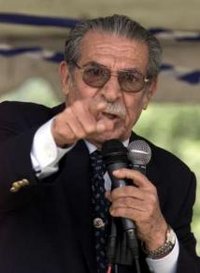
According to the Arab League report, the “Free Syria Army” and “armed opposition groups” are responsible for many of the killings.
In January, it was reported that MI6, the CIA, and British SAS  are in Syria working with the Free Syrian Army and the Syrian National Council  to overthrow the al-Assad regime. The Free Syrian Army is widely recognized as a creation of NATO. It is comprised largely of militants from the Muslim Brotherhood  – itself an asset of British intelligence  – and is funded, supported, and armed by the United States, Israel, and Turkey.
The report lends credence to reports filed in November of last year by journalist Webster Tarpley, who visited the Middle Eastern nation.
“What average Syrians of all ethnic groups say about this is that they are being shot at by snipers. People complained that there are terrorist snipers who are shooting at civilians, blind terrorism simply for the purpose of destabilizing the country. I would not call this civil war – it is a very misleading term. What you are dealing with here are death squads, you are dealing with terror commandos; this is a typical CIA method. In this case it’s a joint production of CIA, MI6, Mossad, it’s got money coming from Saudi Arabia, The United Arab Emirates and Qatar,” Tarpley told RT . [another word for this from South America where the CIA and American trained (School of the Americas) indigenous special forces honed their lawbreaking "skills" is Desaparecido - which see]

Tarpley said the United States is pushing a “bankrupt model of the color revolution, backed up by terrorist troops – people from Al-Qaeda and the Muslim Brotherhood” and the objective is “to smash the Middle East according to ethnic lines.”
Excerpts from the Arab League observers’ report make it clear “that there is widespread violence on both sides, but that the opposition and the Western media have exaggerated the violence and casualties inflicted by government forces,” writes Nicolas Davies  for War Is A Crime blog, formerly After Downing Street.
“The UN has stopped accepting casualty figures claimed by the opposition, and has frozen its “official” estimate of civilian deaths at 5,400, without acknowledging that this may already be highly exaggerated,” Davies explains. “This is not yet a bloodbath on the scale of Libya, where even the new government admits that at least 25,000 people died in the NATO-led war.  Syria could follow the Libya model though, if NATO and the GCC keep providing weapons and military training to the Free Syrian Army and are prepared to beef it up with special forces on the ground, and as long as the UN approves a no-fly zone to provide cover for another 9,700 air strikes.”
The establishment media put the number of dead between 1,000 and 5,000. The International Criminal Court, Hisham Abu Hajer (of the Libyan “rebels,” in other words al-Qaeda), Pravda and other sources put the number at between 50,000 and 100,000 . Tarpley estimated the number at 150,000, a staggering number for a population of just under six and half million people .
Relevant excepts from Report of the Head of the League of Arab States Observer Mission to Syria  from December 24, 2011 to January 18, 2012 follow:
“The Mission determined that there is an armed entity that is not mentioned in the protocol. This development on the ground can undoubtedly be attributed to the excessive use of force by Syrian Government forces in response to protests that occurred before the deployment of the Mission demanding the fall of the regime. In some zones, this armed entity reacted by attacking Syrian security forces and citizens, causing the Government to respond with further violence. In the end, innocent citizens pay the price for those actions with life and limb.
In Homs, Idlib and Hama, the Observer Mission witnessed acts of violence being committed against Government forces and civilians that resulted in several deaths and injuries. Examples of those acts include the bombing of a civilian bus, killing eight persons and injuring others, including women and children, and the bombing of a train carrying diesel oil. In another incident in Homs, a police bus was blown up, killing two police officers. A fuel pipeline and some small bridges were also bombed.
28. The Mission noted that many parties falsely reported that explosions or violence had occurred in several locations. When the observers went to those locations, they found that those reports were unfounded.
29. The Mission also noted that, according to its teams in the field, the media exaggerated the nature of the incidents and the number of persons killed in incidents and protests in certain towns.
According to their latest reports and their briefings to the Head of the Mission on 17 January 2012 in preparation for this report, group team leaders witnessed peaceful demonstrations by both Government supporters and the opposition in several places. None of those demonstrations were disrupted, except for some minor clashes with the Mission and between loyalists and opposition. These have not resulted in fatalities since the last presentation before the Arab Ministerial Committee on the Situation in Syria at its meeting of 8 January 2012.
Some observers reneged on their duties and broke the oath they had taken. They made contact with officials from their countries and gave them exaggerated accounts of events. Those officials consequently developed a bleak and unfounded picture of the situation.
Arab and foreign audiences of certain media organizations have questioned the Mission’s credibility because those organizations use the media to distort the facts. It will be difficult to overcome this problem unless there is political and media support for the Mission and its mandate. It is only natural that some negative incidents should occur as it conducts its activities because such incidents occur as a matter of course in similar missions.
75. Recently, there have been incidents that could widen the gap and increase bitterness between the parties. These incidents can have grave consequences and lead to the loss of life and property. Such incidents include the bombing of buildings, trains carrying fuel, vehicles carrying diesel oil and explosions targeting the police, members of the media and fuel pipelines. Some of those attacks have been carried out by the Free Syrian Army and some by other armed opposition groups.
Since its establishment, attitudes towards the Mission have been characterized by insincerity or, more broadly speaking, a lack of seriousness. Before it began carrying out its mandate and even before its members had arrived, the Mission was the target of a vicious campaign directed against the League of Arab States and the Head of the Mission, a campaign that increased in intensity after the observers’ deployment. The Mission still lack the political and media support it needs in order to fulfil its mandate. Should its mandate be extended, the goals set out in the Protocol will not be achieved unless such support is provided and the Mission receives the backing it needs to ensure the success of the Arab solution.”

Thursday, August 9, 2012

Spy = Judas

Labels:  

The Son of Perdition

We must obey God and never the minions of the Anitichrist, no matter what pretended authority they claim to have. Traditional Catholic Prayers: We must obey God

The Law of God is for all men and is written upon our hearts and is in our consciences and is our guide to doing good. Traditional Catholic Prayers: The Law of God

The model of all spies and saboteurs and betrayers is Judas Iscariot, the Son of Perdition. Judas Iscariot is the "familiar devil" of all spy organizations and spies including neighborhood spies. MI6 pioneered the use of secret societies and false religion (Freemasonry) to disrupt and destroy peoples and nations they wanted to take over. The NKVD (Cheka, GPU, KGB, FSB) and OSS-CIA and Mossad are modeled on that. None of them are loyal to anyone or anything but are Satanic subversives working for the aims and goals of the Antichrist (Dajjal). There is NOTHING lawful NOR justified in any of them at all - not ever. They are responsible on the way to the short lived world wide Devil worshiping empire of the Antichrist for all the genocides in South America and Central America and Mexico and Europe and Russia and China and Africa and the Middle East, especially Occupied Palestine. Especially they use death squads and the 'Desaparecido' and murder and torture to advance their Satanic agenda. Anyone who sides with them or helps them or submits to them is damned for eternity with them.


Gospel According to Saint Matthew

Chapter 26
[14] Then went one of the twelve, who was called Judas Iscariot, to the chief priests, [15] And said to them: What will you give me, and I will deliver him [Jesus Christ] unto you? But they appointed him thirty pieces of silver. [16] And from thenceforth he sought opportunity to betray him.

John 6:
[71] Jesus answered them: Have not I chosen you twelve; and one of you is a devil? [72] Now he meant Judas Iscariot, the son of Simon: for this same was about to betray him, whereas he was one of the twelve.

John 13:2
And when supper was done, (the devil having now put into the heart of Judas Iscariot, the son of Simon, to betray him,)

The end of all spies and saboteurs and betrayers and Gulag state tryannical oppressors is eternal damnation.
These both apply to all of them.

John 8:44
You are of your father the devil, and the desires of your father you will do. He was a murderer from the beginning, and he stood not in the truth; because truth is not in him. When he speaketh a lie, he speaketh of his own: for he is a liar, and the father thereof.

Matthew 25:41
Then he shall say to them also that shall be on his left hand: Depart from me, you cursed, into everlasting fire which was prepared for the devil and his angels.

Wednesday, August 8, 2012

Guatemala, Ríos Montt and the SOA | SOA Watch: Close the School of the Americas

Guatemala, Ríos Montt and the SOA | SOA Watch: Close the School of the Americas

Ed. note - in the below "disappeared" is known in Latin America as "Desaparecido" - which see.


Guatemala, Ríos Montt And The SOA


TUESDAY, 13 MARCH 2012 19:24
By: Nick Alexandrov

Rios MonttThree decades after José Efraín Ríos Montt finished his coursework at the U.S. Army School of the Americas (SOA)—where tens of thousands of Latin American soldiers have been trained in the art of violent repression; it was renamed the Western Hemisphere Institute for Security Cooperation (WHINSEC) in 2001—he seized power in Guatemala, and then ripped its social fabric to shreds.  “During the 14 months of Ríos Montt’s rule, an estimated 70,000 unarmed civilians were killed or ‘disappeared;’ hundreds of thousands were internally displaced,” according to Amnesty International.  In the summer of 1982, he launched “Operation Sofia,” which destroyed 600 Mayan villages.


Had Ríos Montt lived centuries ago, he might be remembered as a hero today.  We can compare him, for example, to the Admiral who, as scholar David Stannard recounts, on one campaign “set forth across the countryside, tearing into assembled masses of sick and unarmed native people, slaughtering them by the thousands.”  That was Columbus on Hispaniola, back in March 1495.  Or perhaps Ríos Montt is a worthy successor to the man the Iroquois dubbed “Town Destroyer” in the 1770s.  Historian Robert A. Ferguson relates the words of Seneca Chief Cornplanter: “When that name is heard, our women look behind them and turn pale, and our children cling close to the necks of their mothers.”  The Indians were referring to George Washington.
But killers of this caliber today face challenges their predecessors never confronted.  For the past several decades, groups of activists in the U.S. and especially Latin America have brought attention to Washington-backed terror campaigns in countries like Guatemala, winning a major victory this past January 26, when “Judge Carol Patricia Flores Blanco ruled…that there was sufficient evidence linking Ríos Montt” to human rights violations for him to “face trial on genocide and crimes against humanity,” Rory Carroll reported in the Guardian.
Horrific as Ríos Montt’s crimes are, we should bear in mind that his policies were fundamentally in line with those of the Guatemalan officials running the country both before and after his term in office, as well as in close conformity with Washington’s longstanding goals for the region.  During World War II, U.S. State Department planners wrote frankly of the “problem,” as they saw it, with “the other American republics,” which were “manifesting an increasingly strong spirit of independence and jealous insistence on complete sovereignty.”  This nuisance presented difficulties in light of, say, Washington’s efforts to ensure it would be granted “long-term rights for the use…of certain naval and air bases in the other American republics,” and its wish “to maintain the economies” of Latin American nations in accordance with its principles—“quite apart from equity, it is to the selfish interest of the United States” to do so, planners emphasized.
Just as these policies were taking shape, Guatemala entered what was, from the U.S. government’s perspective, a decade-long crisis.  In 1944, a popular revolt brought down Jorge Ubico, the dictator Washington supported.  His successor, Juan José Arévalo, won overwhelmingly in the election held that December; while in office, he started democratizing the country.  Jacobo Arbenz followed as president in 1951, and a year later passed the Agrarian Reform Law, with which the government gained the power to expropriate idle land—most of the United Fruit Company’s, for example.  This law fit in with Arbenz’s broader strategy, which was to limit the power of the major companies for which Ubico had created an ideal business climate, generally the sort of environment in which corporations are treated like people in need of nurture, and “human lives are so much trash,” to borrow the poet Charles Olson’s formulation.  Under Ubico, Susanne Jonas explains in The Battle for Guatemala, the government was “active…in protecting and subsidizing (but never regulating or restricting) private enterprise;” it also repressed most of the population, keeping workers poor, terrified, and atomized—and profits high.
But ultimately it was Guatemala’s “increasingly strong spirit of independence” under Arbenz, more so than any specific policies limiting United Fruit’s freedom to operate, that led to his downfall in the 1954 CIA coup.  With Arbenz out of the picture, the Guatemalan government, acting on U.S. Embassy instructions, began hunting down thousands of perceived subversives, torturing many of them in an effort to terrorize the population back into submission, and to destroy the popular organizations that had begun to form during the brief democratic period.  Thus brutalized, the public could do little to protest, for example, the 1955 Petroleum Code, written in English and “a giveaway measure” for foreign companies, Jonas explains.  And there were other measures restoring business privileges Arbenz had undermined.  Since none of these arrangements would have met with widespread support, the counterrevolution’s task was to ensure immediately that Guatemalans could not influence issues affecting their lives, and then to create a society in which Guatemalans could not even conceive of having such influence—“the United States felt it necessary to root out all traces of progressive politics,” Jonas concludes.
To this end, Washington restructured Guatemala’s security forces in the 1960s, doubling the army’s size, and creating the Mobile Military Police, which expanded the state’s reach into rural regions.  These changes coincided with U.S. training for counterinsurgency units, both at the SOA and in-country, as when Colonel John D. Webber traveled to Guatemala in 1966 to monitor the new squadrons’ instruction.  Despite official rhetoric to the contrary, government repression was “totally disproportionate to the military force of the insurgency,” according to the authors of the 1999 UN-backed Historical Clarification Commission—it was state terror, in plain terms, due to which perhaps 8,000 people paid the ultimate cost between 1966 and 1968.  But things weren’t all bad.  In 1962, a Chase Manhattan Bank report noted “the more favorable business climate” of the post-Arbenz era, in which foreign investments “will begin to pick up,” its authors had little doubt.
Efforts to crush progressive politics intensified in the following years, and were pursued with utter ferocity in the early 1980s.  The 1981-1983 period was the one in which “agents of the State of Guatemala, within the framework of counterinsurgency operations”—developed with Washington’s help, it cannot be overemphasized—“committed acts of genocide against groups of Mayan people,” according to the 1999 truth commission.  These were the years when Ríos Montt was largely running the show, with the help of his cabinet, two-thirds of whom—like the dictator himself—were SOA alumni.  Documents from “Operation Sofia” (the code name for the genocidal assault on Mayan communities) on the National Security Archive website demonstrate that this policy’s planning and direction were carried out at the highest levels of the Guatemalan government.
In Guatemala: Nunca Mas!, the report issued by the the Guatemalan Archdiocese’s Human Rights Office, we get a sense of what this “more favorable business climate” was like.  One testimony recalls “burned corpses, women impaled and buried as if they were animals ready for the spit, all doubled up, and children massacred and carved up with machetes.”  Another described how soldiers tied up a family inside a house, and then torched it; a two-year-old was among those burned to death.  Yet another tells how a pregnant woman “in her eighth month” came face-to-face with counterinsurgency forces: “they cut her belly, and they took out the little one, and they tossed it around like a ball.”  And in 1980, after shooting a woman lame, a group of “soldiers left their packs and dragged her like a dog to the riverbank.  They raped and killed her.”
These are just four examples of thousands, and part of the broader policy of brutalization for which, in particular, Defense Minister Héctor Gramajo Morales bore major responsibility.  In recognition for his efforts, he was honored at the SOA’s December 1991 commencement exercises in Fort Benning, GA; he also received a Mason fellowship to study at Harvard’s John F. Kennedy School of Government, a safe haven for other contributors to the cause of Guatemalan genocide denial.  Samantha Power, who taught there before Obama tapped her for his National Security Council, did not even bother to mention Guatemala in her Pulitzer-Prize winning “A Problem from Hell”: American and the Age of Genocide, perhaps one reason for her image, at least in the New York Times’ world, as a “fiercely moral” figure.
Again and again in the history sketched out above, we see that Washington’s goal was to destroy, and then prevent from re-emerging, Guatemalan democracy.  In this aim it largely succeeded.  We also see that officials in the U.S. and Guatemala assumed that neither Guatemalan officers nor their U.S. trainers were to be punished for participating in mass slaughter; impunity reigned, and attempts to face the past honestly provoked panicked responses.  In 1998, for instance, Bishop Juan José Gerardi, one of the key figures behind Guatemala: Nunca Más!, was murdered two days after presenting the report in the Guatemala City Cathedral.  His killers pummeled his face with a concrete slab, mutilating it beyond recognition.  Colonel Byron Disrael Lima Estrada was one of three men responsible for the attack; his CV, according to the National Security Archive, “reads like a guide to a career in repression,” not least because of his training at the SOA.  Other activists carried on the bishop’s work, and it was only because of their efforts that basic moral principles have recently been applied to Guatemala’s criminal ex-rulers.   Now, as a result of decades of human rights efforts, Ríos Montt and others may be forced to take responsibility for their actions.
But while activists have made progress on these fronts, in many regards the majority of Guatemalans still suffer from the legacy of the 1954 coup, and subsequent governmental assault.  In an article for the Guardian last spring, Felicity Lawrence pointed out that while Guatemala produces plenty of food, most of it is sent out of the country in accord with an IMF agro-export plan imposed in the 1980s, leaving half of all children under 5 malnourished—the same percentage of the population that lives in extreme poverty.  Oxfam director Aida Pesquera summed up the key issues: “The food’s here but the main problem is distribution.  Land is concentrated in very few hands.  The big companies pay very little tax.  Labor conditions on plantations are appalling.”  In short, it is as if Arbenz never existed.
Meanwhile, mining companies thrive as Guatemalans starve.  Operating within the Central American Free Trade Agreement’s framework of expansive investor and corporate rights, these businesses have hired private security teams to help maintain the climate Chase Manhattan Bank lauded half a century ago.  In the current iteration, this means that Idar Hernández Godoy, secretary of the banana workers’ union SITRABI, was shot to death last year for his organizing efforts.  Lawrence reported that plantation laborers, or at least those not too terrified to talk about their work conditions, “said that joining a union was a sackable offense that would lead to blacklisting,” and that work with poisonous agrochemicals—without protective clothing—was becoming increasingly common.
This was the situation in Guatemala when Otto Pérez Molina, SOA graduate, was elected president late last year.  As an army major in the 1980s, he was stationed in the Ixil region when 70-90% of its villages were destroyed.  His personal history, and the history of SOA graduates in Guatemala generally, indicates the country’s future may remain dark—unless something is done about it.  Next month, School of the Americas Watch (SOAW) will hold its Days of Action in Washington, D.C., from April 14-17.  The organization has been working for over twenty years not only to close the School, but more broadly to draw attention to, and then undermine, U.S. militarism in Latin America.  Planned events include a conference from April 14-15 on continuing repression in countries like Guatemala, Honduras and Colombia, and activist strategies for change; two days devoted to direct action and lobbying will follow.  More information can be found at soaw.org.  It is only through a massive, collective effort that we can ensure, first, that Ríos Montt and others will not escape unblemished into history the way men like George Washington have; and second, that the institutions that enhance and benefit from heartless repression become a distant memory.


Copyright © 1998 - 2012 SOA Watch: Close the School of the Americas.

Tuesday, August 7, 2012

US foreign policy in Guatemala

US foreign policy in Guatemala


A "killing field" in the Americas:
US policy in Guatemala

The reality of Guatemala

Guatemala, with 10 million people, is the most populous country in Central America. It is run by an oligarchy of wealthy landowners and big business interests that reap the country's agricultural and commercial rewards at the expense of the rest of the population. The country has been headed by military dictators and figurehead-presidents. Ultimate control belongs to the Army.

Guatemala is a country without social or economic justice, especially for the 6 million indigenous Mayan Indians who make up the majority of the population. There is a marked disparity in income distribution, and poverty is pervasive. On coffee plantations, peasants, descendants of the ancient Maya, live in concentration camp-like conditions, as de facto slaves. 40% of the indigenous people have no access to health care, and 60% have no access to safe drinking water. Education in rural areas is non-existent, with the result that 50% of the people are illiterate. Half of the country's children suffer from malnutrition. Every day in Guatemala, a country in which everything grows, people go hungry.

The real power in Guatemala is in the hands of the Army, and that power has been used to violently control the people, resulting in the worst human rights record in the hemisphere. During more than 30 years of civil war, over 150,000 Guatemalans have been killed or disappeared [Ed. note - see Desaparecido], tens-of-thousands have been forced to flee to Mexico, 1 million have been displaced inside the country, and more than 440 Indian villages have been destroyed. 75,000 widows and 250,000 orphans have been produced out of the carnage. And, for more than four decades, the United States government has consistently supported the Guatemalan Army and the ruling class in their policies of repression.


The early history

The harsh realities of present day Guatemala sprouted from the bitter seeds that were planted in its early history. Spanish conquistador Pedro de Alvarada (1485-1541) began the conquest and subjugation of the Mayan city-states in the 1500s. Land ownership, mineral production, and agriculture were organized to benefit the Spanish. Although independence came in 1821, foreign control of huge banana and coffee plantations continued the patterns that developed in the colonial period, and Indian lands continued to be confiscated.

In the 1920s, after a century of involvement in agriculture in Guatemala and the export of its food crops, the US established military missions in all Latin American countries. Guatemala's military was tied to the US military through training, aid, and a commitment to protect US economic interests, and the Army became a major force.

United Fruit Company

Under dictator Jorqe Ubico (1931-1944), American-owned United Fruit Company (UFC) gained control of forty-two percent of Guatemala's land, and was exempted from taxes and import duties. The three main enterprises in Guatemala -- United Fruit Company, International Railways of Central America, and Empress Electrica -- were American-owned (and controlled by United Fruit Company). Seventy-seven percent of all exports went to the US and sixty-five percent of imports came from the US.

"10 Years of Springtime"

Repressive governments have plagued Guatemala throughout its history, with alternating waves of dictators being the rule. But, between 1945 and 1954, there was a period of enlightenment -- an experiment with democracy called the "10 Years of Springtime" -- that started with the election of Juan Jose Arevalo to the presidency.

While in power from 1945 to 1951, Arevalo established the nation's social security and health systems and a government bureau to look after Mayan concerns. Arévalo's liberal regime experienced many coup attempts by conservative military forces, but the attempts were not successful.

Arévalo was followed by Colonel Jacobo Arbenz Guzmán who became president in democratic elections in 1951. At the time, 2% of landowners owned 70% of the arable land and farm laborers were kept in debt slavery by these landowners. Arbenz continued to implement the liberal policies of Arevalo, and instituted an agrarian reform law to break up the large estates and foster individually owned small farms. The land reform program involved redistribution of 160,000 acres of uncultivated land owned by United Fruit Company. United Fruit was compensated for its land.

United Fruit, Eisenhower and the end of reform

United Fruit was a state within the Guatemalan state. It not only owned all of Guatemala's banana production and monopolized banana exports, it also owned the country's telephone and telegraph system, and almost all of the railroad track. In addition to redistributing United Fruit land, the government also began competing with United Fruit in the production and export of bananas.

Important people in the ruling circles of the US, involved with United Fruit Company, used their influence to convince the US government to step in. (Secretary of State John Foster Dulles' law firm had prepared United Fruit's contracts with Guatemala; his brother, CIA Director Allen Dulles, belonged to United Fruit's law firm; John Moors Cabot, Assistant Secretary of State for Inter-American Affairs, was the brother of a former United Fruit president; President Eisenhower's personal secretary was married to the head of United Fruit's Public Relations Department.)

In 1954, Eisenhower and Dulles decided that Arbenz finally had to go, and the US State Department labeled Guatemala "communist". On this pretext, US aid and equipment were provided to the Guatemalan Army. The US also sent a CIA army and CIA planes. They bombed a military base and a government radio station, and overthrew Arbenz Guzmán, who fled to Cuba.

The coup restored the stranglehold on the Guatemalan economy of both the landed elite and US economic interests. President Eisenhower was willing to make the poor, illiterate Guatemalan peasants pay in hunger and torture for supporting land reform, and for trying to attain a better future for themselves and their families. In order to ensure ever-increasing profits for an American corporation, the US State Department, the CIA, and United Fruit Company had succeeded in taking freedom and land from Guatemala's peasants, unions from its workers, and hope for a democratic Guatemala from all of its people.

Aided by the US, Colonel Castillo Armas became the new president. The US Ambassador furnished Armas with lists of radical opponents to be eliminated, and the bloodletting promptly began. Under Armas, thousands were arrested and many were tortured and killed. United Fruit got all its land back. As an extra present, the Banana Worker's Union was banned. Armas disenfranchised one-third of the voters by barring illiterates from voting. He outlawed all political parties, labor confederations, and peasant organizations. He closed down opposition newspapers and burned "subversive" books. The "Springtime" had ended.

Dictators and repression

The coup in Guatemala inaugurated an era of military rule in Central America. Generals and Colonels acted with impunity to wipe out dissent and garner wealth for themselves and their friends.
And, the killing of defenseless people became state policy in Guatemala. Between 1954 and 1981, more than 60,000 people were murdered. Guatemala continues to suffer the worst record of human rights abuses in Latin America.

The Armas regime was followed by a succession of repressive military dictatorships. As both protest and repression became more violent, civil war emerged, especially in the highlands. Industrialization in the 1960s and '70s helped the rich get richer, while the cities became increasingly squalid as the rural dispossessed fled the countryside to find urban employment. The military continued its violent suppression of anti-government elements, especially in the countryside, among the indigenous Mayan population, resistance grew, and a guerrilla army began to form.

The Green Berets, the CIA, and death squads

During the 1960s and 70s, American military aid and training made Guatemala's army the strongest and most sophisticated in Central America. Between 1966 - 68, during the Johnson presidency, the Green Berets were sent to Guatemala to transform its Army into a modern counter-insurgency force and to conduct a Vietnam -style war there. This is the origin of the killing machine that operates in Guatemala today.

Death squads, never before seen in Latin America, were started during this period. Army leaders, government officials, and the businessmen who supported and often bankrolled the death squads, had close ties with many US administrations. The squads had lists of people that were suspected communists, or who opposed the existing system of elite-corporate-Army control. Those on the lists were hunted down and killed.

The US mission and its advisors prodded the military to take measures to establish a US base for counterinsurgency (counter-revolutionary) actions, in order to maintain cheap labor for the landowners and US corporations, and to preserve the System. Terror was the weapon, and the American CIA was the agent. Targeting guerrillas, peasants, students, labor leaders, and professionals, the Guatemalan military jailed thousands. And thousands more, struggling to overcome poverty and injustice, were murdered or disappeared by the police, the army, and the death squads, all armed and trained by the CIA.

Journalists, lawyers, teachers, members of opposition parties, and anyone who expressed sympathy for the anti-government cause were machine-gunned. Anyone attempting to organize a union or improve the lot of the peasants was subject to torture, mutilation, and death. Men were found decapitated or castrated. Some had their eyes gouged-out, their testicles cut off and put in their mouths, their hands or tongues cut off; women had their breasts cut off. Electric shock to the genitals was routinely used, with equipment and instructions supplied by the CIA. American planes and pilots, flying out of Panama, dropped napalm on suspected targets.

By the end of 1968, the guerrillas had been wiped out. For the Pentagon it had been a limited war; for the Guatemalans the war had been total.

The CIA, the Guatemalan G-2, and Israel

But, the war did not end with victory over the guerrillas. Since the 1960s, the CIA has had links with a Guatemalan Army unit -- the G-2 -- that maintains a network of torture centers and body dumps throughout Guatemala and has killed thousands of Guatemalan civilians. Operating out of the US Embassy, CIA undercover agents, secretly working with the G-2 -- a group of 2,000 elite Guatemalan Army Intelligence officers -- have trained, advised, armed, and equipped these officers to torture, assassinate and disappear thousands of Guatemalan dissidents. Some G-2 bases have their own crematoriums where the tortured and murdered are disposed of.

In the 1970s, international publicity revealed the pattern of torture and killing, and public reports exposed the Guatemalan Army as the most repressive in Latin America. This series of events resulted in a change in human rights sentiment in the US. In 1977, US President Jimmy Carter cut off overt military aid. However, money and arms still got to there -- through the CIA. When President Lucas Garcia began his fearsome regime in 1978, and set out to eliminate all the new popular leaders by either murdering or coopting them, and when death squads roamed the land and murdered at will, the CIA was there to help.

In addition to US and CIA support, Argentina, and Chile provided expertise and aid to Guatemala's military. And, Israel has played a very important role in Guatemala since 1977, supplying weapons, building munitions factories, and training soldiers.

Reagan and Rios Montt

The 1980s was marked by barbaric repression and the massacre of the indigenous population. A succession of elected dictators, supported by the US, left suffering in their wake. Because of the notoriety that again developed from reports of human rights violations by the Guatemalan Army, President Reagan changed the US policy of overt aid to the Guatemalan Army to a two- track policy. While government spokespersons made public pronouncements in support of human rights and the return to civilian rule, the Reagan Administration signaled to the Guatemalan Army its approval for winning the war, and it lobbied Congress for more aid. The CIA continued to work with Guatemala's security forces.

General Efrain Rios Montt, a graduate of the School of the Americas (SOA), at Fort Benning, Georgia, came to power in a 1982 coup. Praised as a "born-again" Christian reformer, in truth he was one of the most savage of Guatemalan dictators. His "Beans and Rifles" program was designed to keep guerrillas out of Indian villages -- beans for those who cooperated, rifles for those who didn't. He declared a "state of siege", and on television, he stated that he had "declared a state of siege so that we could kill legally". He banned public meetings, suspended the constitution, replaced elected officials, and censored the press. He also instituted Civil Defense Patrols (PACs) to control the population.

Rios Montt moved the war from urban centers to the countryside where "the spirit of the lord" guided him against "communist subversives', mostly indigenous Indians. As Guatemalans suffered torture, kidnappings, and massacres at the hands of the government, he presented himself as the savior of the population. Using the lessons he had learned at the SOA, he implemented a "pacification" program similar to that used by the US in Vietnam, intended to give the impression that the government wanted to reestablish democracy in the country. In reality, as the "pacification" program moved from village to village, it essentially established concentration camps populated by those who had been able to survive the massacres and political genocide which the government itself carried out.

During the 17 months of Rios Montt's "Christian" campaign, 400 villages were destroyed, 10 - 20,000 Indians were killed, and over 100,000 fled to Mexico. Early in 1983, President Reagan resumed military shipments to Guatemala, claiming that Montt's program against the guerrilla insurgency was working. He said that Montt was given a "bum rap" on human rights.

Montt was overthrown in August, 1983. In December, 1985 Vinicio Cerezo Arevalo, a civilian who campaigned as a populist reformer, was elected president. But, the Army continued to have the power. Cerezo disbanded the secret police (DIT), but assassinations of students, peasants, and human rights activists continued through the Army's G-2, with CIA assistance.

The Reagan administration and the death squads

Before his administration took office in 1980, President Reagan courted the Guatemalan right, whose views he shared. He promised then-president of Guatemala General Romeo Lucas Garcia and leaders of the right, a 180 degree turn in US policy toward their country. The agreement provided for the restoration of US weapons sales, the curtailment of State Department criticism of human rights violations, and the promise that the US would intervene militarily in the event of a popular uprising. The assurances by Reagan may have led the Guatemalan government officials who ran the death squads to feel confident that the US would support their activities. The death squads were staffed and directed by the Guatemalan Army and Police under the command of President Lucas. Private businessmen paid the salaries and often assisted in compiling lists of potential victims -- usually student, labor, professional, and political leaders.

The significant increase in the number of death squad assassinations -- including the assassination of 34 of the top leadership of the moderate Christian Democratic Party -- that took place after Reagan took office, may have been a direct result of his assurances to the Guatemalan right. In February 1981, Amnesty International, reporting on massive human rights violations in Guatemala, attributed nearly 6,000 deaths to the Lucas Gracia government in less than three years, many of them at the hands of death squads. The attendance of Mario Sandoval Alarcon, considered to be the high commander of the Guatemalan death squads, at the Reagan inauguration, reveals the close relationship that existed between the Guatemalan rulers and the Reagan administration.

The war on drugs, the US National Guard, and the indigenous people

Near the end of the Reagan administration, another technique for repression was used -- the war on drugs. While the program had no significant impact on drug production and trafficking, it had serious consequences for indigenous Guatemalans. The spraying of lethal herbicides by anti-drug helicopters and planes caused widespread damage, poisoning large numbers of people, animals, fish, and plants. To escape government violence, some of the tens-of-thousands of indigenous internal refugees in Guatemala at that time, banded together in remote areas. In the name of its anti-drug policy, the government bombed these areas, captured much of the population, and tortured and killed many of them.

In 1989, the Bush administration, under the guise of humanitarian aid, sent National Guard units to Guatemala to provide medical services. They served in areas where the guerrilla movement was the strongest. According to villagers, a visit from the National Guard units sometimes bore more of a resemblance to police interrogations than to medical examinations. As villagers were getting "humanitarian" help, they were questioned about the type of organizations they had, who their leaders were, and what type of people visited their community.

The DeVine case

In 1990, MIchael DeVine, an American businessman living in Guatemala, apparently stumbled upon the Guatemalan Army's drug-trafficking activities. He was kidnapped and murdered. In response, President George Bush cut off military aid to Guatemala and publicly criticized the Army. But, Reagan's two-track policy was still in effect, so Bush continued to send CIA funds to the military to allow them to continue their war, and strengthened the ties between the CIA and the Guatemalan Army.

Under recent presidents, Guatemala's Civil Defense Patrols (PACs) continued a campaign of domination and terror against civilians, especially the indigenous population. Forced military conscription, kidnappings, death threats, and assassinations continued with impunity.

The United Nations human rights mission (MINUGUA)

In 1994, a United Nations human rights verification mission was established to monitor human rights in Guatemala. It is called MINUGUA. MINUGUA highlighted numerous cases of torture, extrajudicial killings, and disappearances by security forces. It showed that human rights violations occur daily. The victims are mostly students, teachers, trade unionists, human rights workers, and peasant activists. MINUGUA reports documented that death squads are run by the Army and National Police, who also traffic in narcotics, and are involved in car theft and kidnappings.

MINUGUA also revealed that the government failed to investigate or punish those responsible. In addition, relatives of human rights violators and witnesses to abuses were targeted for violence and intimidation. Prosecutors and judges who attempted to bring violators to justice, suffered reprisals as well. There were also threats and attacks on MINUGUA mission observers.

Jennifer Harbury vs. the US government

In 1995, US policy toward Guatemala was driven by the unprecedented public attention to the plight of US citizen Jennifer Harbury, the wife of disappeared guerrilla leader Efrain Bamaca. In 1992, Bamaca was captured and murdered. His wife, American attorney Jennifer Harbury, waged an impassioned campaign to find her husband and bring his killers to justice. Her hunger strikes first in Guatemala City and then in front of the White House, touched a chord among Americans. Representative Robert Toricelli of the House Intelligence Committee revealed that both Michael DeVine and Efrain Bamaca had been executed on the orders of Colonel Julio Roberto Alpirez, who had been on the CIA payroll for years, and had been trained at the School of the Americas.

Harbury's struggle against the lies, intimidation, and cover-up mounted by the Guatemalan authorities brought to US public attention a reality all too familiar to Guatemalans. In addition, her pressure for answers from the US government prompted the unraveling of a series of revelations about the CIA's secret assistance to abusive military institutions and officers in Guatemala. The scandal revealed a secret policy that for many years had made all but irrelevant Washington's public postures on human rights in Guatemala. In the cascade of revelations, it became clear the CIA had secretly provided millions of dollars in assistance to Guatemala's G-2 unit, even after the US government cut-off of overt military aid and sales in 1990.

In March 1995, the Clinton Administration, as a result of Jennifer Harbury's hunger strike in front of the White House, suspended military training for Guatemalan Army officers. Shortly thereafter, Clinton ordered most of the CIA's assistance to the Guatemalan military suspended, except for anti-narcotics funding. The Intelligence Oversight Board (it had never before been convened) was convened at the end of 1995, but its report was a whitewash, concluding that "No evidence has been found that any employee of the CIA in any way directed, participated in or condoned the murder of Michael DeVine." Perhaps, Alpirez was not considered an "employee" even though he was on the CIA payroll. It seems certain that there will be a similar finding in the Bamaca execution as well.

Several millions of dollars in military aid cut off in 1990 by the Bush administration, was channeled by Clinton into a peace fund to support the work of the MINUGUA human rights verification mission.

The "New World Order" and Guatemala

The war against Guatemalans still involves guns, bombs and human rights abuses, but the war of the 1990s is also an economic war against the poor. It is an international system of social, economic, and political control which works to separate the largest portion of the population of the world -- those who are poor, people of color, and women, especially within the developing world -- from the smallest portion of the population who are wealthy.

During the 1980s debilitating debt, global inflation, and a national economy sympathetic to foreign business exacerbated the problems of Guatemala's poor. The poor became even poorer and those in the small middle class were pushed closer to the edges of poverty. Debt repayment problems led Guatemala to accept IMF and World Bank structural adjustment policies (SAPs) that cut social services and capped wages, and have resulted in increased unemployment, lower wages, less access to health and education, and an alarming growth of hunger and malnutrition.

Economic and social indicators are much worse for women than men in Guatemala. Because of the war, thirty-eight percent of urban women and fifty-six percent of rural women are widows. Of course, women have the double burden of being primary caretakers for their families and providing for their economic needs. Women are so desperate for jobs to feed their families that they work in the informal sector as domestic help, artisans, or farm workers. Women are often more willing to take the jobs as factory workers in the growing maquila industry (foreign-owned sweatshops).

In Guatemala, in the 90s, the Cold War has been replaced by the "war against drugs" and NAFTA. The war on drugs has given the enemies of democracy in Guatemala an excuse to bomb the indigenous population in the countryside. The real narcotraffickers are not in the countryside; they are in the cities where the seats of power are. And NAFTA, is attempting to ensure that the landed elite and the agri-corporations will control the country for some time to come.

But, there are signs of hope. First, for the first time since the ClA-sponsored coup in 1954, progressive candidates formed a political party and ran candidates for the November 1995 election.

Second, although atrocities still occur, the government's response offers some hope. Public outrage over the killing of returning refugees from Mexico in 1995, and the presence of MINUGUA, resulted in a public announcement of responsibility by the President of Guatemala and the forced resignation of the Minister of Defense.

Third, the revelation by Jennifer Harbury last spring of the ClA's complicity in the deaths of her husband and the US citizen Michael DeVine has led to a campaign to declassify documents held by US security and intelligence agencies. Also, international media attention has created more political space for Guatemalans to pressure their government for reopening investigations into human rights abuses in hundreds of cases that have been dismissed or ignored.

Guatemala today stands on the brink of a long-awaited peace agreement -- the government and representatives of all sectors of society have been negotiating conditions for peace. The peace process represents much more than a cease fire. After more than thirty-five years of armed conflict and staggering injustice, Guatemalans want a transformed society -- democratic leadership, rights for indigenous people and displaced communities, demilitarization, constitutional reforms, an end to impunity, a Truth Commission to examine human rights abuses, political participation, and attention to socio-economic issues such as land reform. Americans can help this process by demanding that the US government stop the death squads, support political and economic reform, and end the decades-old war against the Guatemalan people.


Central America watch

Home Page