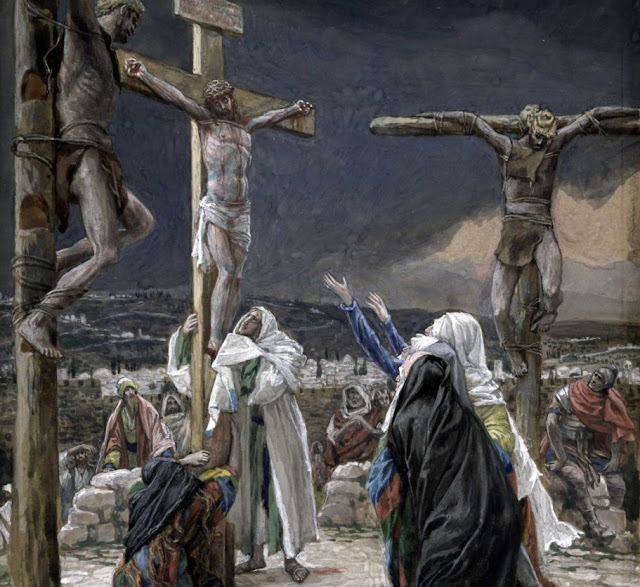
![]() The Resurrection in the flesh of Our Lord and Saviour Jesus Christ - the absolute meaning of Easter - properly called the Resurrection of The Lord Jesus Christ.
From above quote: "The physical body lies in state of no return whilst the soul rest awaiting for the final call, salvation and eternal life." ...physical body lies in state of no return I hope you don't mean that as it is written. As it is written it is total apostate heresy that denies the final resurrection in the flesh of all men which is guaranteed by The Lord Jesus Christ at His return from heaven in the same flesh in which He arose from the dead and ascended into heaven. To provide absolute understanding of the truth of His own Resurrection which at that time was in the future and now has already happened two thousand years ago and to provide absolute understanding of the truth of our resurrection in our same bodies we have now when Our Lord Jesus Christ returns from heaven with all of His elect angels, Our Lord Jesus Christ raised Lazarus from the dead. JOHN 11 CHAPTER XI. Christ raises Lazarus to life. The rulers resolve to put him to death. 1 Now there was a certain man sick, named Lazarus, of Bethania, of the town of Mary, and of Martha, her sister. 2 (And Mary was she *that anointed the Lord with ointment, and wiped his feet with her hair: whose brother, Lazarus, was sick.) 3 His sisters, therefore, sent to him, saying; Lord, behold, he whom thou lovest, is sick. 4 And Jesus hearing it, said to them; This sickness is not unto death, but for the glory of God: that the Son of God may be glorified by it. 5 Now Jesus loved Martha, and her sister Mary, and Lazarus. 6 When he had heard, therefore, that he was sick, he still remained in the same place two days. 7 Then after that he said to his disciples; Let us go into Judea again. 8 The disciples say to him; Rabbi, the Jews but just now sought to stone thee: and goest thou thither again? 9 Jesus answered: Are there not twelve hours of the day? If a man walk in the day, he stumbleth not, because he seeth the light of this world: 10 But if he walk in the night, he stumbleth, because the light is not in him. 11 These things he said: and after that he said to them; Lazarus, our friend, sleepeth: but I go that I may awake him out of sleep. 12 His disciples, therefore, said; Lord, if he sleep, he shall do well. 13 But Jesus spoke of his death: and they thought that he spoke of the repose of sleep. 14 Then, therefore, Jesus said to them plainly; Lazarus is dead. 15 And I am glad, for your sake, that I was not there, that you may believe: but let us go to him. 16 Then Thomas, who is called Didymus, said to his fellow-disciples: Let us also go, that we may die with him. 17 Jesus therefore came: and found that he had been four days already in the grave. 18 (Now Bethania was near Jerusalem, about fifteen furlongs off.) 19 And many of the Jews were come to Martha, and Mary, to comfort them concerning their brother. 20 Martha, therefore, as soon as she heard that Jesus wast come, went to meet him: but Mary sat at home. 21 Martha therefore said to Jesus: Lord, if thou hadst been here, my brother had not died: 22 But now also I know that whatsoever thou wilt ask of God, God will give it thee. 23 Jesus saith to her: Thy brother shall rise again. 24 Martha saith to him; I know that he shall rise again,* in the resurrection at the last day. 25 Jesus said to her; I am the resurrection, and the life: *he that believeth in me, although he be dead, shall live: 26 And every one that liveth, and believeth in me, shall not die for ever. Believest thou this? 27 She saith to him; Yea, Lord, I have believed that thou art Christ, the Son of the living God, who art come into this world. 28 And when she had said these things, she went, and called her sister, Mary, secretly, saying; The master is come, and calleth for thee. 29 She, as soon as she heard this, riseth quickly, and cometh to him. 30 For Jesus was not yet come into the town: but he was still in that place where Martha had met him. 31 The Jews, therefore, who were with her in the house, and comforted her, when they saw Mary that she rose up speedily and went out, followed her, saying; She goeth to the grave to weep there. 32 When Mary, therefore, was come where Jesus was, seeing him, she fell down at his feet, and saith to him: Lord; if thou hadst been here, my brother had not died. 33 When Jesus, therefore, saw her weeping, and the Jews that were come with her weeping, he groaned in the spirit, and troubled himself. 34 And said; Where have you laid him? They say to him; Lord, come and see. 35 And Jesus wept. 36 The Jews, therefore, said; Behold how he loved him. 37 But some of them said: *Could not he that opened the eyes of the man born blind, have caused that this man should not die? 38 Jesus, therefore, again groaning in himself, cometh to the sepulchre: Now it was a cave: and a stone was laid over it. 39 Jesus saith; Take away the stone. Martha, the sister of him that was dead, saith to him; Lord, by this time he stinketh, for he is now of four days. 40 Jesus saith to her; Did not I say to thee, that if thou believe, thou shalt see the glory of God? 41 They took, therefore, the stone away: And Jesus, lifting up his eyes, said; Father, I give thee thanks that thou hast heard me. 42 And I knew that thou hearest me always; but because of the people who stand about, have I said it: that they may believe that thou hast sent me. 43 When he had said these things, he cried with a loud voice: Lazarus, come forth. 44 And presently he that had been dead came forth, bound feet and hands with winding-bands; and his face was bound about with a napkin. Jesus said to them; Loose him, and let him go. 45 Many, therefore, of the Jews, who were come to Mary and Martha, and had seen the things that Jesus did, believed in him. 46 But some of them went to the Pharisees, and told them the things that Jesus had done. 47 The chief priests, therefore, and the Pharisees, gathered a council, and said; What do we, for this man doth many miracles? 48 If we let him alone so, all men will believe in him: And the Romans will come, and take away our place and nation. 49 *But one of them, named Caiphas, being the high priest that year, said to them; You know nothing at all. 50 Neither do you consider that it is expedient for you that one man should die for the people, and that the whole nation perish not. 51 And this he spoke not of himself: but being the high priest of that year, he prophesied that Jesus should die for the nation. 52 And not only for the nation, but to gather together in one the children of God, that were dispersed. 53 From that day, therefore, they devised to put him to death. 54 Wherefore Jesus walked no more openly among the Jews, but he went into a country near the desert, unto a city that is called Ephrem, and there he abode with his disciples. 55 And the Pasch of the Jews was at hand: and many from the country went up to Jerusalem before the Pasch, to purify themselves. 56 They sought, therefore, for Jesus: and they discoursed one with another, standing in the temple: What think you, that he is not come to the festival day? And the chief priests and Pharisees had given a commandment, that if any man knew where he was, he should tell, that they might apprehend him. ____________________ * 2: Matt. xxvi. 7.; Luke vii. 31.; Infra xii. 3. 24: Luke xiv. 14.; Supra v. 2. 25: Supra vi. 40. 37: Supra ix. 6. 49: Infra xviii. 14. ==================== JOHN 11 CHAPTER XI. Ver. 25. I am the resurrection, and the life. That is, the author of both. Wi. — I am the resurrection, I am he who will at the last day raise him up; I can, therefore, if I will, raise him up now also. S. Aust. Ver. 27. Thou art Christ, the Son of the living God. Martha breaks out into an act of perfect faith. See C. i. v. 49. Wi. Ver. 31. It was customary to visit, occasionally, the sepulchres, there to weep over the deceased. V. Ver. 33. He groaned in the spirit, and troubled himself. The Latin and Greek, both in this and the 38th verse, express a more than ordinary inward trouble. Christ, as he was truly man, had the affections and passions of human nature; yet so that he was master, even of the first motions, which could not raise in him any disturbance or disorderly inclinations. He permitted, therefore, and, as it is said, raised in himself these affections of compassion and grief at this time. Wi. Ver. 34. Where have you laid him? He asks what he knows, says S. Aug. to raise their attention, their faith, hope, &c. Wi. Ver. 35. Jesus wept. A mark of his human nature, when he was going to give them a proof of his divinity, in raising the dead to life. Wi. — The tears of the disconsolate sisters called forth tears from the tender commiseration of Jesus. Nor was it unworthy the Son of God to shed tears. See Luke xix. 41. About to give proofs of his divinity in raising the dead, he is pleased to give, first, undoubted proofs of his humanity, that he might shew himself both God and man. Ver. 39. Take away the stone. He could have done this by his word and command; or he could have made Lazarus come out without taking off the stone; he needed not to pray, who could do and command every thing. Wi. Ver. 41. Father, I give thee thanks, that thou hast heard me. He knew that what he asked, even as man, must needs be granted; but he prayed for our instruction. Wi. — Christ was about to pray for the resurrection of Lazarus; but his eternal Father, who alone is good, prevented his petition, and heard it before he presented it. Therefore does Christ begin his prayer, by returning his almighty Father thanks for having granted his request. Orig. tract. 18. in Joan. Ver. 43. He cried with a loud voice: Lazarus come forth. His will had been sufficient. He calls upon the dead man, says S. Chrys. as if he had been living; and it is no sooner said than done. Wi. On the last day when Our Lord Jesus Christ commands this of all people that have ever lived, ALL will rise in the same bodies they possessed in life and come to the General Judgement before Our Lord Jesus Christ. __________________________________________________________________ MATTHEW 27 CHAPTER XXVII. The continuation of the history of the passion of Christ. His death and burial. 66 And they departing, made the sepulchre sure, with guards, sealing the stone. MATTHEW 27 CHAPTER XXVII. Ver. 66. They departing. See how beyond the possibility of contradiction these precautions prove the reality of Christ's resurrection, and how the inveterate enemies of Christ become unwilling witnesses of it; for, since the sepulchre was guarded, there was an impossibility of any deceit on the part of the disciples. Now, if the least deceit was utterly impracticable, then indeed Christ our Lord was infallibly risen; and to remove every, the least possibility of deceit, Pilate would not permit the soldiers alone to seal up the monument. S. Thos. Aquin. — The high priests made the sepulchre sure, sealing the stone at the entrance of the monument with the public seal, [the software here doesn't do Greek], proof against all fraud, either of corrupt guards or of designing followers, as Darius did, (Daniel vi. 17.) that no violence might be offered him. All this diligence, on the part of the enemies of the Christian faith, was permitted by divine Providence, that our faith in Christ's resurrection might be more certain, his glory greater, and the minds of the people better disposed to believe. Jans. MATTHEW 28 CHAPTER XXVIII. The resurrection of Christ. His commission to his disciples. 1 And *in the end of the sabbath, when it began to dawn towards the first day of the week, came Mary Magdalene, and the other Mary, to see the sepulchre. 2 And behold there was a great earthquake. For an Angel of the Lord descended from heaven: and coming, rolled back the stone, and sat upon it. 3 And his countenance was as lightning, and his raiment as snow. 4 And for fear of him, the guards were struck with terror, and became as dead men. 5 And the angel answering, said to the women: Fear not you: for I know that you seek Jesus who was crucified: 6 He is not here; for he is risen, as he said. Come, and see the place where the Lord was laid. 7 And going quickly, tell ye his disciples that he is risen: and behold he will go before you into Galilee: there you shall see him. Lo, I have foretold it to you. 8 And they went out quickly from the sepulchre, with fear and great joy, running to tell his disciples. 9 And behold Jesus met them, saying: All hail. But they came up and took hold of his feet, and worshipped him. 10 Then Jesus said to them: Be not afraid. Go, tell my brethren that they go into Galilee, there they shall see me. 11 Now when they were departed, behold some of the guards came into the city, and told the chief priests all things that had been done. 12 And they being assembled together with the ancients, having taken counsel, they gave a great sum of money to the soldiers; 13 Saying: Say you, that his disciples came by night, and stole him away when we were asleep. 14 And if the governor shall hear this, we will persuade him, and secure you. 15 So they, taking the money, did as they were taught. And this word was spread abroad among the Jews even unto this day. 16 And the eleven disciples went into Galilee, unto the mountain where Jesus had appointed them. 17 And seeing him, they adored: but some doubted. 18 And Jesus coming, spoke to them, saying: All power is given to me in heaven and in earth. 19 *Going, therefore, teach ye all nations: baptizing them in the name of the Father, and of the Son, and of the Holy Ghost; 20 Teaching them to observe all things whatsoever I have commanded you: and behold I am with you all days, even to the consummation of the world. ____________________ * 1: A.D. 33.; Mark xvi. 1.; John xx. 1. 19: Mark xvi. 15. ==================== [note: the Greek won't print here] MATTHEW 28 CHAPTER XXVIII. Ver. 1.[1] And in the end of the sabbath, when it began to dawn towards the first day of the week. According to the letter, in the evening of the sabbath, which began to dawn on the first of the sabbath; (or of the sabbaths in the common Greek copies.) This latter translation, which is that of the Rheims Testament, is certainly more according to the letter, and more obscure than it need to be. First, by translating, on the first of the sabbath, where sabbath is taken for a week, as in other places, Luke xviii. 12. Acts xx. 7. and 1 Cor. xvi. 2. It may therefore here be literally translated, on the first day of the week. Secondly, By the evening, is here meant the night: for in the Scriptures, both the Latin and Greek word, which we find in this place, not only signifies that time which we commonly call the evening, but is also put for the whole night itself, and for the time from sunset to sunrise next morning. Thus it is taken in the first chapter of Genesis, where, in the computation of natural days of 24 hours, all the hours in which it was dark, are called vespere, in the Sept. And all the hours in which it was light, are called mane, . et factum est vespere & mane dies unus, i.e. primus. And from the fourth day, on which were created sun and moon, by vespere was understood all the time from the sun setting on such parts of the earth, to its rising to them again: and mane signified all the day, or the hours that the sun appeared to the like parts of the earth. Therefore, the literal and proper sense of the verse is: in the night, i.e. in the latter part of the night of the sabbath, or after the sabbath, towards the morning of the first day of the week. And that in this place is signified the latter part of the night, and not what is commonly called the evening, appears first by the following words, when it began to dawn, or to be light. Secondly, It appears by the other evangelists. S. Mark (xvi. 1.) says, when the sabbath was past . . . very early in the morning. S. Luke says, (xxiv. 1,) very early in the morning. S. John (xx. 1.) says of Mary Magdalene, that she came in the morning, when it was yet dark. From all which it is plain, that Mary Magdalene, and the other pious women, came to the sepulchre at the end of the night after the sabbath-day, or when it began to be light, and about sunrise on the first day of the week, on our Sunday. — There may indeed be some doubt whether the Latin word vesperè be not an adverb, corresponding to the Greek , serò. And then it may be translated with Dr. Wells: late in the night after the sabbath, as it began to dawn towards the first day of the week. But this makes no difference at all as to the sense. And the other Mary, &c. S. Mark says, Mary, the mother of James and Salome. S. Luke also names Joanna, who was wife to Chusa, Herod's steward. These women had rested the sabbath, and as soon as it was over, i.e. after sunset, they bought spices, and prepared them in the night, in order to embalm the body next morning. Wi. Ver. 2. Behold . . an angel. The angel did not remove the stone to afford a passage to Christ when he arose; for Christ most certainly arose before the angel appeared; but he removed the stone to prepare the way for the women, and to shew the soldiers that Christ was arisen. He sat on the stone, that the women might know he had removed it; and, in the second place, that they might not be terrified at the appearance of the soldiers; for he exhorted them not to fear, but to come and see; and lastly, to prevent the soldiers from putting in another body, had they been so disposed. The holy women seem not to have known that there were guards placed near the sepulchre; otherwise they would not have been so solicitous who should roll away the stone for them, as how they should deceive the guards and break the seal. Tirinus. — For an angel of the Lord. This angel, who came to testify Christ's resurrection, removed the great stone; but Christ was risen before, who according to all the fathers, says Estius, rose, the sepulchre being yet shut.[2] — S. Matthew and S. Mark name but one angel; S. Luke and S. John name two. It may be answered, that the women saw one at one time, and two at another: one upon the stone, out of the monument; (which also frightened the guards) afterwards this angel disappeared, and the women coming near, and looking into the vault, saw two angels, when he that was on the right side said, why seek you him that is living, among the dead? — Another difference to be observed, is, that S. Matthew, Mark and John tell us, that the angel, or angels, sat; and S. Luke, that they stood: they might sit at one time, and stand at another. Besides that in the style of the Scriptures, standing, or sitting, many times imply no more than that they were present there. — In the third place, we take notice that Mary Magdalene seems to have come running to S. Peter, and S. John, as soon as she saw the stone removed, with these words, They have taken away the Lord . . . and we know not where they have laid him: John xx. 2, we do not there read that she said any thing of the angels. Or perhaps S. Peter and S. John ran away before they heard all that Magdalene had to say. In all these there is no contradiction; and the difficulties rise only from this, that each evangelist does not relate all the circumstances. Wi. Ver. 4. The guards were struck, &c. Fear and astonishment seized upon them, because they had not that charity for our Redeemer, of which he is so deserving; and they became petrified, like statues, at the thought that the crucified Jesus was arisen from the sepulchre. For these men guarded the sacred tomb, actuated more by passion and cruelty than by any sentiment of love and duty. Rabanus. Ver. 5. It is not yours to fear, who love Jesus Christ: let those rather fear, who through hatred have crucified Jesus. All such, if they do not repent of their wickedness, must have to undergo the greatest extremities of pain. S. Chrys. hom. xc. — Those miscreants fear, because they have not charity, but fear not you; for I know you seek him that was crucified, who is risen, as he promised you. These affectionate women sought Jesus among the dead, who was then among the living. The recent storm of calamities had nearly overwhelmed their faith, and the weight of temptations had so enfeebled their understanding, that they came to seek the Lord of heaven as one dead among the dead. S. Jerom. — The angel blushes not to style Jesus the crucified; for this is now the height and perfection of all good. By these glad tidings he endeavoured to expel their fears, speaking with a smiling countenance, as the messenger of the most joyful news. S. Chrys. hom. xc. Ver. 6. He is risen, as he said. This is to put them in mind of what they ought to have remembered, and believed. — S. Luke is more particular; and tells us the angel said: remember how he spoke to you, when he was yet in Galilee, that the Son of man must be delivered into the hands of sinners, and be crucified, and on the third day rise again. Wi. — By this the angel give them to understand, that if they would not believe him upon his own testimony, they should at least on the testimony of their Redeemer's promises, who had frequently assured them that on the third day he should rise again. S. Chrys. hom. xc. Ver. 7. Into Galilee. It is not without reason that the angel informs the women that he will go before them into Galilee; for Galilee is interpreted a transmigration, or a passage. O happy women, who merited the glorious ministry of announcing to a sunk and distressed world the triumphant resurrection of our Redeemer. But thrice happy those souls, who in the day of judgment shall deserve to sing in everlasting canticles, the joy you now conceive in your breasts at the happy resurrection of Jesus. Ven. Bede. — Moreover, the disciples being Galileans, it was natural for them to return to Galilee, after the festival week of the Passover. V. Ver. 9. Jesus met them. According to S. Mark, Christ appeared first to Mary Magdalene; and the particulars are related by S. John. She at first did not know him, but took him for the gardener: then he called her by her name Mary, and she knew him: he said to her, touch me not, for I have not yet ascended to my Father; i.e. according to the common exposition, I have not ascended, nor am yet going to ascend; thou mayest see me again before I ascend: this is not the last time. — We also read here, (v. 9,) that he appeared to some of the other women, as they were returning to Jerusalem from the sepulchre, and that they laid hold on his feet, and adored him; nor is it said that he hindered them. Wi. — They were then returning to carry the news to the disciples, when they laid hold of his feet. To touch the feet, was in the Scripture a species of veneration; (see Exod. iv. 25. 4 Kings iv. 27.) as among the Greeks, the touching of the knees. Thus Homer's Illiad, b. i., . v 500. And again, v. 512; . Ver. 10. There they shall see me. Our Saviour, on the day of his resurrection, shewed himself alive five different times: 1. to Mary Magdalene; 2. to the women leaving the sepulchre; 3. to S. Peter; 4. to the two disciples going to Emmaus; 5. to the disciples assembled together, when the two returned from Emmaus. And after the day of his resurrection, before he ascended into heaven, he appeared other five times: 1. after eight days, when Thomas was present; 2. when the seven disciples were fishing on the sea of Tiberias; (S. John c. xxi.) 3. to the eleven on Mount Thabor; 4. in Jerusalem, on the day of his ascension; and 5. on the same day on Mount Olivet, when he was taken from them. Dion. Carth. — The seventh apparition of Jesus, which was by the sea or lake of Tiberias, S. John calls the third, which may mean in any numerous assembly of his disciples; the first being on the day of his resurrection, and the second the Sunday following. This may also be referred to the number of days. He first appeared to different persons on the very day of his resurrection; secondly, eight days afterwards, and then a third time. S. Aug. — The history of our Lord's different apparitions in not very clear, and it is necessary to have recourse to the first chapter of the Acts, and to the 15th chapter of S. Paul's first epistle to the Corinthians. S. Austin says, (l. iii. de cons. Evang. c. xxv,) that there are ten apparitions of our Lord recorded in the four evangelists, which he specifies; but Maldonatus, on the 28th chap. of S. Mat. enumerates 13 different apparitions. Ver. 11. Some of the guards came into the city. It is probable they had retired a while to some place to consult what to say, and how to avoid being punished. The chief priests, after consulting upon the matter, ordered them to say, that when they were asleep, the disciples came and stole away Jesus's body. This report was spread about every where. S. Augustin laughs at them for their blindness and folly, in bringing men in for witnesses of a fact, which they themselves own was done whilst they were asleep. Wi. — The poet, Sedulius, also is no less severe on these faithless guards: Mentita est vox vana sibi; tamen ista figuram Res habet egregiam, Judæis constat ademptum, Quem nos devoto portamus pectore Christum. Ver. 12. Gave a great sum of money. These princes of the Jewish nation still persisting in their malice, refused to turn to their Creator by hearty repentance, and wished to persuade the world that Jesus was not risen, sacrificing that money to falsehood, which was given for the use of the temple. For as they offered Judas 30 pieces of silver to betray his Master, so now they offer a great sum of money to suppress a truth so useful and so necessary for man. S. Jerom. Ver. 13. It hence appears, that the chief priests themselves were fully convinced of the fact; for otherwise, they would not have bribed the soldiers to dissemble, but would have accused the soldiers before the president of a neglect of duty. T. — How was it possible for the timid and weak disciples, who dared not shew themselves in public, to come in defiance of an armed multitude to steal away the body! If these men dared not even to come forward in defence of their Master when alive, is it probable that these same men after his death would steal away his body? And could they, even allowing the possibility of conceiving the design, have removed the stone, which required a great number of hands to stir? Was not the mouth of the sepulchre also sealed? But whydi they not steal away the body the first night, before the guards were stationed? For it was on Saturday the priests petitioned for a guard. Why did they not also take the clothes, which S. Peter saw lying in the sepulchre? Would not a delay in taking off the clothes, and the napkin that bound his head, have appeared dangerous? Would it not have exposed their lives, particularly as the body had been anointed, and some time would be requisite to remove the linen, which would adhere to the body? The means they take to make the miracle uncertain, render it utterly undeniable. For in protesting that the disciples stole it away, they confessed that the body was no longer in the sepulchre. The fear and doubts of the disciples, joined to the idle story of the soldiers, is an evident demonstration, that the account of the body being stolen away, is a gross calumny. S. Chrys. hom. xc. — But let us again see how beautifully Sedulius paints the same in verse. ——Fare improbe Custos, Responde scelerata cohors, si Christus, ut audes Dicere, concluso furtim prductus ab antro Sopitos latuit, cujus jacet intus amictus? Cujus ad exuvias sedet angelus? Anne beati Corporis ablator velociùs esse putavit Solvere contectum, quam devectare ligatum? Cum mora sit furtis contraria. Cautiùs ergo Cum Domino potuere magis sua lintea tolli. Ver. 16. The eleven disciples went into Galilee, yet not till above eight days after. As to the order of Christ's apparitions, in the gospels: He appeared first to Mary Magdalene, and to other devout women; then to S. Peter; next to two disciples going to Emmaus; after that to the apostles that were all together, except only S. Thomas. These apparitions were all on the very day he rose from the dead. We find also (Jo. xx,) that eight days after he appeared to all the eleven apostles, Thomas being then present, to whom he said, put in thy finger hither, &c. This is generally thought to have happened at Jerusalem. When the apostles and disciples were gone into Galilee, he shewed himself to seven of them, as they were fishing on the lake of Tiberias. Jo. xxi. 4. We read also in this chap. (v. 16,) that he appeared to them on a mountain in Galilee: what mountain is was we know not. It may be of this apparition that S. Paul says, (1 Cor. xv. 6,) Then was he seen by more than five hundred brethren at once. He also tells us he appeared to S. James. See v. 7. But when or where this was, is not mentioned. In fine, Christ till his ascension frequently appeared to them, and conversed with them. He taught them to understand the holy Scriptures, and all that belonged to their ministry: he gave them power to forgive sins: He sent his apostles as his heavenly Father had sent him. He gave in particular to S. Peter the charge over his whole flock: He promised to send down upon them the Holy Ghost; and to remain with them himself to the end of the world, i.e. with his Church. Wi. — It is supposed that then and there took place what S. Paul mentions, that Jesus Christ shewed himself to more than 500 of the brethren together. V. Ver. 17. They adored: but some doubted. This, says Theophylactus, need not be understood of the apostles, but of others, who had not seen Christ after his resurrection. It may also be expounded of those disciples who had doubted at the first, and particularly of S. Thomas the apostle. Wi. — These doubted not of the resurrection or divinity of Christ, but whether the person that appeared to them was really their Master, Jesus Christ. V. Ver. 18. All power is given to me. The Arians object that the power which Christ had, is said to be given him by another. The Catholics answer, that Christ, as man, received this power from God. 2dly. It may also be said, that the eternal Son, though he be equal, and be the same God with the Father, yet he proceeds and receives all from the Father. Wi. — See here the warrant and commission of the apostles and their successors, the bishops and pastors of Christ's Church. He received from his Father, all power in heaven and in earth: and in virtue of this power he sends them (even as his Father sent him, S. John xx. 21.) to teach and disciple, , not one, but all nations, and instruct them in all truths: and that he may assist them effectually in the execution of this commission, he promises to be with them, (not for three or four hundred years only) but all days, even to the consummation of the world. How then could the Catholic Church go astray? having always with her pastors, as is here promised, Christ himself, who is the way, the truth, and the life. S. John xiv. 6. Ch. — Some hence infer that Jesus Christ, according to his human nature, was sovereign Lord of the whole world; but more properly this may be taken of his spiritual power, such as regards the salvation of souls. For Jesus Christ says to Pilate, my kingdom is not of this world. This spiritual power, Jesus Christ communicated in part to his apostles and their successors in the ministry, as to his vicars: As my Father hath sent me, so I send you. Whatsoever you shall loose upon earth, shall be loosed also in heaven: behold here the power both in heaven and earth. E. Ver. 19. Teach all nations. In S. Mark we read, going into the whole world, preach to every creature, that is capable of it; not only to the Jews, but to all nations throughout the whole world, baptizing them, &c. The Anabaptists pretend to shew from this place, that none are to be baptized, unless they be first taught and instructed. This is true, as to persons who are already come to an age, in which they are capable of being instructed before their baptism. But according to the tradition and constant doctrine of the Catholic Church, received also by the pretended Reformed Churches, new born children are to be baptized before they are capable of instruction: nor can they enter into the kingdom of heaven without baptism. — In the name of the Father, &c. We are made Christians in the name of the Father, and of the Son, and of the Holy Ghost: we profess to believe, and hope for our salvation, by believing, hoping, serving, and adoring the same three divine Persons, from whence the Fathers prove the Father, the Son, and the Holy Ghost to be one God, and equal in all perfections. Wi. — Had Christ only said, Lo! I am with you all days; it might, in that case, be limited to the natural lives of the apostles; but as He moreover adds, even to the consummation of the world, it must necessarily be extended to their successors in the ministry, till the end of time. E. — By these words Go, teach, he gives them the power of teaching not only what relates to faith, but also what is necessarily connected with piety and a holy conversation. For we see added a further explanation, teaching them to observe all things whatsoever I have commanded you; which words, beyond all doubt, must be referred to the precepts of a holy life. How egregiously then must those men be deceived, who infer from the words teach all nations, that faith alone will suffice. What follows, baptizing them, shews another part of the pastoral functions, which consists in the administration of the sacraments. Hence also all heretics are refuted, who pretend to affirm that all ecclesiastical ministry consists in barely delivering the word. Estius, in dif. loca. Ver. 20. Behold I am with you all days, even to the end of the world, embraces two points necessary for the Church; viz. integrity of doctrine, and sanctity of life; for, if either of these should be wanting to the Church, it might then be justly said, that she had been left and abandoned by Christ, her Spouse. E. — Jesus Christ will make good his promise: 1. by always dwelling in the hearts of the faithful; 2. by his sacramental presence in the holy Eucharist; 3. by his providential care, and constant protection to his holy Catholic Church. These last six lines of S. Matthew's gospel, says the bright luminary of France, Bossuet, most clearly demonstrate the infallibility and indefectibility of the one, holy, Catholic Church, which all are commanded to hear and obey. ____________________ [1] V. 1. Vespere autem Sabbati quæ lucescit in prima Sabbati. , (one Greek copy, ) , (in unam seu primam Sabbatorum.) What must the Latin, quæ, and the Greek, , agree with? We must understand in the Latin, dies; i.e. die quæ lucescit: and in the Greek, we must understand, . — We may also observe, that in the Greek we read not , but , the adverb, sero; so that in the Latin to correspond with the Greek, it should also be vespere, late after the sabbath. In fine, that vespera is used in Scripture for the night: see what is said in Genesis, on all the days of creation; and the annotations on Matt. xiv. 15. —Paulus Burgensis, in his Additions, published with his Glossa on Gen. 1 p, Attendendum quod Hebræi per vespere intelligunt Noctem, quæ incipit a vespera, et terminatur in mane sequenti, &c. [2] V. 2. Estius. Est omnium Patrum sententia Christum resurrexisse clauso sepulchro. ====================
If Christ had not come ![]() and redeemed man ![]() then indeed we all would go to dust and remain there after Adam sinned. ![]() Adam and Eve expelled from the garden of Eden and their lifespan limited because of their sin against God. But now, Christ is come and we all will rise in the flesh. All of the Church Fathers in complete consensus and all the creeds of the Church teach the physical Resurrection of Christ and our own physical Resurrection. The Second Coming of Christ and link to the Apocalypse The Second Coming of Christ in return from heaven with all of His angels is a doctrinal certainty and absolute truth of the Catholic faith. The Apocalypse is the affirmation of this to John the Apostle on Patmos by the Risen Christ and with warnings of things to come first and then the eternal Judgement by Our Lord Jesus Christ; the history of the world is included as well. After the Judgement by Christ, then the saints will live with the Holy Trinity and the elect angels in this recreated universe forevermore. Christ's Resurrection and Ascension is absolutely linked to His return and our resurrection and His Judgement of us. From the: CATHOLIC DICTIONARY The Catholic Press, Inc. CHICAGO, ILLINOIS Imprimatur + Samuel Cardinal Stritch Archbishop of Chicago - Chicago, August 5, 1950 Resurrection of Christ. The greatest of all Christ's miracles and the proof of His divine mission. For although He worked many other wonders, yet without His Resurrection, as Saint Paul states (1 Cor. 15:17), our faith would be vain and we would still be in our sins. The reason for this is that resurrection from the dead was the sign which Christ Himself promised as the proof of His divine mission (Matt. 12:38 - 41; John 2:19), and had He failed to return to life on the third day He would have been convicted of being an imposter. His enemies, the priests and Pharisees, understood full well the importance of this sign, and therefore took precautions to seal the tomb and post guards (Matt. 27:62 - 66). Since these arrangements excluded the possibility of fraud, they thereby increased for posterity the certainty of the miracle. The Resurrection was not an apparent return or a mere hallucination of the Apostles, but resumption by Christ of His human body. It is a historical fact attested by witnesses who could neither deceive, wish to deceive, nor be deceived. Those whom the Bible mentions as having seen the Risen Christ include: Mary Magdalene, Mary the mother of James, and Salome; the Apostles; Cleophas and another disciple at Emmaus; Saint Paul; more than 500 disciples. Of the fact of Christ's Resurrection, therefore, there can be no doubt (Matt. 28; Mark 16; Luke 24; John 20). The Apostles bore witness to it constantly; in fact, it formed the basis of their entire preaching (e.g., Acts 2:24-32; 2 Cor. 5:15; 2 Tim. 2:8). Not only is it the foundation of our faith; it is also the pledge and example of our own resurrection. Easter Sunday is the Feast of the Resurrection. Resurrection of the Body. The doctrine that the souls of all men, both good and bad, will be reunited to their bodies at the second coming of Christ. Just as the body shares in the good acts or in the sins of the soul in this life, so it will share in its reward or in its punishment in eternity. Each soul will be reunited, by the power of God, to identically the same body which it inhabited in this life. The risen body, will be without any defect of human nature and will be invested with the special qualities of the glorified body. This doctrine is the 11th article of the Creed, and one of the principal doctrines of our Faith. This consoling truth was known to the orthodox Jews of the Old Testament (2 Mach. 7:9-11) and was more clearly and emphatically taught by Our Lord on various occasions (Matt. 22:23-32; John 5: 28-29). Indeed, by Himself rising from the dead, Christ gave us a pattern and a pledge of our own resurrection (1 Cor. 15:20-23; 1 Thess. 4:13); for at His command on the last day our bodies will be restored to us in a condition like to His own glorified body: subject to our souls, and immune from decay, suffering, and death (1 Cor. 15:42-44). Christ's Kenosis is how we are saved, His Resurrection in the flesh is our guarantee of our being raised in the flesh, in fact of all men being raised in the flesh, some to eternal life and others to judgement and eternal perdition. Holy Holy Holy Lord God of hosts who will return in glory and in flaming fire taking vengeance upon those who know not God and who obey not the Lord Jesus Christ Heb:5: 1 ¶ For every high priest taken from among men is ordained for men in the things that appertain to God, that he may offer up gifts and sacrifices for sins: 2 Who can have compassion on them that are ignorant and that err: because he himself also is compassed with infirmity. 3 And therefore he ought, as for the people, so also for himself, to offer for sins. 4 Neither doth any man take the honour to himself, but he that is called by God, as Aaron was. 5 So Christ also did not glorify himself, that he might be made a high priest: but he that said unto him: Thou art my Son: this day have I begotten thee. 6 As he saith also in another place: Thou art a priest for ever, according to the order of Melchisedech. 7 Who in the days of his flesh, with a strong cry and tears, offering up prayers and supplications to him that was able to save him from death, was heard for his reverence. 8 And whereas indeed he was the Son of God, he learned obedience by the things which he suffered. 9 And being consummated, he became, to all that obey him, the cause of eternal salvation: 10 ¶ Called by God a high priest, according to the order of Melchisedech. 11 Of whom we have much to say and hard to be intelligibly uttered: because you are become weak to hear. 12 For whereas for the time you ought to be masters, you have need to be taught again what are the first elements of the words of God: and you are become such as have need of milk and not of strong meat. 13 For every one that is a partaker of milk is unskilful in the word of justice: for he is a little child. 14 But strong meat is for the perfect: for them who by custom have their senses exercised to the discerning of good and evil. (DRV) St. Paul explains this same thing with different wording in Philippians. Phil:2: 5 For let this mind be in you, which was also in Christ Jesus: 6 Who being in the form of God, thought it not robbery to be equal with God: 7 But emptied himself, taking the form of a servant, being made in the likeness of men, and in habit found as a man. 8 He humbled himself, becoming obedient unto death, even to the death of the cross. 9 For which cause, God also hath exalted him and hath given him a name which is above all names: 10 That in the name of Jesus every knee should bow, of those that are in heaven, on earth, and under the earth: 11 And that every tongue should confess that the Lord Jesus Christ is in the glory of God the Father. (DRV) This is crucial to our understanding of Christ's mission to save us. In the above "emptied" is kenosis in the Greek. Christ's kenosis (He Who is the Immortal Son of God and has always existed from before He created anything, His emptying out of Himself for us and to us) consists of "taking the form of a servant" at His incarnation of the Blessed Virgin Mary by the Holy Spirit, "being made in the likeness of men" extremely important -- His incarnation in the flesh, "in habit found as a man" this part explains phrases like "learned obedience". Jesus never had to learn anything for Himself since He is in His nature as the Immortal Word of God, one with God, and Omniscient - All Knowing. But He willed to be born and grow up and be taught by Joseph and Mary. Think about it, it was the Blessed Virgin who taught Him the Psalms that He was the Mediator for David to receive by inspiration of the Holy Spirit and record for us. In simple terms He taught David the Psalms and willed that Mary would teach Him on earth the same psalms, though, of course He knew them already. So all references to His learning and growing and being perfected are only those things that He willed to go through for two basic reasons for our sakes. Number two first: to show us what our attitude and efforts should be on His behalf as His ambassadors to the rest of mankind. He "learned" but is actually teaching us. Number one in importance: "being made in the likeness of men" extremely important -- His incarnation in the flesh. St. Athanasius Contra Mundum (against the world [opposing heresy]) addresses this when he explains that had Christ the Immortal Son of the Father in the Unity and Power of the Holy Spirit simply have erased Adam's sin then the natural debt we all inherited to die from that sin would have meant that all men would die forever and be lost since God doesn't lie and He pronounced that the separation of man from God due to sin would by the natural property of human nature make anything else impossible. In other words if God simply erased the sin He would have erased men as well thereby. Worst yet, St. Athanasius tells us, the devil would thereby have won that round. But what God did, the Son, Who because of His Divine substance/essence - nature cannot die, is to take upon himself the real human nature of all men subsumed from Mary -- and therefore of Adam (see the genealogies in St. Matthew's, Chapter 1, and St. Luke's, Chapter 3, Gospels; in St. Luke's Gospel all the way back to Adam). Since of Adam, then, of all men. Since He had and has that nature in total union with His divine nature, when he suffered and died (it is in this sense that St. Paul says "learned obedience") in our place as the ransom from death then we become sons and daughters by adoption unto real eternal life at the future Return of Christ and the General Resurrection of the flesh, each of us, our bodies reunited with our same soul and same spirit. Therefore death, which insured that God's law would be obeyed, was originally God's way to insure that man would not become a diabolic creature totally in bondage to the devil, incapable of being in union with the Holy God, Himself. Christ took death, merited by all men, upon Himself preserving what God had said to Adam and Eve "upon that day (of disobedience) you will die". Therefore, Christ's death, then becomes the ransom to bring us out of thralldom to the devil and into union with God in Christ. Christ's Resurrection then becomes the guarantor of our resurrection -- which will absolutely happen. This is a brief description of Christ's kenosis. Christ's kenosis is the weightiest subject in the whole Bible. Christ's obedience loosed the debt of Adam's disobedience as Mary's obedience undid the knot of Eve's disobedience (that last is from St. Irenaeus). A note of warning: those who retie the knot of Eve's disobedience and who bind themselves again in the debt of Adam's disobedience by becoming part of pagan religions, who profess atheism or agnosticism, who follow after the Antichrist or who walk not in God's commandments though they pretend to be Christ's, will certainly be resurrected, but to eternal undying destruction in the lake of fire with the devil and all the fallen angels and all of the demons. Only the saints will inherit paradise with the elect angels in this universe recreated by God at the second coming of Jesus Christ at the end of this age of grace. The Kenosis of Christ and our confession of Him and His Salvation of us and Holy Communion - St. Irenaeus, 180 A.D. For as it was not possible that the man [Adam and all of His progeny] who had once for all been conquered, and who had been destroyed through disobedience, could reform himself, and obtain the prize of victory; and as it was also impossible that he could attain to salvation who had fallen under the power of sin,-the Son effected both these things, being the Word of God, descending from the Father, becoming incarnate, stooping low, even to death, and consummating the arranged plan of our salvation, upon whom [Paul], exhorting us unhesitatingly to believe, again says, "Who shall ascend into heaven? that is, to bring down Christ; or who shall descend into the deep? that is, to liberate Christ again from the dead." Then he continues, "If thou shall confess with thy mouth the Lord Jesus, and shalt believe in thine heart that God hath raised Him from the dead, thou shall be saved." And he renders the reason why the Son of God did these things, saying, "For to this end Christ both lived, and died, and revived, that He might rule over the living and the dead." And again, writing to the Corinthians, he declares, "But we preach Christ Jesus crucified; "and adds, "The cup of blessing which we bless, is it not the communion of the blood of Christ? " - St. Irenaeus, Against Heresies, Book III, Chapter XVIII, Section 2. __________________________________________________________________ The Creed of the Whole and Undivided Church as Given by the Apostles + Against Heresies, St. Irenaeus, Bishop of Lyon France and Martyr for the faith (Lyon is ancient Lugdunum in Roman times.) BOOK I CHAP. X. - UNITY OF THE FAITH OF THE CHURCH THROUGHOUT THE WHOLE WORLD. { note that St. Irenaeus, 180 A.D., is the first to record the creed later called the Apostles Creed – with a lot more than we usually see } I. The Church: all true Loving Catholic Apostolic Orthodox true brethren and benefactors each of us holding You Christ Jesus Our Only Lord and Saviour the Head directly, though dispersed throughout the whole world, even to the ends of the earth, has received from the apostles and their disciples this faith; in one God, the Father Almighty, Creator, Framer, Maker of heaven, and earth, and the sea, and all things that are in them; and in one Christ Jesus, the Son of God, who became incarnate for our salvation; and in the Holy Spirit, who proclaimed through the prophets the dispensations of God, and the advents and the birth from a virgin, and the passion and the resurrection from the dead, and the ascension into heaven in the flesh of the beloved Christ Jesus, our Lord, and His [future] parousia from heaven in the same flesh in which he suffered, in the glory of the Father, “to gather all things in one,” and to raise up anew all flesh of the whole human race, in order that to Christ Jesus, our Lord, and God, and Saviour, and King, according to the will of the invisible Father, “every knee should bow, of things in heaven, and things in earth, and things under the earth, and that every tongue should confess” to Him, and that He should execute just judgment towards all; that He may send spiritual wickednesses,” and the angels who transgressed and became apostates, together with the ungodly, and unrighteous, and wicked, and profane among men, into everlasting fire but may, in the exercise of His grace, confer immortality on the righteous, and holy, and those who have kept His commandments, and have persevered in His love, some from the beginning of their Christian course and others from their repentance, and may surround them with everlasting glory. 2. As I have already observed, the Church, having received this preaching and this faith, although scattered throughout the whole world, yet, as if occupying but one house, carefully, preserves it. She also believes these points of doctrine just as if she had but one soul, and one and the same heart, and she proclaims them, and teaches them, and hands them down, with perfect harmony, as if she possessed only one mouth. For, although the languages of the world are dissimilar, yet the import of the tradition is one and the same. For the Churches which have been planted in Germany do not believe or hand down anything different, nor do those in Spain, nor those in Gaul, nor those in the East, nor those in Egypt, nor those in Libya, nor those which have been established in the central regions of the world { Jerusalem, the mother of all the Churches is here referred to }. But as the sun, that creature of God, is one and the same throughout the whole world, so also the preaching of the truth shineth everywhere, and enlightens all men that are willing to come to a knowledge of the truth. Nor will anyone of, the rulers in the Churches, however highly gifted he may be in point of eloquence, teach doctrines different from these (for no one is greater than the Master); nor, on the other hand, will he who is deficient in power of expression inflict injury on the tradition. For the faith being ever one and the same, neither does one who is able at great length to discourse regarding it, make any addition to it, nor does one, who can say but little, diminish it. 3 It does not follow because men are endowed with greater and less degrees of intelligence, that they should therefore change the subject-matter of the faith itself, and should conceive of some other God, besides Him who is the Creator, Framer, Maker, and Preserver of this universe ( as if He were not sufficient for them ), or of another Christ, or another Only-begotten. …while the Catholic Church possesses one and the same faith throughout the whole world, as we have already said. (Pg.) 332 (Pg.) 497 Book 4 Chapter XXVI Section 4. ( Concerning how we act towards heretics – the evolutionary Gnostics ) From all such persons, therefore, it behoves us to keep aloof,…but to adhere to…the doctrine of the Apostles. __________________________________________________________________ Nicene Creed at the first Nicene council - 325 A.D, We believe in one God, the Father Almighty, Maker of all things visible and invisible. And in one Lord Jesus Christ, the Son of God, begotten of the Father, the only-begotten; that is, of the essence of the Father, God of God, Light of Light, very God of very God, begotten, not made, being of one substance with the Father; by whom all things were made both in heaven and on earth; who for us men, and for our salvation, came down and was incarnate and was made man; he suffered, and the third day he rose again, ascended into heaven; from thence he shall come to judge the quick and the dead. And in the Holy Spirit. But those who say: 'There was a time when he was not;' and 'He was not before he was made;' and 'He was made out of nothing,' or 'He is of another substance' or 'essence,' or 'The Son of God is created,' or 'changeable,' or 'alterable'—they are condemned by the holy catholic and apostolic Church. __________________________________________________________________ The Athanasian Creed Whoever wills his salvation before all else let him profess the Catholic faith. For unless a person keeps this faith whole and entire, he will undoubtedly be lost forever. Now the Catholic faith is this: that we worship one God in the Trinity and the Trinity in unity. Neither confounding the Persons, nor dividing the Substance. For there is one person of the Father, another of the Son, another of the Holy Spirit. But the Father and the Son and the Holy Spirit have one divinity, equal glory, and coeternal majesty. What the Father is, the Son is, and the Holy Spirit is. The Father is uncreated, the Son is uncreated, and the Holy Spirit is uncreated. The Father is infinite, the Son is infinite, and the Holy Spirit is infinite. The Father is eternal, the Son is eternal, and the Holy Spirit is eternal. Nevertheless, there are not three eternal beings, but one eternal being. So there are not three uncreated beings, nor three infinite beings, but one uncreated being and one infinite being. Likewise, the Father is omnipotent, the Son is omnipotent, the Holy Spirit is omnipotent. Yet there are not three omnipotent beings, but one omnipotent being. Thus the Father is God, the Son is God, and the Holy Spirit is God. However, there are not three gods, but one God. The Father is Lord, the Son is Lord, and the Holy Spirit is Lord. However, there as not three lords, but one Lord. For as we are obliged by Christian truth to acknowledge every Person singly to be God and Lord, so too are we forbidden by the Catholic religion to say that there are three Gods or Lords. The Father was not made, nor created, nor generated by anyone. The Son is not made, nor created, but engendered by the Father alone. The Holy Spirit is not made, nor created, nor generated, but proceeds from the Father and the Son. There is, then, one Father, not three Fathers; one Son, not three sons; one Holy Spirit, not three holy spirits. In this Trinity, there is nothing before or after, nothing greater or less. The entire three Persons are coeternal and coequal with one another. So that in all things, as is has been said above, the Unity is to be worshipped in Trinity and the Trinity in Unity. He, therefore, who wishes to be saved, must believe thus about the Trinity. It is also necessary for eternal salvation that he believes steadfastly in the incarnation of our Lord Jesus Christ. Thus the right faith is that we believe and confess that our Lord Jesus Christ, the Son of God, is both God and man. As God, He was engendered of the substance of the Father before time; as man, He was born in time of the flesh of His Mother. He is perfect God; and He is perfect man, with a rational soul and human flesh. He is equal to the Father in His divinity, but inferior to the Father in His flesh. Although He is God and man, He is not two, but one Christ. And He is one, not because His divinity was changed into flesh, but because His humanity was assumed unto God. He is one, not by a mingling of substances, but by unity of person. As a rational soul and flesh are one man: so God and man are one Christ. He died for our salvation, descended to the waiting souls of the faithful departed, and rose from the dead on the third day. He ascended into heaven, sits at the right hand of God the Father almighty. From there He shall come to judge the living and the dead. At His coming, all men are to arise with their own bodies; and they are to give an account of their own deeds. Those who have done good deeds will go into eternal life; those who have done evil will go into the everlasting fire. This is the Catholic faith. Everyone must believe it, firmly and steadfastly; otherwise He cannot be saved. Glory be to Thee, O equal Trinity, one God, before all ages, now and forever. Amen. __________________________________________________________________ Matthew 28:20 Teaching them to observe all things whatsoever I have commanded you: and behold I am with you all days, even to the consummation of the world. "Jesus Christ will make good his promise: 1. by always dwelling in the hearts of the faithful; 2. by his sacramental presence in the holy Eucharist; 3. by his providential care, and constant protection to his holy Catholic Church. These last six lines of S. Matthew's gospel, says the bright luminary of France, Bossuet, most clearly demonstrate the infallibility and indefectibility of the one, holy, Catholic Church, which all are commanded to hear and obey." From the above exegesis on Matthew 28:20 This does not include the Apostate Vatican and the Apostate so called popes there since V2, they deny the Resurrection and worship Satan and every pagan god and are Judaizing Gnostics who are therefore also totally complicit with the Jews' Deicide and Perfidy and they are excommunicated Freemasons and Communists and Atheists - every abomination under the sun - all of them and everyone who sides with them are going to hell forever with their coming Satanic master, the Antichrist - who will be a Jew. | ||||
| ||||
Rom. 11:32 For God hath concluded all in unbelief, that he may have mercy on all. Then comes The Justice of God Mat. 3:12 Whose fan is in his hand, and he will thoroughly cleanse his floor and gather his wheat into the barn; but the chaff he will burn with unquenchable fire. Rev. 6:16 And they say to the mountains and the rocks: Fall upon us, and hide us from the face of him that sitteth upon the throne and from the wrath of the Lamb.
God's declaration of Truth
GOD HAS SHOWN MERCY. FOR THOSE WHO REJECT THAT, THERE IS ONLY THE JUSTICE AND VENGEANCE OF GOD WHICH IS ETERNAL DAMNATION.
Luke Chapter 19
The words of Our Only Lord and Saviour Jesus Christ in red.
19:10 "For the Son of man is come to seek and to save that which was lost."
19:11 As they were hearing these things, he added and spoke a parable, because he was nigh to Jerusalem and because they thought that the kingdom of God should immediately be manifested.
19:12 He said therefore: "a certain nobleman went into a far country, to receive for himself a kingdom and to return.
19:13 And calling his ten servants, he gave them ten pounds and said to them: Trade till I come.
19:14 But his citizens hated him and they sent an delegation after him, saying: 'We will not have this man to reign over us.'
19:15 And it came to pass that he returned, having received the kingdom: and he commanded his servants to be called, to whom he had given the money, that he might know how much every man had gained by trading,
19:16 And the first came saying: 'Lord, thy pound hath gained ten pounds.'
19:17 And he said to him: 'Well done, thou good servant, because thou hast been faithful in a little, thou shalt have power over ten cities.'
19:18 And the second came, saying: 'Lord, thy pound hath gained five pounds.'
19:19 And he said to him: 'Be thou also over five cities.'
19:20 And another came, saying: ' Lord, behold here is thy pound, which I have kept laid up in a napkin.
19:21 For I feared thee, because thou art an austere man: thou takest up what thou didst not lay down: and thou reapest that which thou didst not sow.'
19:22 He saith to him: 'Out of thy own mouth I judge thee, thou wicked servant. Thou knewest that I was an austere man, taking up what I laid not down and reaping that which I did not sow.
19:23 And why then didst thou not give my money into the bank, that at my coming I might have exacted it with usury?'
19:24 And he said to them that stood by: 'Take the pound away from him and give it to him that hath ten pounds.'
19:25 And they said to him: 'Lord, he hath ten pounds.'
19:26 But I say to you that to every one that hath shall be given, and he shall abound: and from him that hath not, even that which he hath shall be taken from him.
19:27 But as for those my enemies, who would not have me reign over them, bring them hither and slay them in my presence."
19:28 And having said these things, he went before, going up to Jerusalem.
19:29 And it came to pass, when he was come nigh to Bethphage and Bethania, unto the mount called Olivet, he sent two of his disciples,
19:30 Saying: "Go into the town which is over against you, at your entering into which you shall find the colt of an ass tied, on which no man ever hath sitten: loose it and bring it.
19:31 And if any man shall ask you: 'Why are you loosing it?' You shall say thus unto him: Because the Lord hath need of it.' "
19:32 And they that were sent went their way and found the colt standing, as he said unto them.
19:33 And as they were loosing the colt, the owners thereof said to them: "Why are you loosing it?
19:34 But they said: "Because the Lord has need of it."
19:35 And they brought it to Jesus. And casting their cloaks over the colt, they set Jesus on it.
19:36 And as he went, they spread their cloaks upon the road.
19:37 And when he was drawing near, being now at the descent of the Mount of Olives, the whole company of his disciples began to rejoice and to praise God with a loud voice, for all the miracles that they had seen,
19:38 Saying: "Blessed is he who comes as king, in the name of the Lord! Peace in heaven and glory in the highest!"
19:39 And some of the Pharisees, from the crowds, said to him: "Master, rebuke thy disciples."
19:40 He said to them: "I tell you that if these keep silence, the stones will cry out."
19:41 And when he drew near, seeing the city, he wept over it, saying:
19:42 "If thou also hadst known, and that in this thy day, the things that are to thy peace: but now they are hidden from thy eyes.
19:43 For the days shall come upon thee: and thy enemies shall cast a trench about thee and compass thee round and straiten thee on every side,
19:44 And beat thee flat to the ground, and thy children who are in thee. And they shall not leave in thee a stone upon a stone: because thou hast not known the time of thy visitation."
19:45 And entering into the temple, he began to cast out them that sold therein and them that bought.
19:46 Saying to them: "It is written: My house is the house of prayer. But you have made it a den of thieves."
19:47 And he was teaching daily in the temple. And the chief priests and the scribes and the rulers of the people sought to destroy him.
19:48 And they found not what to do to him: for all the people were very attentive to hear him.
The Second Epistle of St. Paul to the Thessalonians
The day of the Lord is not to come till the man of sin be revealed. The apostle's teachings are to be observed.
2:1 And we beseech you, brethren, by the coming of our Lord Jesus Christ and of our gathering together unto him:
2:2 That you be not easily moved from your sense nor be terrified, neither by spirit nor by word nor by epistle. as sent from us, as if the day of the Lord were at hand.
Chap. 2. Ver. 2. Spirit . . . utterance. . . letter indicate three possible sources of their belief that the parousia is imminent. Spirit refers to some falsely claimed revelation, utterance may be a statement of Paul’s which was misunderstood, or wrongly attributed to him, the letter seems to be one forged in Paul’s name.2:3 Let no man deceive you by any means: for unless there come a revolt first, and the man of sin be revealed, the son of perdition
Ver. 3. . . The parousia must be preceded by a great apostasy, i.e., a great religious revolt, and the advent of the man of sin, i.e., Antichrist. Son of perdition, one entirely deserving of eternal punishment.
Ver. 3. The day of the Lord will not come. These words have been inserted to complete the sentence, which in the original is elliptical. The expanded reads "Let no man deceive you by any means: for the day of the Lord will not come unless there come a revolt first, and the man of sin be revealed, the son of perdition"
2:4 Who opposeth and is lifted up above all that is called God or that is worshipped, so that he sitteth in the temple of God, shewing himself as if he were God.
Ver. 4. In the temple, that of Apostate Jerusalem which the full consensus of the Church Fathers declare he will rebuild - i.e. the Temple of Remphan; and in the Apostate shell of the former Christian church, which he perverts to his own worship: as the Freemasons have done to the Vatican.
Ver. 4. Antichrist will be characterized by great impiety and pride. He sits in the temple of God, etc. He will aspire to be treated as God and proclaim that he is really God.
2:5 Remember you not that, when I was yet with you, I told you these things?
2:6 And now you know what restrains him, that he may be revealed in his proper time.
Ver. 6. What restrains him. The Thessalonians knew the obstacle. We also know that it is Jesus Christ.
2:7 For the mystery of iniquity is already at work: only that he who is at present restraining it, does still restrain, until he is gotten out of the way.
Ver. 7. Mystery of iniquity, the evil power of Satan’s threefold prevarication and total Apostasy from God, of which Antichrist is to be the public exponent and champion. He who is at present restraining it. The obstacle is now spoken of as a person. Some point out that Michael the archangel and his heavenly army are obstacles, and this is true, which now prevent the appearance of Antichrist – but the primary obstacle is, as St. Justin Martyr teaches: Jesus Christ Himself; when the great Apostasy is complete, then in effect, Christ is “gotten out of the way.”2:8 And then that wicked one shall be revealed: whom the Lord Jesus shall kill with the spirit of his mouth and shall destroy with the brightness of his coming: him
Ver. 8. When Christ appears in glory, He will inflict defeat and death on Antichrist by a mere word of command.2:9 Whose coming is according to the working of Satan, in all power and signs and lying wonders:
Ver. 9 – 10. By the aid of Satan Antichrist will perform prodigies which men will falsely regard as miracles, and by means of which they will be led to adopt sinful practices.2:10 And with all wicked deception to those who are perishing. For they have not received the love of truth that they might be saved. 2:11 Therefore God shall send them the operation of error, to believe lying:
Ver. 11. God shall send. . .That is God shall suffer them to be deceived by lying wonders, and false miracles, in punishment of their not entertaining the love of truth.
Ver. 11. 'God sends.' God will allow their willful rejection of truth to have its natural results of spiritual blindness, impenitence and damnation. A misleading influence, or, “a delusion.” The operation of error - the Greek reads: "energian planes" or literally the energy of delusion, which is exactly and actually the fallen spirits of the devils and demons conjured by pagan religion, especially by idolatry. NOW, currently, the Assisi delusion of the Apostates, Ratzinger and Wojtyla and many others present with them, is a very real and prime example. To give oneself over to this is to invite utter and complete damnation of oneself by God.2:12 That all may be judged who have not believed the truth but have consented to iniquity. 2:13 But we ought to give thanks to God always for you, brethren, beloved of God, for that God hath chosen you firstfruits unto salvation, in sanctification of the spirit and faith of the truth:
Ver. 13. First-fruits, i.e., earliest believers in the gospel. Some manuscripts read: “from the beginning.” That is, God called them from all eternity.2:14 Whereunto also he hath called you by our gospel, unto the purchasing of the glory of our Lord Jesus Christ. 2:15 Therefore, brethren, stand fast: and hold the teachings, which you have learned, whether by word or by our epistle.
Ver. 15. Teachings, i.e., his teachings whether given orally or in writing. Concerning Apostolic teaching – the oral is included in the written at the point we have the whole New Testament complete, i.e. with the completion of St. John’s Gospel.
2:16 Now our Lord Jesus Christ himself, and God and our Father, who hath loved us and hath given us everlasting consolation and good hope in grace,
2:17 Exhort your hearts and confirm you in every good work and word.
St. Irenaeus
Blog List
-
Palestine Cry: Palestine Cry: Public domain: Delatores - Palestine Cry: Palestine Cry: Public domain: Delatores Palestine Cry: Public domain: Delatores *See these related links:* *Public domain* *Public domain...10 years ago
-
Traditional Catholic Prayers: When therefore you shall see the abomination of desolation, which was spoken of by Daniel the prophet, standing in the holy place: he that readeth let him understand. - Traditional Catholic Prayers: When therefore you shall see the abomination of desolation, which was spoken of by Daniel the prophet, standing in the holy ...10 years ago
-
Palestine Cry: Palestine Cry: The passing of a global icon - Africa - Al Jazeera English | World War III of the Antichrist - Palestine Cry: Palestine Cry: The passing of a global icon - Africa - Al Jazeera English | World War III of the Antichrist Palestine Cry: The passing of ...10 years ago
-
God and His Messiah Jesus Christ our Lord - our right and duty to witness to Him: 9/11 and Zion: What Was Israel’s Role? - God and His Messiah Jesus Christ our Lord - our right and duty to witness to Him: 9/11 and Zion: What Was Israel’s Role? Wednesday, August 22nd, 2012 |...10 years ago
-
Traditional Catholic Prayers: The Litany of the Saints - Traditional Catholic Prayers: The Litany of the Saints From the Roman: Diurnal The Hours of the Day of the Roman Breviary Imprimatur Tornaci, die 3 August...10 years ago
-
The Vatican Findings of Malachi Martin - Lucifer's Lodge Found! - *We were warned by Our Lord Jesus Christ and the Apostles and Church Fathers this would happen and not to ever be a part of it upon pain of eternal hellfi...11 years ago
-
Christ’s Sacrifice and Baptism in Him - See: Traditional Catholic Prayers: January 1 is the Feast of the Circumcision - Eternal Faith & Beliefs « BellesHeures's Weblog The Epiphany is when the ...12 years ago
-
Baptism - *John 14:6 Jesus saith to him: I am the way, and the truth, and the life. No man cometh to the Father, but by me. * *Matthew 28:19Going therefore, teac...12 years ago
-
The Apocalypse, the Book of the Revelation: 11. - All the good in the world that you pretend to do, if you do not confess Jesus Christ from the heart with the mouth and do it in Him and for Him, with NO f...13 years ago
-
Apostate Vatican II versus Apostolic Catholicity - Home - Apostate Vatican II versus Apostolic Catholicity - Home POPE SAINT GREGORY THE GREAT - CHURCH FATHER The Church Fathers, especially as referred to here,...13 years ago
-
The Justice of God: Israel is the Nation of the Antichrist = Dajjal: The Final Trial of the evil onslaught is upon us which began with the destruction of the Apostate Temple of the Jews in 70 A.D. and will increase until the end of this age - only God knows when that will be. - The Justice of God: Israel is the Nation of the Antichrist = Dajjal: The Final Trial of the evil onslaught is upon us which began with the destruction of ...13 years ago
-
The Parousia of 'Isa al-Maseeh - Views from a hill Golgotha today. The hill where Christ was crucified and not far is the tomb He rose from on the first Easter. What He sees today is...13 years ago
-
THE FINAL TRIAL OF CHRISTIANS AND MUSLIMS TOGETHER – attacked by the Haburah, the Kahal, the Organized Criminal Zionist Conspiracy - THE FINAL TRIAL OF CHRISTIANS AND MUSLIMS TOGETHER click on picture God and His Messiah Jesus Christ our Lord – our right and duty to witness to Him: Wat...14 years ago
-
Look up, your redemption is at hand: Nuzul i Isa, the Parousia of 'Isa al-Maseeh - Look up, your redemption is at hand: Nuzul i Isa, the Parousia of Isa al-Maseeh Views from a hill Golgotha today. The hill where Christ was crucifie...14 years ago
-
Traditional Catholic Prayers: Second Epistle Of Saint John the last Apostle and Evangelist Chapter 1 - Traditional Catholic Prayers: Second Epistle Of Saint John the last Apostle and Evangelist Chapter 1 *Second Epistle Of Saint John the last Apostle and Ev...14 years ago
-
The Book of St. John the Apostle and Evangelist of the Revelation Given Him by the Risen Lord Jesus Christ. - *The Revelation of The Lord God Jesus Christ* The Book of St. John the Apostle and Evangelist of the Revelation Given Him by the Risen Lord Jesus Christ. ...14 years ago
A few words
The articles posted in the main here are from a variety of sources and perspectives, but all based on the unchangeable truth that all law comes from God, or if it is something that pretends a legalism but does not agree with God's law, then it is nothing lawful at all; the Noachide nonsense is the prime example of that which is not at all lawful.
See the right side pane and below the posts at the bottom of the page for a number of sources that help shed light on this.
All copyrighted sources are quoted and used for comment and education in accord with the nonprofit provisions of: Title 17 U.S.C., Section 107.
By Command of God
Eucharist in house churches Commanded by God - HE COMMANDS TO NOT HAVE ANYTHING TO DO WITH THE VATICAN WHICH HAS ALREADY BECOME TOTALLY APOSTATE AND DIABOLIC AT THIS POINT.
Go Here: The Return of Christ
And here: Parousia of Jesus Christ Our Lord
The Promise of His coming. His commands to prepare and be worthy.
Statement of what is happening in the world in connection with the Second Coming of Our Lord and Saviour Jesus Christ.
Nuzul i Isa and Qiyamah, the Parousia of Jesus Christ Our Lord and His judgement of all men that have ever lived.
Rv:22:7 Behold I come quickly. Blessed is he that keepeth the words of the prophecy of this book.
Showing posts with label Resurrection of Christ. Show all posts
Thursday, April 3, 2014
Traditional Catholic forum message board - CathInfo.com
Sunday, March 31, 2013
Palestine Cry: Resurrection of Christ. St. Sabas, Abbot

Rev. Alban Butler (1711–73). Volume XII: December.
The Lives of the Saints. 1866.
December 5
St. Sabas, Abbot
From his life excellently written by Cyril, monk of Palestine, in 557, author of the life of St. John the Silent, of that of St. Euthymius, and of this of St. Sabas, which is correctly published by Bollandus, 20th of January, and in Greek by Cotelerius Monum. Gr. t. 3. pp. 220, 574. These acts in Metaphrastes are adulterated by certain counterfeit additions. See Assemani, t. 5, p. 410.
A.D. 532.
ST. SABAS, one of the most renowned patriarchs of the monks of Palestine, was born at Mutalasca, in Cappadocia, not far from Cæsarea, the capital, in 439. The name of his father was John, and that of his mother, Sophia: both were pious, and of illustrious families. The father was an officer in the army, and being obliged to go to Alexandria in Egypt, took his wife with him, and recommended his son Sabas, with the care of his estate, to Hermias, the brother of his wife. This uncle’s wife used the child so harshly that, three years after, he went to an uncle called Gregory, brother to his father, hoping there to live in peace. Gregory having the care of the child, demanded also the administration of his estate, whence great law suits and animosities arose between the two uncles. Sabas, who was of a mild disposition, took great offence at these discords about so contemptible a thing as earthly riches, and, the grace of God working powerfully in his heart, he resolved to renounce for ever what was a source of so great evils among men. He retired to a monastery called Flavinia, three miles from Mutalasca, and the abbot received him with open arms, and took great care to see him instructed in the science of the saints, and in the rules of a monastic profession. His uncles, blinded by avarice and mutual animosity, were some years without opening their eyes; but at last, ashamed of their conduct towards a nephew, they agreed together to take him out of his monastery, restore to him his estate, and persuade him to marry. In vain they employed all means to gain their point. Sabas had tasted the bitterness of the world, and the sweetness of the yoke of Christ, and his heart was so united to God, that nothing could draw him from his good purpose. He applied himself with great fervour to the practice of all virtues, especially humility, mortification, and prayer, as the means to attain all others. One day, whilst he was at work in the garden, he saw a tree loaded with fair and beautiful apples, and gathered one with an intention to eat it. But reflecting that this was a temptation of the devil, he threw the apple on the ground, and trod upon it. Moreover, to punish himself, and more perfectly to overcome the enemy, he made a vow never to eat any apples as long as he lived. By this victory over himself, he made great progress in all other virtues, exercising himself by day in labour, accompanied with prayer, and by night in watching in devotions, always flying idleness as the root of all evils, sleeping only as much as was absolutely necessary to support nature, and never interrupting his labours but to lift up his hands to God. Though he was the youngest in the house he soon surpassed all the rest in fervour and virtue. So tender was his charity and compassion, that once when he was serving the baker, who had put his wet clothes into the oven to dry, and, forgetting them, had put in fire, seeing him much troubled for his clothes, he went into the oven and fetched them out through the flames without hurt. When Sabas had been ten years in this monastery, being eighteen years old, with the leave of his abbot, he went to Jerusalem to visit the holy places, and to edify himself by the examples of the eminent solitaries of that country. He passed the winter in the monastery of Passarion, governed at that time by the holy abbot Elpidius. All the brethren were charmed with his virtue, and desired earnestly that he would fix his abode among them: but his great love of silence and retirement made him prefer the manner of life practised by St. Euthymius. He cast himself at the feet of that holy abbot, conjuring him with many tears to receive him among his disciples. St. Euthymius judged him too young to continue in his laura with the anchorets; so extreme a solitude being only proper for the most perfect; for a laura consisted of a cluster of separate cells or hermitages in a desert. Euthymius, therefore, recommended him to the monastery below the hill, which was under the conduct of Theoctistus and a kind of noviceship to the laura, from which it lay about three miles distant, the laura itself being twelve miles from Jerusalem. 1
Sabas consecrated himself to God with new fervour, working all day, and watching in prayer a good part of the night. As he was very lusty and strong, he assisted all his brethren in their offices, and prepared himself the wood and water for the house with extraordinary care and cheerfulness. He served the sick with singular diligence and affection; and was always the first and the last at the divine office, and in every regular duty. A temptation put his virtue to the trial. He was sent by his abbot as companion to another monk on certain affairs to Alexandria. There his parents knew him and desired to engage him to accept his father’s post and estate in the world; but he gave them to understand that would be to apostatize from the service of God which he had chosen. They pressed him at least to accept a large sum of money for his necessaries; but he would only take three pieces of gold, and those he gave all to his abbot on his return. When he was thirty years of age he obtained leave of St. Euthymius to spend five days a-week in a remote cave, which time he passed without eating any thing, in prayer and manual labour. He left his monastery on Sunday evening, carrying with him palm-twigs, and came back on Saturday morning with fifty baskets which he had made, imposing upon himself a task of ten a-day. Thus he had lived five years, till St. Euthymius chose him and one Domitian for his companions in his great yearly retreat in the deserts of Rouban, in which Christ is said to have performed his forty days’ fast. They entered this solitude together on the 14th of January, and returned to their monastery on Palm-Sunday. In the first retreat Sabas fell down in the wilderness, almost dead with thirst. St. Euthymius, moved with compassion, addressed a prayer to Christ, that he would take pity on his young fervent soldier, and, striking his staff into the earth, a spring gushed forth; of which Sabas drinking a little, recovered his strength so as to be enabled to bear the fatigues of his retreat. 2
After the death of St. Euthymius a relaxation of discipline crept into that monastery: on which account Sabas, sensible that a religious house in such a condition is like a general shipwreck, in which every one must save himself as he can, retired into a desert toward the East, in which St. Gerasimus lived. The devil here endeavoured to affright him by appearing in divers shapes of serpents and beasts: but the servant of God, armed with prayer and faith, surmounted all his assaults. Four years the saint had spent in his wilderness in a total separation from all commerce with men, when, directed by an admonition of heaven, he chose his dwelling in a cave on the top of a high mountain, at the bottom of which ran the brook Cedron. The water of that torrent not being there drinkable, he fetched what he used from a spring, five miles off, through a very rough and steep way. He was obliged to hang a cord down the descent to hold himself by in mounting it. Wild herbs which grew on the rocks were his food, till some countrymen who found him by this cord, brought him on certain days a little bread, cheese, dates, and other little things which he might want. 3
After he had lived here five years, several resorted to them, desiring to serve God under his direction. He was at first unwilling to consent; but charity overcoming the resistance which his humility raised, he founded a new laura, which at first consisted of seventy persons, all desirous to devote themselves to praise and serve God without interruption. He marked to each the place to build their cell; and, having prayed to God that that they might find water, caused a pit to be dug at the foot of the mountain, where a spring was discovered which subsisted in succeeding ages. He built also a little chapel with an altar. The number of his disciples was shortly increased to one hundred and fifty; which obliged him to extend his laura on the other side of the torrent. He watched over all, and provided for their necessities with an incredible attention. He taught them to overcome their passions, to discover and defeat the artifices of the devil, and to pray with fruit and holy perseverance. To cut off all necessities and pretexts of ever leaving their solitude, by the help of certain charitable persons, he supplied them with all things in a manner suitable to persons dead to the world. He had no priest in his community, and he thought no religious man could aspire to that dignity without presumption. He grieved, however, to depend upon the opportunity of some strange priest for the celebration of the divine mysteries. Certain factious spirits in the community formed a schism against their holy abbot, and accused him to Sallust, then lately made bishop of Jerusalem. The prelate found their invectives groundless, except that the want of a priest was a real defect in the community. He therefore compelled Sabas to receive that sacred character at his hands. The abbot was then fifty-three years old. The reputation of his sanctity drew persons from very remote countries to his laura. Our saint assigned a particular chapel for the Armenian monks, where they performed the first part of the divine office, which consists of prayers and instructions in their own tongue: but met in the great church to finish it, and to make the oblation and receive the communion with the rest. After the death of the saint’s father, his mother came to him, and served God under his direction. With the money which she brought he built two hospitals, one for strangers, and another for the sick; also an hospital at Jericho, and a monastery on a neighbouring hill, called Castel; and another small one a mile distant, for the young, where they learned the psalter and religious exercises. When they were perfect in these, and ripe in years, he translated them to the house of Castel; and drew out of this nursery those that were most perfect into his laura. Sallust, patriarch of Jerusalem, established St. Sabas exarch or superior-general over all the monks of Palestine, who lived in several cells, and St. Theodosius over all who lived in community, or the Cenobites. St. Sabas, after the example of St. Euthymius, left his disciples every year after the octave of the Epiphany, and passed the whole Lent without being seen by any one, eating nothing all that time, except that he received the holy eucharist every Saturday and Sunday, which he always took with him for that purpose. If any of his disciples accompanied him, he caused them to carry with them some dried bread for their subsistence. In one of these retreats he found a holy hermit who had lived on wild herbs, without seeing any man thirty-eight years. He had with him very edifying discourses; but the next year he found him dead and buried him. The patriarch Sallust dying in 493, the rebellious monks above-mentioned went to his successor Elias, hoping that he would hear their complaints. Sabas was informed of their cabals, and, not to be an occasion of others’ malice, withdrew himself privately, saying, that we must resist the devils, but yield to men, for the sake of peace. 4
He went into the desert of Scythopolis, near the river Gadara, where he went into a great cave to pray. It happened to be the den of a huge lion. At midnight the beast came in, and finding this guest, dared not to touch him, but taking him gently by his garments, plucked him as if it had been to draw him out. The saint was no ways affrighted or troubled, but began leisurely and with much devotion to recite aloud the midnight psalms. The lion went out, and when the holy man had finished matins, came in again, and pulled him by the skirts of his clothes as he had done before. The saint spoke to the beast and said, the place was big enough to hold them both. The lion at those words departed, and returned thither no more. Certain thieves found St. Sabas in his cave, and were so moved by his example and discourses, that they all embraced a penitential life. Many persons here, again, put themselves under his conduct; but, finding himself distracted by their direction, and by a number of visitants who resorted thither, he abandoned his cell to them; and this place grew into a monastery. He enjoyed the sweetness of perfect solitude some time, when, moved with tender charity and compassion, he went to visit his former rebellious monks, who continued hardened in their iniquity, and were joined by twenty others. The saint was pierced with grief to see them thus give death to their own souls, and draw others into the same perdition. It seemed to him that he felt his own limbs torn from his body whilst he saw his monks separated from him. In order to soften their hatred and malice, he gave them every token of the greatest sweetness, tenderness, and goodness; but they were not yet to be gained. He left them a second time, to ask their conversion with greater fervour of the Father of mercies. He retired near Nicopolis, living some time under the boughs of a shady tree, the fruit of which furnished him with food till the master of the field built him a cell and afforded him his scanty diet. Elias, the patriarch, ordered Sabas to appoint a superior for the disciples whom he had gathered at Nicopolis, and to return to his great laura, to which he sent his orders to receive him. The factious monks, in a rage, threw down a building which he had raised, and, after many disorders, left that place, and settled in certain old ruinous cells near the brook Theon. The great laura was freed from their scandals, and Sabas soon renewed in it the spirit of fervour and charity. His zeal and compassion for the seditious apostates made him still weep for them. He even procured and sent them seventy pieces of gold to build them a church and furnish them with necessaries. This excess of goodness made them enter into themselves, confess their crime, and submit themselves to their abbot. St. Sabas nominated a superior to govern them; and, under his direction, this became a new and very regular monastery. The saint founded several others after the same model. 5
The eastern churches were then in great confusion. The Emperor Anastasius supported the Eutychian heresy, and banished many Catholic bishops. The patriarch Elias sent to him as deputies St. Sabas, with other famous abbots, to endeavour to stop the fury of this persecution. Sabas was seventy years old when he undertook this journey to Constantinople. As he was dressed like some poor beggar, the officers at the gate of the imperial palace admitted the rest, but stopped him. Sabas made no reply, but withdrew into a corner to employ his time in prayer. When the emperor had read the letter of the patriarch, in which great commendations were bestowed on Sabas, he asked where he was? The saint was sought, and at length found in a corner reciting the psalms. Anastasius gave the abbots liberty to ask what they wanted or desired for themselves; the rest presented their petitions, but Sabas had no request to make in his own name. Being pressed by the emperor to ask some favour, he only begged that his majesty would restore peace to the church, and not disturb the clergy. The emperor gave him a thousand pieces of gold to employ in charities. Sabas staid all the winter in Constantinople, and often visited the emperor to gain his point. The prince had caused a heretical council at Sidon to condemn the general council of Chalcedon, and required the bishops to subscribe his decree, banishing many who refused to do it. However, he spared Elias, patriarch of Jerusalem, at the repeated entreaties of Sabas, and dismissed the holy abbot with honour, giving him a thousand pieces of gold more to be distributed among the poor in his country. The saint returned to his solitude, and the emperor dying, according to what our holy abbot had foretold, Justin, his successor, favoured the true faith. St. Sabas, laying hold of that opportunity, went to Cæsarea, Scythopolis, and other places, preaching the Catholic faith, and bringing back many monks and seculars into its fold. A drought which had continued five years, produced a famine in Palestine. The prayers of the saint obtained supplies for his seven monasteries in their extreme necessity, and at last rain, to the universal joy of the whole country. 6
In the ninety-first year of his age, at the request of Peter, patriarch of Jerusalem, he undertook a second journey to Constantinople, in favour of the Christians of Palestine, who had been calumniated at court. Justinian, who had then occupied the imperial throne, received him with great honour, granted him all his requests, and offered to settle annual revenues for the maintenance of all his monasteries. The holy abbot thanked his majesty, but said they stood not in need of such revenues, as long as the monks should serve God. However, he begged a remission of all taxes in favour of the people of Palestine for a certain term, in consideration of what they had suffered by the plunders of the Samaritans: that his majesty would build an hospital at Jerusalem for the pilgrims, and a fortress for the protection of the hermits and monks against the inroads of barbarians: that he would bestow some ornaments on the church of our Lady which was lately built, and would afford his protection to the Catholics. All which things were granted. It happened one day that the emperor being busy in council in despatching certain affairs of the saint, who was himself present, when it was the hour of tierce, the abbot went out to recite his prayers. His companion, called Jeremy, said it was not well done to leave the emperor on such an occasion. “My son,” replied Sabas, “the emperor does his duty, and we must do ours;” so exact was he in all the rules of his state. St. Sabas returned into Palestine with the imperial orders, which he delivered to the magistrates of Jerusalem, Scythopolis, and Cæsarea, and saw everywhere put in execution. Soon after his return to his laura he fell sick: the patriarch persuaded him to suffer himself to be conveyed to a neighbouring church, where he served him with his own hands. The pains of the saint were very sharp, but God supported him under them in perfect sentiments of patience and resignation. Finding his last hour approach, he begged the patriarch that he might be carried back to his laura. He appointed Melitas of Berytus his successor, gave him excellent instructions, and then lay four days in silence, without seeing any one, that he might entertain himself with God alone. On the 5th of December, in the evening, having received the holy communion, he departed to our Lord, in 532 (not 531, as Jos. Assemani demonstrates against Baronius, &c.), being ninety-four years old. He is commemorated on this day both in the Greek and Latin Calendars. 7
St. Sabas met with persecutors among the monks, to whom his virtue seemed too scrupulous a severity; and these men were long insensible to his mild remonstrances, and holy instructions, animated by the example of his admirable sanctity. How easily do men blind themselves in their passions, and excuse to themselves, nay canonize, their more subtle vices! And how difficult is it for such sinners to be reclaimed! It is much easier to convert a notorious sinner, than one who is falsely just. The one feels his miseries, the other crowns himself with his own hands, and, like the proud Pharisee, makes his own panegyric or apology. This dreadful blindness is a frequent case: men every day study by a false conscience to palliate crimes, and allow themselves many unjustifiable liberties under false pretences. As St. Austin complains, what our passions strongly incline us to, we often call holy. Not to perish by such illusions, we must banish out of our hearts all self-conceit, learn perfectly to die to ourselves, especially in regard to our darling or ruling passions, and never take our passions for our counsellors or guides, as we shall be sure to do if we rely too much on ourselves. We must often suspect and narrowly examine our own hearts, which are frequently the greatest cheats with which we can have to deal. We are often imposed upon by other men: but a thousand times oftener by ourselves. 8

From the: CATHOLIC DICTIONARY The Catholic Press, Inc. CHICAGO, ILLINOIS Imprimatur + Samuel Cardinal Stritch Archbishop of Chicago - Chicago, August 5, 1950
Resurrection of Christ. The greatest of all Christ's miracles and the proof of His divine mission. For although He worked many other wonders, yet without His Resurrection, as Saint Paul states (1 Cor. 15:17), our faith would be vain and we would still be in our sins. The reason for this is that resurrection from the dead was the sign which Christ Himself promised as the proof of His divine mission (Matt. 12:38 - 41; John 2:19), and had He failed to return to life on the third day He would have been convicted of being an imposter. His enemies, the priests and Pharisees, understood full well the importance of this sign, and therefore took precautions to seal the tomb and post guards (Matt. 27:62 - 66). Since these arrangements excluded the possibility of fraud, they thereby increased for posterity the certainty of the miracle. The Resurrection was not an apparent return or a mere hallucination of the Apostles, but resumption by Christ of His human body. It is a historical fact attested by witnesses who could neither deceive, wish to deceive, nor be deceived. Those whom the Bible mentions as having seen the Risen Christ include: Mary Magdalene, Mary the mother of James, and Salome; the Apostles; Cleophas and another disciple at Emmaus; Saint Paul; more than 500 disciples. Of the fact of Christ's Resurrection, therefore, there can be no doubt (Matt. 28; Mark 16; Luke 24; John 20). The Apostles bore witness to it constantly; in fact, it formed the basis of their entire preaching (e.g., Acts 2:24-32; 2 Cor. 5:15; 2 Tim. 2:8). Not only is it the foundation of our faith; it is also the pledge and example of our own resurrection. Easter Sunday is the Feast of the Resurrection. Resurrection of the Body. The doctrine that the souls of all men, both good and bad, will be reunited to their bodies at the second coming of Christ. Just as the body shares in the good acts or in the sins of the soul in this life, so it will share in its reward or in its punishment in eternity. Each soul will be reunited, by the power of God, to identically the same body which it inhabited in this life. The risen body, will be without any defect of human nature and will be invested with the special qualities of the glorified body. This doctrine is the 11th article of the Creed, and one of the principal doctrines of our Faith. This consoling truth was known to the orthodox Jews of the Old Testament (2 Mach. 7:9-11) and was more clearly and emphatically taught by Our Lord on various occasions (Matt. 22:23-32; John 5: 28-29). Indeed, by Himself rising from the dead, Christ gave us a pattern and a pledge of our own resurrection (1 Cor. 15:20-23; 1 Thess. 4:13); for at His command on the last day our bodies will be restored to us in a condition like to His own glorified body: subject to our souls, and immune from decay, suffering, and death (1 Cor. 15:42-44).
The Catholic Creed: The Resurrection of the Lord Jesus Christ
THE resurrection of the dead is one of the most consoling truths of Christianity. To die forever would be the most terrible of all destinies. The plant and the animal, unendowed with reason, die, never to live again; but they have not, at least, any apprehension as to what death is. To die is to them one of the thousand accidents bound up with life; to the plant it is as nothing, and for the animal without reason a merely transitory pang, death itself being but the affair of a moment. For man, on the contrary, death has terrors which precede it, anguish accompanying it, and apprehensions consequent upon it. The most strongly attempered spirit shudders on reflecting that it must incur death; the most selfish man has attachments which he with difficulty severs; the most determined unbeliever experiences doubts as to the shadowy Tomorrow of death. Man would then be the most pitiable among all beings were Religion not at hand to say to him, "The grave is a place of momentary rest; you will come forth thence one day. The God that gave being to your limbs will restore them; the Resurrection of Jesus Christ gives thereof an assured pledge."
This confidence in the future resurrection is a subject of the greatest joy to the children of God, the groundwork of their faith, the mainspring of their hope, and the most lasting comfort amid the evils of this life. For if Christ had not risen, says the apostle St. Paul, in vain would we believe in Him. He would be convicted of having been an impostor, and His apostles of being mad; His death would not have availed us anything, and we should still be dwelling in the bonds of sin. Those dying in Jesus Christ would perish, and, our hope in Him not extending beyond the present life, we should be the most unfortunate of men, inasmuch as, after having had, as our portion in this life, sufferings and afflictions, we should not be able to console ourselves with the expectation of future good. But Jesus Christ having come forth living from the tomb, His doctrine is confirmed by His Resurrection; it establishes the certitude of His mission in His character as Son of God, the efficacy of the sacrifice He offered on the cross, the divinity of His priesthood, the rewards of the other life, and the glorified resurrection of the flesh.
Reflection.— We shall one day rise again; but let us range by the side of such a consoling expectation that terrible warning of the prophet Daniel, "Many of those that sleep in the dust of the earth shall awake, some unto life everlasting, and others unto reproach eternal."

Mar Saba Monastery near Bethlehem
The Lives of the Saints. 1866.
December 5
St. Sabas, Abbot
From his life excellently written by Cyril, monk of Palestine, in 557, author of the life of St. John the Silent, of that of St. Euthymius, and of this of St. Sabas, which is correctly published by Bollandus, 20th of January, and in Greek by Cotelerius Monum. Gr. t. 3. pp. 220, 574. These acts in Metaphrastes are adulterated by certain counterfeit additions. See Assemani, t. 5, p. 410.
A.D. 532.
ST. SABAS, one of the most renowned patriarchs of the monks of Palestine, was born at Mutalasca, in Cappadocia, not far from Cæsarea, the capital, in 439. The name of his father was John, and that of his mother, Sophia: both were pious, and of illustrious families. The father was an officer in the army, and being obliged to go to Alexandria in Egypt, took his wife with him, and recommended his son Sabas, with the care of his estate, to Hermias, the brother of his wife. This uncle’s wife used the child so harshly that, three years after, he went to an uncle called Gregory, brother to his father, hoping there to live in peace. Gregory having the care of the child, demanded also the administration of his estate, whence great law suits and animosities arose between the two uncles. Sabas, who was of a mild disposition, took great offence at these discords about so contemptible a thing as earthly riches, and, the grace of God working powerfully in his heart, he resolved to renounce for ever what was a source of so great evils among men. He retired to a monastery called Flavinia, three miles from Mutalasca, and the abbot received him with open arms, and took great care to see him instructed in the science of the saints, and in the rules of a monastic profession. His uncles, blinded by avarice and mutual animosity, were some years without opening their eyes; but at last, ashamed of their conduct towards a nephew, they agreed together to take him out of his monastery, restore to him his estate, and persuade him to marry. In vain they employed all means to gain their point. Sabas had tasted the bitterness of the world, and the sweetness of the yoke of Christ, and his heart was so united to God, that nothing could draw him from his good purpose. He applied himself with great fervour to the practice of all virtues, especially humility, mortification, and prayer, as the means to attain all others. One day, whilst he was at work in the garden, he saw a tree loaded with fair and beautiful apples, and gathered one with an intention to eat it. But reflecting that this was a temptation of the devil, he threw the apple on the ground, and trod upon it. Moreover, to punish himself, and more perfectly to overcome the enemy, he made a vow never to eat any apples as long as he lived. By this victory over himself, he made great progress in all other virtues, exercising himself by day in labour, accompanied with prayer, and by night in watching in devotions, always flying idleness as the root of all evils, sleeping only as much as was absolutely necessary to support nature, and never interrupting his labours but to lift up his hands to God. Though he was the youngest in the house he soon surpassed all the rest in fervour and virtue. So tender was his charity and compassion, that once when he was serving the baker, who had put his wet clothes into the oven to dry, and, forgetting them, had put in fire, seeing him much troubled for his clothes, he went into the oven and fetched them out through the flames without hurt. When Sabas had been ten years in this monastery, being eighteen years old, with the leave of his abbot, he went to Jerusalem to visit the holy places, and to edify himself by the examples of the eminent solitaries of that country. He passed the winter in the monastery of Passarion, governed at that time by the holy abbot Elpidius. All the brethren were charmed with his virtue, and desired earnestly that he would fix his abode among them: but his great love of silence and retirement made him prefer the manner of life practised by St. Euthymius. He cast himself at the feet of that holy abbot, conjuring him with many tears to receive him among his disciples. St. Euthymius judged him too young to continue in his laura with the anchorets; so extreme a solitude being only proper for the most perfect; for a laura consisted of a cluster of separate cells or hermitages in a desert. Euthymius, therefore, recommended him to the monastery below the hill, which was under the conduct of Theoctistus and a kind of noviceship to the laura, from which it lay about three miles distant, the laura itself being twelve miles from Jerusalem. 1
Sabas consecrated himself to God with new fervour, working all day, and watching in prayer a good part of the night. As he was very lusty and strong, he assisted all his brethren in their offices, and prepared himself the wood and water for the house with extraordinary care and cheerfulness. He served the sick with singular diligence and affection; and was always the first and the last at the divine office, and in every regular duty. A temptation put his virtue to the trial. He was sent by his abbot as companion to another monk on certain affairs to Alexandria. There his parents knew him and desired to engage him to accept his father’s post and estate in the world; but he gave them to understand that would be to apostatize from the service of God which he had chosen. They pressed him at least to accept a large sum of money for his necessaries; but he would only take three pieces of gold, and those he gave all to his abbot on his return. When he was thirty years of age he obtained leave of St. Euthymius to spend five days a-week in a remote cave, which time he passed without eating any thing, in prayer and manual labour. He left his monastery on Sunday evening, carrying with him palm-twigs, and came back on Saturday morning with fifty baskets which he had made, imposing upon himself a task of ten a-day. Thus he had lived five years, till St. Euthymius chose him and one Domitian for his companions in his great yearly retreat in the deserts of Rouban, in which Christ is said to have performed his forty days’ fast. They entered this solitude together on the 14th of January, and returned to their monastery on Palm-Sunday. In the first retreat Sabas fell down in the wilderness, almost dead with thirst. St. Euthymius, moved with compassion, addressed a prayer to Christ, that he would take pity on his young fervent soldier, and, striking his staff into the earth, a spring gushed forth; of which Sabas drinking a little, recovered his strength so as to be enabled to bear the fatigues of his retreat. 2
After the death of St. Euthymius a relaxation of discipline crept into that monastery: on which account Sabas, sensible that a religious house in such a condition is like a general shipwreck, in which every one must save himself as he can, retired into a desert toward the East, in which St. Gerasimus lived. The devil here endeavoured to affright him by appearing in divers shapes of serpents and beasts: but the servant of God, armed with prayer and faith, surmounted all his assaults. Four years the saint had spent in his wilderness in a total separation from all commerce with men, when, directed by an admonition of heaven, he chose his dwelling in a cave on the top of a high mountain, at the bottom of which ran the brook Cedron. The water of that torrent not being there drinkable, he fetched what he used from a spring, five miles off, through a very rough and steep way. He was obliged to hang a cord down the descent to hold himself by in mounting it. Wild herbs which grew on the rocks were his food, till some countrymen who found him by this cord, brought him on certain days a little bread, cheese, dates, and other little things which he might want. 3
After he had lived here five years, several resorted to them, desiring to serve God under his direction. He was at first unwilling to consent; but charity overcoming the resistance which his humility raised, he founded a new laura, which at first consisted of seventy persons, all desirous to devote themselves to praise and serve God without interruption. He marked to each the place to build their cell; and, having prayed to God that that they might find water, caused a pit to be dug at the foot of the mountain, where a spring was discovered which subsisted in succeeding ages. He built also a little chapel with an altar. The number of his disciples was shortly increased to one hundred and fifty; which obliged him to extend his laura on the other side of the torrent. He watched over all, and provided for their necessities with an incredible attention. He taught them to overcome their passions, to discover and defeat the artifices of the devil, and to pray with fruit and holy perseverance. To cut off all necessities and pretexts of ever leaving their solitude, by the help of certain charitable persons, he supplied them with all things in a manner suitable to persons dead to the world. He had no priest in his community, and he thought no religious man could aspire to that dignity without presumption. He grieved, however, to depend upon the opportunity of some strange priest for the celebration of the divine mysteries. Certain factious spirits in the community formed a schism against their holy abbot, and accused him to Sallust, then lately made bishop of Jerusalem. The prelate found their invectives groundless, except that the want of a priest was a real defect in the community. He therefore compelled Sabas to receive that sacred character at his hands. The abbot was then fifty-three years old. The reputation of his sanctity drew persons from very remote countries to his laura. Our saint assigned a particular chapel for the Armenian monks, where they performed the first part of the divine office, which consists of prayers and instructions in their own tongue: but met in the great church to finish it, and to make the oblation and receive the communion with the rest. After the death of the saint’s father, his mother came to him, and served God under his direction. With the money which she brought he built two hospitals, one for strangers, and another for the sick; also an hospital at Jericho, and a monastery on a neighbouring hill, called Castel; and another small one a mile distant, for the young, where they learned the psalter and religious exercises. When they were perfect in these, and ripe in years, he translated them to the house of Castel; and drew out of this nursery those that were most perfect into his laura. Sallust, patriarch of Jerusalem, established St. Sabas exarch or superior-general over all the monks of Palestine, who lived in several cells, and St. Theodosius over all who lived in community, or the Cenobites. St. Sabas, after the example of St. Euthymius, left his disciples every year after the octave of the Epiphany, and passed the whole Lent without being seen by any one, eating nothing all that time, except that he received the holy eucharist every Saturday and Sunday, which he always took with him for that purpose. If any of his disciples accompanied him, he caused them to carry with them some dried bread for their subsistence. In one of these retreats he found a holy hermit who had lived on wild herbs, without seeing any man thirty-eight years. He had with him very edifying discourses; but the next year he found him dead and buried him. The patriarch Sallust dying in 493, the rebellious monks above-mentioned went to his successor Elias, hoping that he would hear their complaints. Sabas was informed of their cabals, and, not to be an occasion of others’ malice, withdrew himself privately, saying, that we must resist the devils, but yield to men, for the sake of peace. 4
He went into the desert of Scythopolis, near the river Gadara, where he went into a great cave to pray. It happened to be the den of a huge lion. At midnight the beast came in, and finding this guest, dared not to touch him, but taking him gently by his garments, plucked him as if it had been to draw him out. The saint was no ways affrighted or troubled, but began leisurely and with much devotion to recite aloud the midnight psalms. The lion went out, and when the holy man had finished matins, came in again, and pulled him by the skirts of his clothes as he had done before. The saint spoke to the beast and said, the place was big enough to hold them both. The lion at those words departed, and returned thither no more. Certain thieves found St. Sabas in his cave, and were so moved by his example and discourses, that they all embraced a penitential life. Many persons here, again, put themselves under his conduct; but, finding himself distracted by their direction, and by a number of visitants who resorted thither, he abandoned his cell to them; and this place grew into a monastery. He enjoyed the sweetness of perfect solitude some time, when, moved with tender charity and compassion, he went to visit his former rebellious monks, who continued hardened in their iniquity, and were joined by twenty others. The saint was pierced with grief to see them thus give death to their own souls, and draw others into the same perdition. It seemed to him that he felt his own limbs torn from his body whilst he saw his monks separated from him. In order to soften their hatred and malice, he gave them every token of the greatest sweetness, tenderness, and goodness; but they were not yet to be gained. He left them a second time, to ask their conversion with greater fervour of the Father of mercies. He retired near Nicopolis, living some time under the boughs of a shady tree, the fruit of which furnished him with food till the master of the field built him a cell and afforded him his scanty diet. Elias, the patriarch, ordered Sabas to appoint a superior for the disciples whom he had gathered at Nicopolis, and to return to his great laura, to which he sent his orders to receive him. The factious monks, in a rage, threw down a building which he had raised, and, after many disorders, left that place, and settled in certain old ruinous cells near the brook Theon. The great laura was freed from their scandals, and Sabas soon renewed in it the spirit of fervour and charity. His zeal and compassion for the seditious apostates made him still weep for them. He even procured and sent them seventy pieces of gold to build them a church and furnish them with necessaries. This excess of goodness made them enter into themselves, confess their crime, and submit themselves to their abbot. St. Sabas nominated a superior to govern them; and, under his direction, this became a new and very regular monastery. The saint founded several others after the same model. 5
The eastern churches were then in great confusion. The Emperor Anastasius supported the Eutychian heresy, and banished many Catholic bishops. The patriarch Elias sent to him as deputies St. Sabas, with other famous abbots, to endeavour to stop the fury of this persecution. Sabas was seventy years old when he undertook this journey to Constantinople. As he was dressed like some poor beggar, the officers at the gate of the imperial palace admitted the rest, but stopped him. Sabas made no reply, but withdrew into a corner to employ his time in prayer. When the emperor had read the letter of the patriarch, in which great commendations were bestowed on Sabas, he asked where he was? The saint was sought, and at length found in a corner reciting the psalms. Anastasius gave the abbots liberty to ask what they wanted or desired for themselves; the rest presented their petitions, but Sabas had no request to make in his own name. Being pressed by the emperor to ask some favour, he only begged that his majesty would restore peace to the church, and not disturb the clergy. The emperor gave him a thousand pieces of gold to employ in charities. Sabas staid all the winter in Constantinople, and often visited the emperor to gain his point. The prince had caused a heretical council at Sidon to condemn the general council of Chalcedon, and required the bishops to subscribe his decree, banishing many who refused to do it. However, he spared Elias, patriarch of Jerusalem, at the repeated entreaties of Sabas, and dismissed the holy abbot with honour, giving him a thousand pieces of gold more to be distributed among the poor in his country. The saint returned to his solitude, and the emperor dying, according to what our holy abbot had foretold, Justin, his successor, favoured the true faith. St. Sabas, laying hold of that opportunity, went to Cæsarea, Scythopolis, and other places, preaching the Catholic faith, and bringing back many monks and seculars into its fold. A drought which had continued five years, produced a famine in Palestine. The prayers of the saint obtained supplies for his seven monasteries in their extreme necessity, and at last rain, to the universal joy of the whole country. 6
In the ninety-first year of his age, at the request of Peter, patriarch of Jerusalem, he undertook a second journey to Constantinople, in favour of the Christians of Palestine, who had been calumniated at court. Justinian, who had then occupied the imperial throne, received him with great honour, granted him all his requests, and offered to settle annual revenues for the maintenance of all his monasteries. The holy abbot thanked his majesty, but said they stood not in need of such revenues, as long as the monks should serve God. However, he begged a remission of all taxes in favour of the people of Palestine for a certain term, in consideration of what they had suffered by the plunders of the Samaritans: that his majesty would build an hospital at Jerusalem for the pilgrims, and a fortress for the protection of the hermits and monks against the inroads of barbarians: that he would bestow some ornaments on the church of our Lady which was lately built, and would afford his protection to the Catholics. All which things were granted. It happened one day that the emperor being busy in council in despatching certain affairs of the saint, who was himself present, when it was the hour of tierce, the abbot went out to recite his prayers. His companion, called Jeremy, said it was not well done to leave the emperor on such an occasion. “My son,” replied Sabas, “the emperor does his duty, and we must do ours;” so exact was he in all the rules of his state. St. Sabas returned into Palestine with the imperial orders, which he delivered to the magistrates of Jerusalem, Scythopolis, and Cæsarea, and saw everywhere put in execution. Soon after his return to his laura he fell sick: the patriarch persuaded him to suffer himself to be conveyed to a neighbouring church, where he served him with his own hands. The pains of the saint were very sharp, but God supported him under them in perfect sentiments of patience and resignation. Finding his last hour approach, he begged the patriarch that he might be carried back to his laura. He appointed Melitas of Berytus his successor, gave him excellent instructions, and then lay four days in silence, without seeing any one, that he might entertain himself with God alone. On the 5th of December, in the evening, having received the holy communion, he departed to our Lord, in 532 (not 531, as Jos. Assemani demonstrates against Baronius, &c.), being ninety-four years old. He is commemorated on this day both in the Greek and Latin Calendars. 7
St. Sabas met with persecutors among the monks, to whom his virtue seemed too scrupulous a severity; and these men were long insensible to his mild remonstrances, and holy instructions, animated by the example of his admirable sanctity. How easily do men blind themselves in their passions, and excuse to themselves, nay canonize, their more subtle vices! And how difficult is it for such sinners to be reclaimed! It is much easier to convert a notorious sinner, than one who is falsely just. The one feels his miseries, the other crowns himself with his own hands, and, like the proud Pharisee, makes his own panegyric or apology. This dreadful blindness is a frequent case: men every day study by a false conscience to palliate crimes, and allow themselves many unjustifiable liberties under false pretences. As St. Austin complains, what our passions strongly incline us to, we often call holy. Not to perish by such illusions, we must banish out of our hearts all self-conceit, learn perfectly to die to ourselves, especially in regard to our darling or ruling passions, and never take our passions for our counsellors or guides, as we shall be sure to do if we rely too much on ourselves. We must often suspect and narrowly examine our own hearts, which are frequently the greatest cheats with which we can have to deal. We are often imposed upon by other men: but a thousand times oftener by ourselves. 8
See:
Christ is Risen! Yes! He is risen!
and
JESUS CHRIST IS THE ONLY WAY AND TRUTH AND LIFE - NO ONE COMES TO THE FATHER EXCEPT BY HIM.
For as it was not possible that the man who had once for all been conquered, and who had been destroyed through disobedience, could reform himself, and obtain the prize of victory; and as it was also impossible that he could attain to salvation who had fallen under the power of sin,-the Son effected both these things, being the Word of God, descending from the Father, becoming incarnate, stooping low, even to death, and consummating the arranged plan of our salvation, upon whom [Paul], exhorting us unhesitatingly to believe, again says, "Who shall ascend into heaven? that is, to bring down Christ; or who shall descend into the deep? that is, to liberate Christ again from the dead." Then he continues, "If thou shall confess with thy mouth the Lord Jesus, and shalt believe in thine heart that God hath raised Him from the dead, thou shall be saved." And he renders the reason why the Son of God did these things, saying, "For to this end Christ both lived, and died, and revived, that He might rule over the living and the dead." And again, writing to the Corinthians, he declares, "But we preach Christ Jesus crucified; "and adds, "The cup of blessing which we bless, is it not the communion of the blood of Christ? " - St. Irenaeus, Against Heresies, Book III, Chapter XVIII, Section 2.
From the: CATHOLIC DICTIONARY The Catholic Press, Inc. CHICAGO, ILLINOIS Imprimatur + Samuel Cardinal Stritch Archbishop of Chicago - Chicago, August 5, 1950
Resurrection of Christ. The greatest of all Christ's miracles and the proof of His divine mission. For although He worked many other wonders, yet without His Resurrection, as Saint Paul states (1 Cor. 15:17), our faith would be vain and we would still be in our sins. The reason for this is that resurrection from the dead was the sign which Christ Himself promised as the proof of His divine mission (Matt. 12:38 - 41; John 2:19), and had He failed to return to life on the third day He would have been convicted of being an imposter. His enemies, the priests and Pharisees, understood full well the importance of this sign, and therefore took precautions to seal the tomb and post guards (Matt. 27:62 - 66). Since these arrangements excluded the possibility of fraud, they thereby increased for posterity the certainty of the miracle. The Resurrection was not an apparent return or a mere hallucination of the Apostles, but resumption by Christ of His human body. It is a historical fact attested by witnesses who could neither deceive, wish to deceive, nor be deceived. Those whom the Bible mentions as having seen the Risen Christ include: Mary Magdalene, Mary the mother of James, and Salome; the Apostles; Cleophas and another disciple at Emmaus; Saint Paul; more than 500 disciples. Of the fact of Christ's Resurrection, therefore, there can be no doubt (Matt. 28; Mark 16; Luke 24; John 20). The Apostles bore witness to it constantly; in fact, it formed the basis of their entire preaching (e.g., Acts 2:24-32; 2 Cor. 5:15; 2 Tim. 2:8). Not only is it the foundation of our faith; it is also the pledge and example of our own resurrection. Easter Sunday is the Feast of the Resurrection. Resurrection of the Body. The doctrine that the souls of all men, both good and bad, will be reunited to their bodies at the second coming of Christ. Just as the body shares in the good acts or in the sins of the soul in this life, so it will share in its reward or in its punishment in eternity. Each soul will be reunited, by the power of God, to identically the same body which it inhabited in this life. The risen body, will be without any defect of human nature and will be invested with the special qualities of the glorified body. This doctrine is the 11th article of the Creed, and one of the principal doctrines of our Faith. This consoling truth was known to the orthodox Jews of the Old Testament (2 Mach. 7:9-11) and was more clearly and emphatically taught by Our Lord on various occasions (Matt. 22:23-32; John 5: 28-29). Indeed, by Himself rising from the dead, Christ gave us a pattern and a pledge of our own resurrection (1 Cor. 15:20-23; 1 Thess. 4:13); for at His command on the last day our bodies will be restored to us in a condition like to His own glorified body: subject to our souls, and immune from decay, suffering, and death (1 Cor. 15:42-44).
The Catholic Creed: The Resurrection of the Lord Jesus Christ
The Resurrection of Christ, the Son of God
This confidence in the future resurrection is a subject of the greatest joy to the children of God, the groundwork of their faith, the mainspring of their hope, and the most lasting comfort amid the evils of this life. For if Christ had not risen, says the apostle St. Paul, in vain would we believe in Him. He would be convicted of having been an impostor, and His apostles of being mad; His death would not have availed us anything, and we should still be dwelling in the bonds of sin. Those dying in Jesus Christ would perish, and, our hope in Him not extending beyond the present life, we should be the most unfortunate of men, inasmuch as, after having had, as our portion in this life, sufferings and afflictions, we should not be able to console ourselves with the expectation of future good. But Jesus Christ having come forth living from the tomb, His doctrine is confirmed by His Resurrection; it establishes the certitude of His mission in His character as Son of God, the efficacy of the sacrifice He offered on the cross, the divinity of His priesthood, the rewards of the other life, and the glorified resurrection of the flesh.
Reflection.— We shall one day rise again; but let us range by the side of such a consoling expectation that terrible warning of the prophet Daniel, "Many of those that sleep in the dust of the earth shall awake, some unto life everlasting, and others unto reproach eternal."
above from - Butler's lives of the saints. Moveable feasts.
See:
Subscribe to:
Posts (Atom)