God's declaration of Truth

GOD HAS SHOWN MERCY. FOR THOSE WHO REJECT THAT, THERE IS ONLY THE JUSTICE AND VENGEANCE OF GOD WHICH IS ETERNAL DAMNATION.

Luke Chapter 19

The words of Our Only Lord and Saviour Jesus Christ in red.

19:10 "For the Son of man is come to seek and to save that which was lost."
19:11 As they were hearing these things, he added and spoke a parable, because he was nigh to Jerusalem and because they thought that the kingdom of God should immediately be manifested.
19:12 He said therefore: "a certain nobleman went into a far country, to receive for himself a kingdom and to return.
19:13 And calling his ten servants, he gave them ten pounds and said to them: Trade till I come.
19:14 But his citizens hated him and they sent an delegation after him, saying: 'We will not have this man to reign over us.'
19:15 And it came to pass that he returned, having received the kingdom: and he commanded his servants to be called, to whom he had given the money, that he might know how much every man had gained by trading,
19:16 And the first came saying: 'Lord, thy pound hath gained ten pounds.'
19:17 And he said to him: 'Well done, thou good servant, because thou hast been faithful in a little, thou shalt have power over ten cities.'
19:18 And the second came, saying: 'Lord, thy pound hath gained five pounds.'
19:19 And he said to him: 'Be thou also over five cities.'
19:20 And another came, saying: ' Lord, behold here is thy pound, which I have kept laid up in a napkin.
19:21 For I feared thee, because thou art an austere man: thou takest up what thou didst not lay down: and thou reapest that which thou didst not sow.'
19:22 He saith to him: 'Out of thy own mouth I judge thee, thou wicked servant. Thou knewest that I was an austere man, taking up what I laid not down and reaping that which I did not sow.
19:23 And why then didst thou not give my money into the bank, that at my coming I might have exacted it with usury?'
19:24 And he said to them that stood by: 'Take the pound away from him and give it to him that hath ten pounds.'
19:25 And they said to him: 'Lord, he hath ten pounds.'
19:26 But I say to you that to every one that hath shall be given, and he shall abound: and from him that hath not, even that which he hath shall be taken from him.
19:27 But as for those my enemies, who would not have me reign over them, bring them hither and slay them in my presence."
19:28 And having said these things, he went before, going up to Jerusalem.
19:29 And it came to pass, when he was come nigh to Bethphage and Bethania, unto the mount called Olivet, he sent two of his disciples,
19:30 Saying: "Go into the town which is over against you, at your entering into which you shall find the colt of an ass tied, on which no man ever hath sitten: loose it and bring it.
19:31 And if any man shall ask you: 'Why are you loosing it?' You shall say thus unto him: Because the Lord hath need of it.' "
19:32 And they that were sent went their way and found the colt standing, as he said unto them.
19:33 And as they were loosing the colt, the owners thereof said to them: "Why are you loosing it?
19:34 But they said: "Because the Lord has need of it."
19:35 And they brought it to Jesus. And casting their cloaks over the colt, they set Jesus on it.
19:36 And as he went, they spread their cloaks upon the road.
19:37 And when he was drawing near, being now at the descent of the Mount of Olives, the whole company of his disciples began to rejoice and to praise God with a loud voice, for all the miracles that they had seen,
19:38 Saying: "Blessed is he who comes as king, in the name of the Lord! Peace in heaven and glory in the highest!"
19:39 And some of the Pharisees, from the crowds, said to him: "Master, rebuke thy disciples."
19:40 He said to them: "I tell you that if these keep silence, the stones will cry out."
19:41 And when he drew near, seeing the city, he wept over it, saying:
19:42 "If thou also hadst known, and that in this thy day, the things that are to thy peace: but now they are hidden from thy eyes.
19:43 For the days shall come upon thee: and thy enemies shall cast a trench about thee and compass thee round and straiten thee on every side,
19:44 And beat thee flat to the ground, and thy children who are in thee. And they shall not leave in thee a stone upon a stone: because thou hast not known the time of thy visitation."
19:45 And entering into the temple, he began to cast out them that sold therein and them that bought.
19:46 Saying to them: "It is written: My house is the house of prayer. But you have made it a den of thieves."
19:47 And he was teaching daily in the temple. And the chief priests and the scribes and the rulers of the people sought to destroy him.
19:48 And they found not what to do to him: for all the people were very attentive to hear him.

The Second Epistle of St. Paul to the Thessalonians

The day of the Lord is not to come till the man of sin be revealed. The apostle's teachings are to be observed.

2:1 And we beseech you, brethren, by the coming of our Lord Jesus Christ and of our gathering together unto him:
2:2 That you be not easily moved from your sense nor be terrified, neither by spirit nor by word nor by epistle. as sent from us, as if the day of the Lord were at hand.

Chap. 2. Ver. 2. Spirit . . . utterance. . . letter indicate three possible sources of their belief that the parousia is imminent. Spirit refers to some falsely claimed revelation, utterance may be a statement of Paul’s which was misunderstood, or wrongly attributed to him, the letter seems to be one forged in Paul’s name.

2:3 Let no man deceive you by any means: for unless there come a revolt first, and the man of sin be revealed, the son of perdition

Ver. 3. . . The parousia must be preceded by a great apostasy, i.e., a great religious revolt, and the advent of the man of sin, i.e., Antichrist. Son of perdition, one entirely deserving of eternal punishment.

Ver. 3. The day of the Lord will not come. These words have been inserted to complete the sentence, which in the original is elliptical. The expanded reads "Let no man deceive you by any means: for the day of the Lord will not come unless there come a revolt first, and the man of sin be revealed, the son of perdition"

2:4 Who opposeth and is lifted up above all that is called God or that is worshipped, so that he sitteth in the temple of God, shewing himself as if he were God.

Ver. 4. In the temple, that of Apostate Jerusalem which the full consensus of the Church Fathers declare he will rebuild - i.e. the Temple of Remphan; and in the Apostate shell of the former Christian church, which he perverts to his own worship: as the Freemasons have done to the Vatican.

Ver. 4. Antichrist will be characterized by great impiety and pride. He sits in the temple of God, etc. He will aspire to be treated as God and proclaim that he is really God.

2:5 Remember you not that, when I was yet with you, I told you these things?
2:6 And now you know what restrains him, that he may be revealed in his proper time.

Ver. 6. What restrains him. The Thessalonians knew the obstacle. We also know that it is Jesus Christ.

2:7 For the mystery of iniquity is already at work: only that he who is at present restraining it, does still restrain, until he is gotten out of the way.

Ver. 7. Mystery of iniquity, the evil power of Satan’s threefold prevarication and total Apostasy from God, of which Antichrist is to be the public exponent and champion. He who is at present restraining it. The obstacle is now spoken of as a person. Some point out that Michael the archangel and his heavenly army are obstacles, and this is true, which now prevent the appearance of Antichrist – but the primary obstacle is, as St. Justin Martyr teaches: Jesus Christ Himself; when the great Apostasy is complete, then in effect, Christ is “gotten out of the way.”

2:8 And then that wicked one shall be revealed: whom the Lord Jesus shall kill with the spirit of his mouth and shall destroy with the brightness of his coming: him

Ver. 8. When Christ appears in glory, He will inflict defeat and death on Antichrist by a mere word of command.
2:9 Whose coming is according to the working of Satan, in all power and signs and lying wonders:

Ver. 9 – 10. By the aid of Satan Antichrist will perform prodigies which men will falsely regard as miracles, and by means of which they will be led to adopt sinful practices.

2:10 And with all wicked deception to those who are perishing. For they have not received the love of truth that they might be saved.
2:11 Therefore God shall send them the operation of error, to believe lying:

Ver. 11. God shall send. . .That is God shall suffer them to be deceived by lying wonders, and false miracles, in punishment of their not entertaining the love of truth.
Ver. 11. 'God sends.' God will allow their willful rejection of truth to have its natural results of spiritual blindness, impenitence and damnation. A misleading influence, or, “a delusion.” The operation of error - the Greek reads: "energian planes" or literally the energy of delusion, which is exactly and actually the fallen spirits of the devils and demons conjured by pagan religion, especially by idolatry. NOW, currently, the Assisi delusion of the Apostates, Ratzinger and Wojtyla and many others present with them, is a very real and prime example. To give oneself over to this is to invite utter and complete damnation of oneself by God.
2:12 That all may be judged who have not believed the truth but have consented to iniquity.

2:13 But we ought to give thanks to God always for you, brethren, beloved of God, for that God hath chosen you firstfruits unto salvation, in sanctification of the spirit and faith of the truth:
Ver. 13. First-fruits, i.e., earliest believers in the gospel. Some manuscripts read: “from the beginning.” That is, God called them from all eternity.
2:14 Whereunto also he hath called you by our gospel, unto the purchasing of the glory of our Lord Jesus Christ.

2:15 Therefore, brethren, stand fast: and hold the teachings, which you have learned, whether by word or by our epistle.
Ver. 15. Teachings, i.e., his teachings whether given orally or in writing. Concerning Apostolic teaching – the oral is included in the written at the point we have the whole New Testament complete, i.e. with the completion of St. John’s Gospel.
2:16 Now our Lord Jesus Christ himself, and God and our Father, who hath loved us and hath given us everlasting consolation and good hope in grace,

2:17 Exhort your hearts and confirm you in every good work and word.

St. Irenaeus

St. Irenaeus
St. Irenaeus Against Heresies and the warning against the Antichrist - click on picture

Blog List

A few words

The articles posted in the main here are from a variety of sources and perspectives, but all based on the unchangeable truth that all law comes from God, or if it is something that pretends a legalism but does not agree with God's law, then it is nothing lawful at all; the Noachide nonsense is the prime example of that which is not at all lawful. See the right side pane and below the posts at the bottom of the page for a number of sources that help shed light on this. All copyrighted sources are quoted and used for comment and education in accord with the nonprofit provisions of: Title 17 U.S.C., Section 107.

By Command of God

Eucharist in house churches Commanded by God - HE COMMANDS TO NOT HAVE ANYTHING TO DO WITH THE VATICAN WHICH HAS ALREADY BECOME TOTALLY APOSTATE AND DIABOLIC AT THIS POINT.

GO HERE: Traditional Catholic Prayers: Eucharist in house churches Commanded by God. To rise above the concerns of the world to the service of God.


Traditional Catholic Prayers: Office of the Hours for the Week


Go Here: The Return of Christ

And here:
Parousia of Jesus Christ Our Lord

The Promise of His coming. His commands to prepare and be worthy.

Statement of what is happening in the world in connection with the Second Coming of Our Lord and Saviour Jesus Christ.

Nuzul i Isa and Qiyamah, the Parousia of Jesus Christ Our Lord and His judgement of all men that have ever lived.

Rv:22:7 Behold I come quickly. Blessed is he that keepeth the words of the prophecy of this book.
Showing posts with label Cardinal Ratzinger and the Rise of the Black International. Show all posts

Sunday, March 24, 2013

Traditio: Francis-Bergoglio and Ratzinger Meet Eerily at the Papal Castle at Gandolfo So that One Would Not Know Which One Was Supposed to Be the Actual Newpope


God and His Messiah Jesus Christ our Lord - our right and duty to witness to Him: Gang Stalking


Gang Stalking


Ancient source of gangstalking is circumambulation of pagans. See:


_鬼: HINDU BUDDHIST – TOTAL SATANISM


_鬼: Hindu Buddhist – total Satanism 
click on picture


GANGSTALKING - THE DIABOLIC ATTEMPTS TO SMASH TRUTH AND SPEECH - CLICK ON PICTURE

Gangstalking - The Diabolic attempts to smash truth and speech - click on picture 
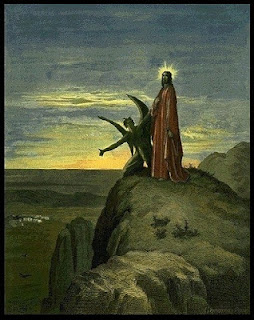
The first gangstalker, Satan, stalking Our Lord and Saviour Jesus Christ. Satan, like all gangstalkers is a total looser.

ALSO GANGSTALKING

Satan and all gangstalkers hate the Truth.

Gangstalkers protect child murderer/molestors: Antipope John Paul ii Great Deceiver and Bishop Brom
The new Murder, Inc., from below:


What about the future [of Gang Stalking], then? Let me close this review with a chilling quote from David Lawson's first book, Terrorist Stalking in America, reporting what the author learned from some of the leaders:
"The leaders ... are starting to balk at exposing their members to arrest for activities which amount to little gain for the movement. they say that anyone who is a target should be killed, and not just harassed for years."
_________________________________________________________________________________ 


"Ratzinger is waited on hand and foot there by a staff of two secretaries and four handmaids, all the while being guarded by Newvatican police officers so that he cannot be arrested and carried off to the International Criminal Court on charges for "crimes against humanity," to wit, aiding and abetting rape and sodomy of tens of thousands of children by his Newchurch clergy." 

Traditio: Francis-Bergoglio and Ratzinger Meet Eerily at the Papal Castle at Gandolfo So that One Would Not Know Which One Was Supposed to Be the Actual Newpope

Francis-Bergoglio and Ratzinger Meet Eerily at the Papal Castle at Gandolfo

So that One Would Not Know Which One Was Supposed to Be the Actual Newpope

From: The TRADITIO Fathers
Francis-Bergoglio and Ratzinger

Will the Real Newpope Please Stand Up?
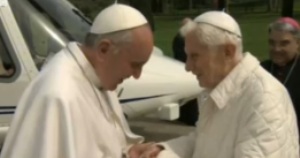
Francis-Bergoglio and Ratzinger Were Dressed Identically
In White Zuchetto and Cassock
Bergoglio Bowed down to Benedict-Ratzinger
As if to Kiss His (Non-existent) Newpapal Ring
Bergoglio Still Doesn't Seem to Think He Is Newpope!

It took him ten days to get around to it, but Francis-Bergoglio finally flew by helicopter on March 23, 2013, to the Papal Castle at Gandolfo to see Ex-Newpope Ratzinger. Bergoglio was scheduled to see Ratzinger on the day after his election, but, without explanation, Bergoglio pushed Ratzinger aside for a week and a half while Bergoglio played "Mr. Humility" around Newvatican.

The meeting was eerie, with both men dressed identically in white zuchetto and cassock, so that one would not know which one was supposed to be the actual Newpope. Bergoglio, who still doesn't seem to that he is Newpope, bent down to kiss Ratzinger's ring, then realized that Ratzinger no longer had the Newpapal ring!

What the two talked about is unknown, but it's a good bet that the 300-page "Red Dossier," prepared by the investigatory commission of three Newcardinals on corruption in Ratzinger's Newpapacy was at the top of the list. It was so embarrassing to Ratzinger that the Newcardinals who elected his successor have been forbidden to see it. Only Bergoglio is now privy to it.

Since Castel Gandolfo is reserved to the pope, one wonders what Ratzinger is still even doing there after his successor was elected. Ratzinger is waited on hand and foot there by a staff of two secretaries and four handmaids, all the while being guarded by Newvatican police officers so that he cannot be arrested and carried off to the International Criminal Court on charges for "crimes against humanity," to wit, aiding and abetting rape and sodomy of tens of thousands of children by his Newchurch clergy. [Some information for this Commentary was contributed by the BBC.]


Friday, February 8, 2013

Ratzinger, Council of apostasy, Watchful eyes of Social Justice


All copyrighted sources are quoted and used for comment and education in accord with the nonprofit provisions of: Title 17 U.S.C., Section 107. The use of these sites and articles are in accordance with Title 17 U.S.C., Section 107 and are protected under: The First Amendment Congress shall make no law respecting an establishment of religion, or prohibiting the free exercise thereof; or abridging the freedom of speech, ….


Pan Europa of the Antichrist


Si Si No No - May 1999 No. 32

PART II

Joseph Cardinal Ratzinger’s Milestones

In 1996, Cardinal Ratzinger published an in-depth interview of himself titled Salt of the Earth1 and in 1997 an autobiography called Milestones: Memoirs 1927- 1977.2 These books are important if we consider the high post the Cardinal holds in the Vatican. In this second article (Part I appeared in The Angelus, March, 1999), we continued our review of Milestones to better understand the current crisis in the Catholic Church.

A NOVEL NOTION OF TRADITION
There is a need, therefore, to be on guard: When Cardinal Ratzinger defends the Catholic position against the "sola scriptura" of the Lutheran heretics, it is necessary to pay attention to what he means by "revelation" and "tradition." In the passage from Milestones in which he rebuts the criticism that seminary professor Schmaus had levied against him earlier, Cardinal Ratzinger establishes, in fact, as we have seen, a link between revelation and tradition, but he does so in the light of the subjective concept of revelation that he professes. He writes that "an essential element of Scripture is the Church as understanding subject, and with this the fundamental sense of tradition is already given" (p.109).
How is this affirmation to be understood? It must be taken according to the notion of revelation which we have seen earlier (see SISINONO, March 1999). He is not talking about the Church which, aided by the Holy Ghost, keeps the deposit of revealed truth unchanged down the ages, explaining it, indeed, but without the power to alter it by a jot or tittle. What he does mean, on the contrary, is the Church which, taken as "understanding" or "perceiving" subject, is necessary for revelation to exist. He means the Church conceived as subject, which for that reason becomes a constitutive element of revelation by taking possession of it, and plays an active, creative role in its relation to revelation. Under this perspective, the Church's tie to revelation means that Scripture depends upon the Church as "knowing subject" in order to be Revelation. The Cardinal writes, in fact, that Revelation "is not simply identical” to Scripture, it is always greater than "what is merely written down" (op. cit., ibid.).
Note, though, that what is outside Holy Scripture is not, according to the Cardinal, provided by oral tradition ("sine scripto traditiones").

To highlight this fact, compare his notion to what was set forth by the Council of Trent and reiterated by Vatican I. Of tradition it is said that the Church "holds...also the traditions themselves, those that appertain both to faith and to morals, as having been dictated either by Christ's own word of mouth, or by the Holy Spirit, and preserved in the Catholic Church by a continuous succession" (Denzinger, The Sources of Catholic Dogma, 783). And from the same place: "...[p]erceiving that this truth and instruction are contained in the written books and in the unwritten traditions, which have been received by the apostles from the mouth of Christ Himself, or from the apostles themselves, at the dictation of the Holy Spirit, have come down even to us, transmitted as it were from hand to hand ….…"
Not so, according to the Cardinal. For him, what is not contained in Sacred Scripture is not given objectively by tradition, as that has always been understood and defined by the Church through the centuries. On the contrary, it is given by the "understanding subject" (the Church) which, making up a part of Revelation as an essential constitutive element, relies only upon itself (and hence on its history or evolution from the "primitive community of believers") for its determination of the truth of Revelation itself.

So, according to the point of view expressed by the Cardinal, the "essential meaning to be given to tradition" is not the result of an immutable truth revealed by God, but results from the truth which the "perceiving subject" constitutes in Revelation in an historically gradual, progressive way because the development of the "receiving subject" in its own self-awareness is gradual and progressive.
The notion that truth only exists thanks to the thinking subject, who imparts truth to its object, is necessarily associated with the other powerful notion in secular thought: that of progress, understood as progress in consciousness...and which can never have, resting as it does on such a basis, a final term or transcendent goal.

The will to introduce into the concept of Revelation the notion that the subject to whom it is addressed constitutes the message's meaning, leads necessarily to a corruption of both concepts, Revelation and Tradition. Revelation is no longer taken as a self-contained body of events and teachings of exclusively supernatural origin, which the subject for whom it is destined - for the salvation of whom these "deeds and values" have been revealed - must accept and keep without any alteration whatsoever, because he finds himself presented with truths which do not depend upon himself, but which come from God. Likewise, tradition is falsified by this conception, because it no longer expresses the idea of a "deposit of Faith" divine in origin, kept for 19 centuries and resulting from Scripture and Tradition preserved and taught by the Church's magisterium. It no longer signifies a "depositum" to which no new interpretation can be given.

On the contrary, this new notion of tradition expresses an idea that is not Catholic. Rather, it has a secular and Protestant origin. It is the idea that the Church, as receiving subject, even as it constitutes essentially and by degrees the truth of Revelation, equally constitutes by degrees the truth of tradition in the framework of a process, of which one can see no end "ad quem," and which has no other point of reference than the consciousness that the Church is supposed to have of itself, a Church which examines itself by using the categories which come from profane philosophies (Kant, Heidegger, and the like, instead of St. Thomas Aquinas).

The effect of this rethinking came to the fore at Vatican Council II, when we saw a new definition of the Church given, a definition that contradicts what the Church herself has taught (by her true tradition) for 19 centuries. We are referring to the notorious "subsistit in" of Lumen Gentium §8, according to which the Catholic Church is no longer the one and only Church of Christ, but that it subsists in her in the same way as in other entities capable of leading to salvation (the so-called "separated brethren" and perhaps even the non-Christians). Cardinal Ratzinger himself confirms, in the above-cited passage, that during the debates at the Council on the topics of Revelation, Scripture and Tradition, he contributed to this new understanding. The ultimate result of this change is to be seen in the theological and liturgical chaos currently prevailing in the Church.

AN IRRATIONAL NOTION OF TRADITION
Tradition thus understood is also presented as a "living process" of the Church, which "becomes history" by opening towards new understandings and which is opposed to the idea of Revelation held by neo-scholastic intellectualism, which would merely be the product of the "pre-fab" logic of St. Thomas. Cardinal Ratzinger uses this concept of "development" when he recounts the opposition which the Theological Faculty of Munich formulated against the proclamation of the dogma of the Assumption. The opposition was based on the affirmation of an "expert," Professor Altaner, patrologist, according to whom "the doctrine of Mary's bodily Assumption into heaven was unknown before the fifth century; this doctrine, therefore, he argued, could not belong to the ‘apostolic tradition'" (op. cit., p.58). The affirmations of the specialist in question are contested, and can also be explained by the desire, which was then quite keen in certain Catholic circles, to enter into the good graces of the Protestants, notoriously hostile because of their heresy concerning the person and the cult of the Blessed Virgin. Cardinal Ratzinger observes that, in this case, Professor Altaner was using a restricted conception of tradition, because, in fact, "they were identifying tradition and textual proofs."

How then does Cardinal Ratzinger justify the dogmatic definition given by Pope Pius XII?  with, perhaps, the same arguments which Pope Pius XII used to justify it, namely, that the Assumption of the holy Mother of God is a truth that has always been believed and taught by the Church, since, in the writings which have come down to us, the holy Fathers and ecclesiastical writers have spoken of it, not as something new, but ''as a truth supported by Sacred Scripture and which is rooted in the hearts of the faithful” (Dogmatic Bull Munificentissimus Deus)?  Not by a long shot. Here is the Cardinal's argument:

But if you conceive of "tradition" as the living process whereby the Holy Spirit introduces us to the fullness of truth and teaches us how to understand what previously we could still not grasp (cf. Jn. 16:12-13), then subsequent "remembering" (cf. Jn. 16:4, for instance) can come to recognize what it had not caught sight of previously and yet was already handed down in the original Word (op. cit., p.59).
In this passage, tradition is defined as "a living process" of which the Holy Ghost is the artisan. The "process" therefore is not linked to texts or even facts. Tradition, according to the Catholic meaning of the word, however, has never been understood as a process or a reality detached from facts (which is what the dogmatic definition of the Assumption demonstrates). The idea of "process" contains the idea of truth which develops by degree thanks to the thinking of man, and this development is here attributed to the Holy Ghost. The Holy Ghost would be operating as the pedagogue of the "understanding subject," and would act gradually by keeping Revelation open! The Catholic notion of tradition, on the contrary, contains the idea of conservation, of the transmission of the deposit of the Faith which has been given once and for all (cf. Jude, v.3), against every possible novelty or subsequent contradictory development.

In the case of the Assumption, they were faced with a fact: the cult which, from the origin of Christianity, professed the bodily assumption of the Blessed Virgin Mary into heaven, and included the veneration of her empty tomb (which is, even to this day, guarded by Christians, albeit the Orthodox). The question was whether to sanction this faith by a dogmatic definition. The fact was the same for 19 centuries, a mystery of Faith continuously and universally professed by the faithful. It had nothing to do with some "process" or "development." The dogmatic definition of the Assumption has no need to be seen as the expression of a "vital process," which succeeded by degrees in creating a new content of faith, which for a long time had been certified by witnesses and felt to belong to dogma. No novelty was introduced. What the Cardinal writes when he says "subsequent 'remembering' can come to recognize what it had not caught sight of previously and was already handed down in the original Word," does not seem to us to fit the case. Here there is no question of "subsequent remembering" because the belief in the Assumption has always existed. It has always remained constantly living and efficacious. For this same reason - the perpetuity of this faith and this devotion - it is certainly not possible to speak of something "not caught sight of previously." The fact is that Cardinal Ratzinger, even as he criticizes Professor Altaner, seems to justify him by speaking of a "subsequent remembering," that is to say, something fabricated" post festum." Later on, even if he judges him to have been wrong and justifies the definition of the Assumption, he does so on the basis of its being the expression of the "living process" which, according to him, is of the essence of tradition; he accepts it, that is, as an expression of the creativity of the Church, "receiving subject" (and hence constitutive) of Revelation. The Church would be, it seems, a theologian who constructs Revelation in the same manner as did the first "primitive community."

A "NEW EXEGESIS" FOR THE "NEW THEOLOGY"

Cardinal Ratzinger during an interview forMilestones in the audience hall of the Congregation for the Doctrine of the Faith (from the book).
The interpretation of this dogmatic declaration, as everyone can see for himself, is rather peculiar. In fact, it presents the typical traits of the New Theology. The Cardinal's theology is not Catholic theology; it is the new theology because it makes the supernatural depend upon man's own thought in order to keep Revelation open. It is not for nothing that he was profoundly influenced - as he himself recognizes - by Henri de Lubac!
In commenting on this passage, it is necessary to add that Cardinal Ratzinger's justification of his argument concerning the role of the Holy Ghost is not supported by the Scripture passages to which he refers. The first is the text in which the Lord announces to the apostles that "the Spirit of truth...will teach you all truth,“ even “things that are to come.” We do not believe this “teaching,” which also includes prophesy, applies to the case at hand. The second text contains an announcement even more specific, which surely does not apply here. It is when He is announcing to them ahead of time the persecution they will suffer at the hands of the Jews.  The Lord says to them: “But these things I have told you, that when the house shall come, you may remember that I told you of them” (Jn. 16:4). The "remembering" of which St. John speaks does not refer to past facts, but is linked to future events: it is linked to the prophetic announcement of the coming persecution for the faith: You will remember tomorrow, Jesus says, what I am telling you today! You will remember a specific event that took place before witnesses. It has absolutely nothing to do with the "living process" or nebulous "remembering" mentioned by the Cardinal, notions which, taking their origin in the "existential philosophies" of laymen and literature, fade into something indeterminate, and which, in any case, display not only a completely irrational notion of tradition, but also one that is completely foreign to true Catholic theology - which is certainly not the theology of the liberal and modernist masters from whom Ratzinger has constantly drawn his inspiration.

APOLOGIA PRO DOMO
Another essential aspect of Cardinal Ratzinger's autobiography is his attempt to disown any responsibility for the modernist deviations that followed upon Vatican II. During the Council, he was the theological advisor of Cardinal Frings, Archbishop of Cologne, one of the prominent representatives of the progressive wing, who had chosen him for this delicate and important task precisely because of the "modern" orientation of his theology.

Young Professor Ratzinger, then just 30 years old, took part in the Council from the inside, aligned with the most radical progressive theologians (the Rahners, de Lubacs, Congars, etc.), those forming the "Rhone Alliance." In his memoirs he seeks to downplay his participation in this "Sodalitium." He writes that "the theological and ecclesial drama of those years [does not] belong in these memoirs" (p.121), but he makes exception in order to comment upon certain questions about which he clearly wishes to make a few points.


THE PREPARATORY SCHEMAS
We learn that Joseph Rat zinger was not in favor of rejecting all the preparatory schemas, rejection which marked the first manoeuver of the progressives at the Council.

He [Cardinal Frings] now began to send me these texts regularly in order to have my criticism and suggestions for improvement. Naturally I took exception to certain things, but I found no grounds for a radical rejection of what was being proposed. It is true that the documents bore only weak traces of the biblical and patristic renewal of the last decades, so that they gave an impression of rigidity and narrowness through their excessive dependency on scholastic theology. In other words, they reflected more the thought of scholars than that of shepherds. But I must say that they had a solid foundation and had been carefully elaborated" (p.121).*     
*       
THE LITURGY
On the question of the liturgy, the Cardinal seeks to defend the Council by maintaining that the prevailing orientation was not especially revolutionary. His defense of the Council on this point rests upon the following argument: no one then could have foreseen the subsequent subversive and revolutionary developments of the liturgical reform, developments which were not justified (according to him) by the texts approved by the Council.

I became a partisan of the liturgical movement at the beginning of the Council...I saw in the elaboration of the Constitution on the Liturgy, which incorporated all the essential discoveries of the liturgical movement, a magnificent start for the Church assembly, and I counselled Card. Frings accordingly. I could not foresee that the negative aspects of the liturgical movement would reappear more vigorous than ever, leading straight to the self-destruction of the liturgy.

According to the Cardinal, then, the Council approved, without having well calculated the dangers, a document that was going to allow the negative developments which we well know and which are still at work. The Cardinal says that neither he nor others could foresee it. Yet, according to the Cardinal's own ideas, a conciliar document should be understood as the expression of the "living process" directed by the Holy Ghost, which for him is the essence of tradition. One wonders how this "living process" could have been suddenly stricken by a spontaneous, long-term necrosis. If the conciliar document on the liturgy indirectly contributed to the negative effects which followed, this would mean that it contained ambiguities or dangerous laxities. Is it to be thought, then, that the drafting of this text, which directly or indirectly is not good (because, one way or another, it has served as a cover for the "auto-destruction" of the liturgy), was inspired by the Third Person of the Most Blessed Trinity?

We also find another demonstration of the way in which the Cardinal's concept of tradition was not Catholic: the creativity of the Church, constitutive subject of Revelation, which is actualized by degrees in the course of "salvation history," would have allowed initiatives which have shown themselves to be disastrous, because they have allowed the ruination of the liturgy. In fact, the preparatory schema on the liturgy was the only one not rejected by the progressives who dominated in the Council, but only because it had already been corrupted by the "essential conquests of the Liturgical Movement, " that is to say, by a manner of understanding the liturgy which only initially fits into Catholic tradition.

The question of the liturgy justifiably occupies the thoughts of the Prefect of the Congregation for the Doctrine of the Faith. Confronted with the prevailing liturgical chaos, what can be the remedy? Most certainly, he avoids highlighting the theologically ambiguous character of the Mass of Pope Paul VI, which is one of the principal causes of the current chaos. Nonetheless, in his Milestones, there is a telling page on the topic, concerning the promulgation of the Novus Ordo Missae of Pope Paul VI. The Cardinal declares himself to be "dismayed by the prohibition of the old missal, since nothing of the sort had ever happened in the entire history of the liturgy" (p.146). (The fact is that the Missale Romanum codified by Pope St. Pius V was never prohibited by Pope Paul VI.)
In any case, Cardinal Ratzinger recounts the truth concerning the missal of St. Pius V, which was not created by this Pope, for it was not a new missal. Faced with Protestant infiltrations into the liturgy, in 1570, Pope St. Pius V:

...decided that now the Missale Romanum - the missal of the city of Rome - was to be introduced as reliably Catholic in every place that could not demonstrate its liturgy to be at least two hundred years old….The prohibition of this missal that was now decreed,...introduced a breach into the history of the liturgy whose consequences could only be tragic…[T]he old building was demolished, and another was built…[T]his has caused us great harm (op. cit., p.148).
His remarks are quite true. What is to be done?

A renewal of liturgical awareness, a liturgical reconciliation that again recognizes the unity of the history of the liturgy and that understands Vatican II, not as a breach, but as a stage of development: these things are urgently needed for the life of the Church. I am convinced that the crisis in the Church that we are experiencing today is to a large extent due to the disintegration of the liturgy, which at times has even come to be conceived of etsi Deus non daretur…Then the community is celebrating only itself, an activity that is utterly fruitless…This is why we need a new Liturgical Movement, which will call to life the real heritage of the Second Vatican Council (ibid.).

After making a substantially correct analysis, Cardinal Ratzinger comes to a disconcerting conclusion: what is needed is a new "liturgical movement," one that will "call to life the real heritage of the Second Vatican Council"! He cannot let go of Vatican II, which would appear to be the anchor of salvation. The solution is not to go back to the genuine tradition of the Church; no, it is necessary to return to the real Vatican II, whose authentic meaning has still not been understood!

The Cardinal does not know how to think in terms other than evolution towards the new: Vatican II must not be seen as a break with tradition (which, in fact, it was) but rather as a "moment of evolution," a stage of development. Pressed to identify the term of the development, the answer is, towards something new, and in this particular case, towards a "new liturgical movement." The "liturgical reconciliation" of which he speaks does not in any way express a recognition of the rights of the true Catholic tradition. It means, on the contrary, reconciliation with Vatican II, by allowing the genuine innovative development (which is, of course, not the same as that of the destroyers of the liturgy) thanks to a new liturgical movement!  We must "return" to the (merely pastoral) Council which denied, in black and white, that the Catholic Church is the one Church of Christ, the one ark of salvation! We must return to the Council, which sought to establish the truth of religion on individual liberty of conscience, and not on revealed truth! We must "return" to the Council, which sought to deny the responsibility of the Jews in the crucifixion of the Lord, in contradiction to the categoric testimony of the Gospels. The solution would be a new liturgical movement, as if the horrific errors of the first one were not enough. It is quite possible that the encouragement given by the Cardinal to the charismatic movements which are daily making inroads in the Church by infecting it with a corrupt spirituality originating in the worst Protestant sects (Quakers, Pentecostals, etc.) should be seen in the light of an attempt to give rise, whatever it may take, to "a new liturgical movement." These remarks describing the Council as a "stage of development" and a "new movement" which would complete the process show that we are witnessing a recrudescence of progressive vigor .

THE COUNCIL

Cardinal Ratzinger, as Prefect of the Congregation for the Doctrine of the Faith, at the signing of the Apostolic Constitution that promulgated the 1983 Code of Canaon Law,Vatican City, January 25, 1983 (from the book).

Finally, our author repeats almost as a refrain that Vatican II has not been understood. Concerning the documentDei Verbum, the Constitution on Divine Revelation, he says that it "has yet to be truly received."  In general, "we still have before us the task of communicating what the Council actually said to the Church at large and, beyond that, of developing its implications" (ibid, p.129). So, 32 years after the Council's closure, they tell us that it has still not been properly understood and that it is necessary to rediscover its authentic meaning. It remains to ask how the Council has not been understood, and by whose fault.
The Cardinal places himself in parallel with the Council: just as the latter has not yet been understood, neither has he. We have seen that he was not in favor of the progressives' integral rejection of the preparatory schemas. Moreover, we learn that his own opposition to the official schema on the Sources of Divine Revelation has not been correctly appreciated either, because actually he had wanted to express the concept of Revelation he holds to be in harmony with tradition. Just as at the time when he was defending his doctoral thesis, his thinking had not been understood by Professor Schmaus, so also, the Cardinal maintains, it was not well understood at the Council.

He was filled with consternation by the increasingly revolutionary development at the Council:

The impression grew steadily that nothing was now stable in the Church, that everything was open to revision. More and more the Council appeared to be like a great Church parliament that could change everything and reshape everything according to its own desires. Very clearly resentment was growing against Rome and against the Curia, which appeared to be the real enemy of everything that was new and progressive. The disputes at the Council were more and more portrayed according to the party model of modern parliamentarism….For believers, it was a remarkable phenomenon that their bishops seemed to show a different face in Rome from the one they wore at home. Shepherds who had been considered strict conservatives suddenly appeared to be spokesmen for progressivism. But were they doing this all on their own? The role that theologians had assumed at the Council was creating ever more clearly a new confidence among scholars, who now understood themselves to be the truly knowledgeable experts in the faith and therefore no longer subordinate to the shepherds….But now in the Catholic Church all of this - at least in the popular consciousness - was up once again for revision, and even the Creed no longer appeared untouchable but seemed rather subject to the control of scholars. Behind this tendency to dominance by specialists one could already detect something else: the idea of an ecclesial sovereignty of the people in which the people itself determines what it wants to understand by Church... (ibid, pp.132-134).

Cardinal Ratzinger effectively evokes the terrible spirit of revolutionary agitation which at a certain point seized the majority of the Council members, and, without intending it, he confirms the remark that Archbishop Lefebvre made, that, at a certain point, Satan had taken hold of the Council. The will to change everything, the mania for novelty at any price born of hatred against the principle of authority, against Rome and the institution of the papacy: Were we to conclude that such things were inspired by the Holy Ghost? They could only come from the Devil. The agitation which took possession of the Church then has still not abated; moreover, it is hard to imagine what pressure from the Vatican or what authority could effectively curb bishops and theologians today.

Concerned by the direction events were taking, Ratzinger, at a conference held at the University of Munster, "tried to sound a first warning signal, but few if any noticed" (p.134). He was even so insistent in the remarks he delivered at the Catholic Day held at Bamberg in 1966 that Cardinal Dopfner was "astonished" by the "conservative accent" that he perceived (ibid).

On the basis of these incisive declarations, the Cardinal places himself on the side of those who, in the terrible post-conciliar period, "had redefined their positions," concerned for the future of the Faith. But, let us note, for him, there was no question of "redefining" his position: From the moment when he claimed that he had not been well understood, that is to say, from the time of his study of the writings of St. Bonaventure, there has been no change. It is clear that Cardinal Ratzinger considers that his position in the post-conciliar period, and even now, is substantially the same as the one he held as a researcher when he was accused (and quite rightly) of wanting to elaborate a subjectivist conception of Revelation. What is striking is that in this autobiography, there is no self-criticism: those who accused him of being a liberal and a modernist simply have not understood his thinking. Likewise, those who accuse Vatican II because of the disastrous situation in the Church which has resulted also have not understood Vatican II. Or rather, the history - and the analysis - of Vatican II are yet to be accomplished.

CONCLUSION
His remarks come across as a fastidious apologia. Cardinal Ratzinger seems to have learned nothing from all that has happened. He is only concerned with showing the continuity of his theology, believing that by so doing he is defending both himself and Vatican II. From this defense a certain image of Cardinal Ratzinger as restorer of the Faith has been created; and it is an image in which many still believe. However, it is only blatant mystification.

The best known work of the Cardinal is the book, Introduction to Christianity, published in 1968 and translated into 17 languages. He speaks of it with satisfaction. Not withstanding, the Christology that he sets forth is scarcely orthodox. Sometimes he only very narrowly avoids the theology of heretics, which has been passively absorbed by the majority of Catholic theologians. He also affirms that Jesus the Messiah is a product of the faith of the primitive community: "He is the One who died on the cross, and Who, to the eyes of faith, rose" (Italian ed., Brescia, 1971, 4th ed., p.171) .The Resurrection is not then an historical fact, but a simple belief of the disciples. Like examples from the book could be multiplied.

The reputation of Ratzinger as restorer of the Church does not rest on his works. It is probably owing to the fact that several times he has quite clearly described certain disorders, and that he has always dissociated himself from the most extreme factions. But this takes away nothing from the modernist foundation of his theological vision: "Ratzinger is always like that: To counter the excesses, from which he keeps his distance, he never proposes Catholic truth, but rather an apparently more moderate error, which, nevertheless, in the logic of error, leads to the same ruinous conclusions" (SISINONO, no.6, 1993, p.6).

Some commentators have compared the Second Vatican Council to the Estates General of the French Revolution. Developing the analogy, one might say that Cardinal Ratzinger is a Girondist. The members of that faction were certainly more politically moderate than were the Jacobins, and especially their left wing (to which, in theology, we could compare the Kungs, Drewermanns, etc.), but they were no less revolutionary. They wanted to accomplish the same objectives, only in a more gradual, pragmatic manner. Their vision of the world, though, was identical: human reason exalted and placed in the center of the universe, democracy, bourgeois individualism; identical, too, was their hatred of Christianity, their desire to confiscate the goods of the Church, etc.

Neither his autobiography nor his book-length interview shows us a Ratzinger different from the one we have known. We can only hope for a miracle, that he might one day soon decide to become an effective Prefect for the Doctrine of the Faith, and intervene authoritatively according to the Church's own theology (and not his own personal one) against the Reign of Error which has been installed in the Catholic world for too long.
Aegidius
(Translated from Courrier de Rome, December 1998)

The SiSiNoNo article reviewed by Bishop Richard Williamson in his monthly Letter to Friends and Benefactors (April 2, 1999) will appear here in its English translation starting in July, 1999.


1. Joseph Cardinal Ratzinger, Salt of the Earth; The Church at the End of the Millennium, an interview with Peter Seewald (San Francisco: Ignatius Press, 1997). Cited passages are taken from this English language version.

2.  Joseph Cardinal Ratzinger, Milestones; Memoirs 1927-1977(SanFrancisco: IgnatiusPress, 1998). Passages cited refer to this English language version.

___________________________________________________________________________

Intelligence reference links.

Cardinal Ratzinger and the Rise of the Black International

Tech_Journal: Vatican and 9/11

Tech_Journal: The Justice of God: Stellar Wind

Tech_Journal: Social Justice via surveillance and overflight and recreational vehicles for global IA


Friday, January 11, 2013

The Truth and not a lie

Seat in Vatican of the False Prophet


Tech_Journal: Vatican and 9/11


9/11 (1)

911 (13)

911 truth (6)


THE LASHON HARAH BY APOSTATES (CALUMNY BY APOSTATES)

The Lashon Harah by apostates (calumny by apostates) hiding inside the apostate shell of Babylon-Vatican seek to try to defame the martyred Father Malachi Martin for telling the truth about Vatican II - the robber council of total Satanic apostasy held with worship actually offered to the devil. Father Martin is unable to defend himself in person - my, my aren't the apostates so brave...

CALUMNY BY APOSTATES

calumny by apostates
click on picture


A Prime example of what the article  "Houses of Sand: In Defense of Malachi Martin" utterly refutes:


THURSDAY, JANUARY 10, 2013
 Malachi Martin: "God Could Have Incarnated as a Cow;" "Priests Should Have Been Female;" Hostile Towards Patriarchy 
"One of the big deficiencies in Christianity is there is no theology of women at all. Although the one thing Jesus needed, the one thing he needed, having decided to become human, the only thing he needed was a woman, and logically all priests should have been female, you know. But male chauvinists got in the way. And as some theologian said, you know --and this is a sideline but let me finish it. As you know it's theologically possible for God to have become a cow if he decided. He could be incarnated as a cow. But even if he had been incarnated in a cow, we men would have taken over, that's the extent. But we've no theology of woman and no theology of love, really human love, because it involves the essence of woman and I don't think we know that theologically."
 (Malachi Martin, December 7, 1973, Firing Line, interviewed by Skull and Bones Bill Buckley) 
Posted by Maurice Pinay at 10:38 PM 


Source of article - "Houses of Sand: In Defense of Malachi Martin": Triumph Communications 

http://www.triumphcommunications.net/9indefenseofmalachimartin.html

Houses of Sand: In Defense of Malachi Martin


Our Lord instructed His followers to build their house upon a rock, not on sand.  What does this admonition have to do with Malachi Martin?  To answer this question, it is first necessary to sketch an outline of the final phase of his life. 

     In the 1960’s, after leaving Rome and arriving in New York City, Malachi Martin began working in the field of communications.  He wrote many books and articles and was heavily involved with the media, doing interviews and fielding questions on phone-in shows. 

     The combination of two factors eventually caused Malachi Martin difficulty.  First, Fr. Martin’s primary thesis was that the Roman Catholic Church was going through a period of grave crisis and, in the words of Pope Paul VI, self-demolition.  This thesis contradicted the official party line of the Church’s ascendant liberal faction that after the Second Vatican Council the Church was enjoying a second Pentecost, a period of great renewal.  Secondly, Malachi Martin’s message resonated with the public.  Sales of his books and recordings were phenomenally successful.  Malachi Martin’s success in striking a chord with the public, combined with the fact that he was contradicting the party line of the liberal Church establishment, earned him the enmity of the liberals.

     It is not surprising that the liberals did not like Malachi Martin’s message.  However, a problem for the liberals was that Fr. Martin’s thesis was difficult to refute.  The facts upheld Fr. Martin’s thesis.  All of the statistical indicators of the Church’s vitality, such as seminary enrollment and church attendance, were in steep decline.  And these statistical indicators which were in a death spiral did not take into account qualitative factors, such as the loss of belief and the spread of heresy among the churchmen.  Liberals and moderate conservatives did attempt to refute Malachi Martin, but because his conclusions were based on the rock of reality, these attempts were not very successful in denting Fr. Martin’s popularity. 

     In an attempt to undermine the effectiveness of Malachi Martin’s communications, his opponents resorted to what are called “ad hominem” attacks, or attacks on the person.  In fact, it is the only effective strategy that Fr. Martin’s opponents could have used.  The focus of this article is to discuss these attempts at character assassination.

Denying Fr. Martin’s Priesthood

     A characteristic of the personal attacks on Malachi Martin is that they are built on sand, in the sense that they are continually shifting.  At first, many of the attacks on Fr. Martin focused on the premise of doubting his status as a priest.  There were rumors that Fr. Martin had left the priesthood and got married.  It was frequently stated that he no longer had the faculties to function as a priest.  The effectiveness of these attacks came to an end after Fr. Martin’s death, when Fr. Vincent O’Keefe, a former vicar-general of the Jesuit order, stated that Fr. Martin had received a dispensation to release him from his vows of poverty and obedience, but not chastity.  He stated that Fr. Martin remained a valid priest all of his life and had never married.  Fr. O’Keefe was vicar-general at the time that Fr. Martin left the Jesuits.  Thus, Fr. Martin left the Jesuits, but not the priesthood.  He was secularized, not laicized.  He continued to say Mass privately.  The information that Fr. O’Keefe released was exactly what Fr. Martin had told me during our interviews.

Accusations of Robert Kaiser

     The attacks on Fr. Martin did not cease with the official confirmation that he had never left the priesthood.  The attacks since then have revolved around the accusation that Fr. Martin had affairs with women.  This, by the way, is one of the oldest attack lines in the book.  St. Athanasius, defender of orthodoxy at the time of the Arian heresy, was accused of having affairs with women.  St. Gerard Majella was falsely accused of having engaged in this behavior.

     The media sometimes reported that Fr. Martin was living with a female companion.  This “female companion” was Kakia Livanos, an elderly Greek woman who was his housekeeper.  She prepared his meals and did the tasks that housekeepers normally do.  It is very common for Catholic priests to have a housekeeper, so there is nothing unusual about this situation.  When Fr. Martin moved to New York, a cardinal advised him to find lodging with a family.  Fr. Martin followed this advice and moved in with the Livanos family.  At the time he moved in with them, they were what is called a nuclear family, consisting of mother, father, and children living at home.  As the decades passed, the number of people living in the household dwindled until only Kakia Livanos remained. 

     Robert Kaiser, a liberal journalist, has written a book, Clerical Error, which claims that Malachi Martin had an affair with his wife during the time of the Second Vatican Council.  This book was published in 2002, long after Malachi Martin’s death.  If these accusations were true, why did Kaiser wait so long to write this book?  Why did Kaiser wait until after Malachi Martin was dead and no longer around to defend himself?  To have waited until Malachi Martin was dead to raise these allegations was extraordinarily cowardly. 

     An important factor is that Kaiser is not a reliable source of information.  He has been described as a journalist who is incapable of distinguishing between fantasy and reality.  In the book, The Desolate City, Anne Roche Muggeridge wrote that Kaiser’s characterization of Cardinal Ottaviani and Cardinal Bea was false.  She wrote, “I recommend Kaiser to anyone planning to set up as a revisionist historian.”  Like many liberal journalists, Kaiser has a definite truth problem. 

     Malachi Martin has been accused more than once of having affairs with women, but what all of these accusations have in common is that they are built on the sands of rumor, gossip, and innuendo, not on provable facts.  None of these accusations would stand up in a court of law.  And in our justice system, the accused is innocent until proven guilty.  The burden of proof is on the accusers, not the accused.  And so far, the accusers have come up with no proof. 
   
     Let’s take a worst case scenario.  Even if one of these accusations were true, it wouldn’t mean that Malachi Martin’s arguments are false.  It wouldn’t even mean that Fr. Martin’s soul is destined for hell.  Fr. Martin went to confession regularly, so if he did have one of these affairs, he certainly would have confessed it and received absolution.  Implicit in the line of argument of Fr. Martin’s accusers is the idea that if he had affairs with women, then we shouldn’t listen to what he has to say.  This line of argument is logically false.  According to this logic, St. Augustine of Hippo never should have been made a saint.  Before his conversion, St. Augustine lived with a woman outside of the bonds of marriage and sired a child out of wedlock.

Malachi Martin: Double Agent?

     Some traditional Catholics mistrust Malachi Martin, saying that he held liberal opinions in the 1960’s and 1970’s.  Some Catholics even suspect that he was a double agent and a member of some shadowy Jewish conspiracy. 

     It probably is true that Fr. Martin became more traditional as he grew older.  He even said so himself.  He once jokingly told me, “Bernard, I find that I am becoming more and more of an irredentist as I grow older.”  There is nothing unusual about this.  Many of the leaders of the traditional movement only became traditional after a period of soul searching.  The late Hamish Fraser, the editor of Approaches, a traditional journal based in Scotland, was at one time a communist.  Even the most prominent traditional leader, Archbishop Marcel Lefebvre, signed all but two of the sixteen Vatican II documents.  Does it matter what Malachi Martin believed in 1960 or 1970?  God judges souls on the basis of where they end up, not where they were.  According to the logic of these critics of Malachi Martin, St. Paul never should have been made a saint.

     It is possible to exaggerate the extent of Malachi Martin’s liberalism at the time of the Second Vatican Council.  Some Catholics mistrust Fr. Martin because he was an assistant to Cardinal Bea, the former head of the Secretariat for Promoting Christian Unity.  Yet, in The Desolate City, Anne Roche Muggeridge points out that Cardinal Bea was orthodox in his beliefs.  He was horrified when he found out that two liberal theologians, Hans Kung and Edward Schillebeeckx, were using the Second Vatican Council to revolutionize the Church’s beliefs and practises.  Of course, Cardinal Bea did have liberal tendencies, but why would we assume that Malachi Martin agreed, even at that time, with all of the opinions of his boss?

     As for the suspicion that Malachi Martin was a double agent and a member of a shadowy Jewish conspiracy; there really is no solid foundation for this kind of suspicion.  Fr. Martin adhered to the doctrine of outside the Church there is no salvation, even to the point of being supportive of Fr. Leonard Feeney.  Fr. Martin was critical of John Paul II’s policy of ecumenism towards the Jewish religion.  In the booksWindswept House and The Deserted Vineyard, he was critical of the Pope’s handling of a concert organized to commemorate the holocaust.  Fr. Martin supported the traditional Church’s position on the need of the Jews to convert and accept Jesus as the Messiah. 

     This article has discussed the most commonly cited accusations against Malachi Martin and suspicions about him.  Their common thread is that they lack substance.  Based on rumors and not provable facts, they are houses built on sand.  We shall now see that the case for Malachi Martin is built on a stronger foundation.

The Fruits of Malachi Martin’s Work

     Because Malachi Martin was controversial and successful, it was inevitable that he would draw attacks.  As Fr. Martin once told me, “If you are not receiving any criticism, then you are not saying anything worthwhile.”  Ultimately, Fr. Martin must be judged on the results of his work.  “By their fruits you shall know them.”  (Matthew 7:16).  The effect of Fr. Martin’s books and recordings has been to sustain the faith of numerous souls.  In our files, we have numerous testimonials from people who have written to us, stating that Fr. Martin’s words have been a great help to them.  Some souls, who lapsed in the practise of the Faith, have been led back to the Church by Malachi Martin.  Other souls, who have had their confidence in the Catholic religion shattered by the crisis in the Church and the malfeasance of churchmen, have gained the strength to persevere during what is perhaps the greatest crisis in the history of Catholicism.  They have stated that by gaining an understanding of the crisis of the Church, they are better able to cope with it.  Many, many souls have been led to traditional Catholicism by Malachi Martin.  The webmaster of one of the leading traditional Catholic websites told me that many people have started attending the Traditional Latin Mass through Malachi Martin.  The conclusion that Fr. Martin’s work has helped the faith of numerous Catholics is based on real evidence, solidly based on the hard rock of reality. 
        
Malachi Martin’s Profile: Saint or Scoundrel?

     A man’s work generally corresponds with his character.  I would invite anyone who has doubts about Malachi Martin to listen to the twenty-two hours of recorded interviews that we conducted with him.  Would a scoundrel be able to deliver such a message of genuine spiritual inspiration?  The real experiences that people have had in their encounters with Malachi Martin produce a far different picture than that of a scoundrel.  On one occasion, Fr. Martin arrived late for one of my interviews because he had gone out to buy food for a hungry family.  On another occasion, he interrupted our interviews so that he could go to confession to a ninety year old priest.  On another occasion, Fr. Paul Wickens and I expressed mutual amazement at the number of people that we had encountered who had received spiritual assistance of some kind from Fr. Martin.  During the last decade of his life, Fr. Martin worked himself to exhaustion for the cause of the Faith, despite being in frail health.  Fr. Martin appeared to have the gift of prophecy.  He foresaw many events, such as the coming of the new world order and the institution of homosexual marriage, long before they became a reality.  He saw the gravity of the situation in the Church and the world clearly, perhaps because he had encounters with the supernatural realm, primarily through his work as an exorcist.  Fr. Martin was one of those rare individuals, even among the clergy, who seemed to live partly on the eternal side of reality.  He was unusually conscious of his mortality and was continually striving for his salvation and the salvation of the souls he encountered. 

     When you add together the factors of his life such as his generosity, gift of prophecy, and spiritual awareness, the overall profile that emerges is that of a man with the characteristics of a saint.  Is it possible to square this profile of Malachi Martin, which is based on the reality of real-life experiences, with the profile of him as a scoundrel?  Answer: It isn’t possible!  Then where does the information of those who portray him as a scoundrel come from?  This question can be answered in one word: Lies.

     It is very possible that the spread of misinformation is behind the attempts to destroy Malachi Martin’s reputation.  It has been documented that during the Cold War the KGB conducted operations to disseminate misinformation.  In his autobiography, advertising guru David Ogilvy mentions that during the Second World War, the British Secret Intelligence Service (SIS) (David Ogilvy worked for the SIS during World War II) conducted operations in South America to ruin the reputations of pro-German businessmen.  One of Malachi Martin’s bestsellers, The Jesuits, is highly critical of the post-Vatican II Jesuit establishment.  Would it not then be surprising if some of the Jesuits would attempt to tarnish Malachi Martin’s reputation?  Since the picture of Malachi Martin as a scoundrel is so out of line with the real man, it cannot be ruled out that an exercise of misinformation is at work. 
   
Importance of the Battle over Malachi Martin’s Reputation

     Why is the battle over Malachi Martin’s reputation so important?  This battle is important because Fr. Martin’s books and recordings have been an effective means of reaching souls and working for the restoration of traditional Catholicism.  In the English-speaking world, Malachi Martin is the traditional Catholic author who has reached the widest audience.  Even after his death, Fr. Martin’s words are still bringing the traditional Catholic message to the public and getting results.  The attempt to ruin Fr. Martin’s reputation is an attempt by liberals to sabotage this good work. 

     Shame on you, traditional Catholics, who spread these nasty rumors about Malachi Martin!  Why are you doing the liberals’ dirty work for them?  You are harming the Church, perhaps even jeopardizing the salvation of some people’s souls.  And by spreading these rumors, you may even be jeopardizing your own soul.  Do you not know that calumny is a sin?

     The works of Malachi Martin have been described as the most complete and accurate assessment of the situation of the Church since Vatican II.  On the other hand, critics of Fr. Martin have disputed his conclusions.  It is important to discuss and debate his conclusions so that an accurate assessment of the period in Church history following Vatican II can be established.  In the debate over this vital question, the attempt to ruin Fr. Martin’s reputation is nothing more than a pathetic sideshow, equivalent to attack ads in an election campaign.  The attempt to ruin Fr. Martin’s reputation is an attempt to sidetrack the debate away from the vital issues.  This attempt will fail, falling into the dustbin of history, because it is a house built on the sands of rumor, gossip, innuendo, and lies.  Traditional Catholics must rally around and support the defenders of the Faith.  We must also stay on message, focusing our efforts on defending the truth, while resisting the temptation to stoop to the level of spreading gossip about the personal lives of our liberal opponents.  In this battle of battles to rebuild the Church in the hour of its greatest crisis ever, let us always remember the words of Our Lord, “And you shall know the truth, and the truth shall make you free.”  (John 8:32).

From:

http://www.triumphcommunications.net/9indefenseofmalachimartin.html


ROMAN CATHOLIC RECORDINGS & BOOKS
Produced and Distributed by
Triumph Communications
1015 Queen's Bush Rd., Wellesley, ON N0B 2T0 Canada
(519) 656-9679

________________________________________________________________

FALSE PEACE OF ASSISI

click on picture

False peace of Assisi


ALSO SEE:

Another reason that Father Malachi Martin was martyred by the apostate Jesuitical Judaists is his revelations about the Vatican-New World Order False Prophet Antichrist religious-political movement would have blown the lid off this prior to 911 - Cardinal Bugnini was most deeply involved in a long time set up of Iran which Iran is totally complicit with, for the New World Order; the Vatican was one of the prime architects and benefactors of 911 and the Antichrist invasion of the Middle East by the Anglo American puppets and their facilitators, the Pan Euro-Zio-"Israeli" occupiers of Palestine:

IRAN, HOME OF THE REAL SARACENS - THE WILLING ARAB PERSIAN SET UP OF THE WHOLE MIDDLE EAST

Iran, home of the real Saracens - the willing Arab Persian set up of the whole Middle East 
click on picture

________________________________________________________________
References for the Holy Land:

THE HOLY LAND


GO HERE


FINAL TRIAL OF CHRISTIANS AND MUSLIMS TOGETHER - THE ONLY TRUE ISRAELO-CHRISTIANS THE PALESTINIANS


FINAL TRIAL OF CHRISTIANS AND MUSLIMS TOGETHER - THE ONLY TRUE ISRAELO-CHRISTIANS THE PALESTINIANS


Final Trial of Christians and Muslims together - THE ONLY TRUE ISRAELO-CHRISTIANS THE PALESTINIANS click on picture

THE FINAL TRIAL OF CHRISTIANS AND MUSLIMS TOGETHER

The Final Trial of Christians and Muslims Together click on picture

THE TRUTH FROM A PRIEST FROM HIS OWN WRITINGS

The Truth from a priest from his own writings click on picture