


“Greater Israel”: The Zionist Plan for the Middle East
The below shows how the Media is easing Russia and Syria into ousting Assad and destroying a united Syria. The Lebanese are caught in a hard place in between all of this. The dismantlement began decades ago when Gamel Abdel Nasser and the shortlived United Arab Republic (1958-1961) were rebuffed from within the Arab community for its sectarian pro-Socialist Stance. Egypt and Sudan and Iraq and Syria were effectively sundered. Nasser's forming of the PLO for Palestinian Liberation from the Zionist occupiers in 1964 has since then met with similar internal and external destruction in a number of ways. The Achilles heel in all of this is the Secular Socialist, that is Russian Communist Socialist underpinning with all real support from Russia never carried through. Russia will not risk nuclear war with the United States. Not then and not now.
Syria Live Blog - Al Jazeera Blogs: "Syria about 6 hours ago
Syria's opposition spokesman lashed out on Sunday against a statement that Assad's is ready to take part in a Geneva peace conference, reiterating the National Coalition's position that any settlement must exclude the embattled leader.
"We are ready to enter into negotiations that are aimed towards transferring power to the people, towards a democratic transition. And that of course means Assad cannot be a part of Syria in the future," Louay Safi told reporters.
Meeting in Istanbul since Thursday, the deeply divided Coalition has yet to reach an official position on US-Russian peace initiative dubbed Geneva 2.
"In principle, our position was to welcome the international [peace] initiative," Safi said.
But "the regime has yet to state a position on its willingness to leave" power, he added.
"We want the regime to be willing to accept Geneva as a framework for negotiations aimed at a transition of power and democratic change."
[AFP]"
MOSCOW — The Syrian government has agreed to participate in an international peace conference coordinated by Russia and the United States, a spokesman for the Russian Foreign Ministry said on Friday.
“We note with satisfaction that Damascus has confirmed its readiness in principle to participate in an international conference in the interest of the Syrians themselves finding a political path to a settlement of the conflict that has been devastating for the country and the region,” the spokesman, Aleksandr Lukashevich, said in a statement.
Reuters: Rockets hit south Beirut after Hezbollah vows Syria victory


The below shows how the Media is easing Russia and Syria into ousting Assad and destroying a united Syria. The Lebanese are caught in a hard place in between all of this. The dismantlement began decades ago when Gamel Abdel Nasser and the shortlived United Arab Republic (1958-1961) were rebuffed from within the Arab community for its sectarian pro-Socialist Stance. Egypt and Sudan and Iraq and Syria were effectively sundered. Nasser's forming of the PLO for Palestinian Liberation from the Zionist occupiers in 1964 has since then met with similar internal and external destruction in a number of ways. The Achilles heel in all of this is the Secular Socialist, that is Russian Communist Socialist underpinning with all real support from Russia never carried through. Russia will not risk nuclear war with the United States. Not then and not now.
Egypt Under Nasser, United Arab Republic
The Suez Crisis enhanced the prestige of Egypt. The canal remained nationalized, Egypt was at last free from British control, and Israel was forced for the first time to withdraw from Arab territory. Syria sought to unite with Egypt, and Nasser agreed to the formation of the United Arab Republic (UAR) in 1958. Syrian enthusiasm cooled, however, as it became apparent that Egypt would dominate the UAR. The UAR suffered a further blow when a new regime in Iraq, which had just overthrown the pro-Western monarchy there in July 1958, chose not to enter the union. Newly independent Sudan also chose not to join the UAR. In July 1961, when the Egyptian government moved toward an openly socialist policy, Syria’s business leaders turned against the union. Syria seceded from the UAR soon thereafter.
Nasser was chagrined at the breakup of the union with Syria. Nevertheless, he retained the name of the UAR for his country and looked for other allies in the Arab world. In 1962 he set up a one-party political system in the UAR, with his Arab Socialist Union the sole party. When Algeria gained independence from France in 1962, the UAR hailed its new regime. When a military coup ousted the ruler of Yemen and established the Yemen Arab Republic in 1962, the UAR recognized the republican regime and sent troops to aid it against royalist forces, which Saudi Arabia supported. This action led to a prolonged proxy war with Saudi Arabia that tied up thousands of the best UAR troops. In 1963 coups in Iraq and Syria led by army officers in the Arab socialist Baath Party installed pro-UAR governments, but talks to bring these countries into the UAR broke down.
Although his attempts to create a political union failed, Nasser promoted Arab unity in other ways. When Israel threatened to draw water from the Jordan River for its national irrigation project, Nasser convened the Arab heads of state to develop a common policy against Israel. In 1964 he facilitated the birth of the Palestine Liberation Organization (PLO), created to provide an organized channel for Palestinian nationalism. In 1966 Nasser made a mutual defense pact with Syria, hoping to moderate the stance of the radical wing of the Syrian Baath Party that had taken power. Instead, the pact emboldened Syria to engage Israel in aerial clashes in April 1967. Israel shot down six Syrian fighter jets and warned Syria against future attacks.
The Soviet government warned the UAR that Israel was concentrating its troops for an invasion of Syria. The Israelis denied the warning, which later proved false. Nevertheless, Nasser responded by sending troops into the Sinai Peninsula, which had been demilitarized after the 1956 war. He called for the removal of UN forces from the Gaza Strip and the Red Sea port of Sharm al-Sheikh, where they had been stationed since the end of the 1956 war. After reoccupying these buffer zones, the UAR announced that it would reimpose its blockade of the Strait of Tiran, preventing Israeli ships from entering or leaving the Gulf of Aqaba. The UAR press and radio also made threats against Israel.
Syria Live Blog - Al Jazeera Blogs: "Syria about 6 hours ago
Syria's opposition spokesman lashed out on Sunday against a statement that Assad's is ready to take part in a Geneva peace conference, reiterating the National Coalition's position that any settlement must exclude the embattled leader.
"We are ready to enter into negotiations that are aimed towards transferring power to the people, towards a democratic transition. And that of course means Assad cannot be a part of Syria in the future," Louay Safi told reporters.
Meeting in Istanbul since Thursday, the deeply divided Coalition has yet to reach an official position on US-Russian peace initiative dubbed Geneva 2.
"In principle, our position was to welcome the international [peace] initiative," Safi said.
But "the regime has yet to state a position on its willingness to leave" power, he added.
"We want the regime to be willing to accept Geneva as a framework for negotiations aimed at a transition of power and democratic change."
[AFP]"
Russia Says Syria Will Attend Geneva Peace Talks
By DAVID M. HERSZENHORN
Published: May 24, 2013
MOSCOW — The Syrian government has agreed to participate in an international peace conference coordinated by Russia and the United States, a spokesman for the Russian Foreign Ministry said on Friday.
“We note with satisfaction that Damascus has confirmed its readiness in principle to participate in an international conference in the interest of the Syrians themselves finding a political path to a settlement of the conflict that has been devastating for the country and the region,” the spokesman, Aleksandr Lukashevich, said in a statement.
The Russian foreign minister, Sergey V. Lavrov, and Secretary of State John Kerry agreed during a meeting in Moscow earlier this month to pull together the peace conference, with Russia responsible for bringing the government of President Bashar al-Assad to the table and the Americans focused on securing the participation of the Syrian opposition. The meeting is expected next month.
But even as Mr. Lukashevich said the Syrian government had committed to participating in the talks, he cited “complicating factors” that were undermining efforts to broker an end to the violence.
He said some steps by the West at the United Nations in New York and in Geneva were counterproductive.
“It’s regrettable that despite our persistent appeals to some partners, after the Russian-American initiative has already been announced, a decision on Syria was imposed on the U.N. General Assembly, which was lopsided in its character and contradicting to the consensus being formed in the world in favor of political settlement in this country,” he said.
Last week, the 193-member General Assembly passed a nonbinding resolution calling for a political transition to end the civil war in Syria, putting the burden on Mr. Assad’s government to stop the killing.
The United Nations’ top human rights official, Navi Pillay, has repeated called for urgent action to halt the violence in Syria, underscoring the level of brutality of the conflict, calling for war crimes investigations on both sides and monitoring the rising death toll and refugee crisis. More than 80,000 people are believed to have died in the conflict, and hundreds of thousands of refugees have crowded into bordering nations.
But Mr. Lukashevich called the proposed peace conference “a real chance to stop the bloodshed and suffering of the Syrians and ensure a peaceful, democratic future for Syria.”
“This opportunity should not be missed,” he said.
A spokesman for Syria’s main political opposition group responded to the announcement that the government would attend by saying there were no signs that it was really willing to produce “a peaceful political solution.”
The spokesman, Khaled Saleh, speaking on the sidelines of a three-day meeting of the opposition in Istanbul, said, “When any meaningful negotiation must start with good-will gestures, the regime continues using chemical weapons and heavily engages Iranian-backed Hezbollah fighters on the ground.”
The Syrian opposition was meeting to elect a new leader and formulate its positions before the expected conference in Geneva . Mr. Kerry will fly to Paris on Monday to meet with Mr. Lavrov to discuss the Geneva meeting, an American official said.
Earlier this week, leading members of the group, the National Coalition for Syrian Revolutionary and Opposition Forces, and top foreign affairs officials, including Mr. Kerry,held an 11-country meeting in Amman, Jordan, on the deteriorating situation in Syria.
At the start of the talks in Istanbul, members of the opposition group expressed hesitation about attending the Geneva meeting, and they asked for clarification on what to expect before committing to it, while emphasizing that such talks might be futile unless Mr. Assad was removed.
“We do not have too much illusion,” said Ahmed Kamel, a member of the coalition. “We know the regime, we know Assad, and we know that he would never quit power without force.”
Russia supports Mr. Assad’s continued leadership, saying his presence would stabilize any transition. Members of the opposition group insist that he must not be a part of any future government.
“The international community says that they can remove Assad from power; so does the U.S.,” Mr. Kamel said on the sidelines of the discussions. “We just need to stop massacres until then.”
The meetings are intended to enlarge the 63-seat national coalition, the largest opposition group, with more members from the liberated areas inside Syria.
Disagreements, however, remained on how to secure representation by gender and ethnic and religious backgrounds, and how to establish trust for newer, little-known candidates.
The opposition group has been without a president since Sheik Moaz al-Khatib resigned the post amid political infighting in March.
At the start of the talks, Sheik Khatib put forward his own 16-step proposal for a political transition to a post-Assad government. Among other things, it would absolve all combatants involved in “legal military action” from prosecution and allow Mr. Assad and 500 people of his choosing, along with their families, to seek refuge in any country willing to welcome them.
Sheik Khatib’s plan, published on his official Facebook page, would retain some members of the current government. Under it, Mr. Assad would hand power to Vice President Farouk al-Sharaa or Prime Minister Wael al-Halqi within 30 days of accepting the plan.
Subsequent measures include dissolving Parliament and transferring legislative powers to an agreed-upon candidate to handle the transition. Sheik Khatib added that the current government would continue to govern for 100 days, restructure the security and military apparatus, and release political prisoners.
But it is not clear whether any other members of the opposition coalition will support the plan. “No one listened to him when he was still head of the coalition; why would they listen to him now?” said an activist contacted via Skype in the suburbs of Damascus, the Syrian capital, who declined to give her name.
And it is unlikely to appeal to the rebels fighting Mr. Assad’s army and its allies on the ground, who say they want Assad loyalists to pay for their actions.
Asi, an activist who works at a makeshift hospital in Qusayr, a Syrian town where clashes are raging between government forces and rebels, wrote on his Facebook page: “This pathetic nobody Moaz, the dangerous, is calling for Assad to leave with 500 individuals and wants to absolve soldiers. You donkey, you’re going to be tried before Assad, God willing.” (The word for “dangerous” in Arabic is similar to Sheik Khatib’s surname.)
Even if the plan did win support, Mr. Assad himself has repeatedly emphasized in televised interviews that he has no plans to leave Syria, and refuses to step down before presidential elections — which he plans to enter — are held next year.
Sheik Khatib portrayed his proposal as a response to ideas by Russia and the United States for a political solution, and a way to “prevent the decay of Syria, its people, its land, its economy.”
Reuters: Rockets hit south Beirut after Hezbollah vows Syria victory
Rockets hit south Beirut after Hezbollah vows Syria victory
BEIRUT |
(Reuters) - Two rockets hit a Shi'ite Muslim district of Beirut on Sunday, driving home the risk of spillover from Syria's civil war, after the head of Lebanese Shi'ite movement Hezbollah said it would keep fighting on the Syrian government's side until victory.
It was the first attack to apparently target Hezbollah's stronghold in the south of the Lebanese capital since the outbreak of the two-year conflict in neighboring Syria, which has sharply heightened Lebanon's own sectarian tensions.
The United States and Russia have proposed an international peace conference to douse a civil war that has killed more than 80,000 people, driven 1.5 million Syrians as refugees abroad and raised the specter of sectarian bloodshed in the wider region.
Syria's government will "in principle" attend the talks tentatively set for June in Geneva and believes it will be an opportunity to resolve the crisis, Syrian Foreign Minister Walid al-Moualem said during a visit to Baghdad on Sunday.
But in an apparent rebuff of Western calls for President Bashar al-Assad to cede power as part of any deal on transition, Moualem said: "No power on earth can decide on the future of Syria. Only the Syrian people have the right to do so."
The U.S. and Russian foreign ministers, striving to refloat a plan for a political transition in Syria, were due to meet in Paris on Monday to work out the details.
Whether the exiled Syrian civilian opposition will take part in the envisaged peace talks - and be able to negotiate effectively, given their internal divisions and shaky rapport with rebels inside Syria - remains in doubt.
The United States has been prodding Assad's opponents to unite before the conference. But the Islamist-dominated coalition has been hamstrung by power struggles during talks going on in Istanbul aimed at broadening its representation and electing a cohesive leadership.
The talks stalled on Sunday in a factional dispute over proposals to dilute Qatar's influence on rebel forces, with Saudi Arabia angling to play a greater role now that Iranian-backed Hezbollah was openly fighting for Assad.
Some observers have viewed the commitment by Hezbollah to Assad's cause as indicating the Lebanese movement does not see the United States weighing in against it. Asked whether the militia's role might alter Washington's reluctance to arm the rebels, a spokesman for President Barack Obama said on Sunday:
"The calculus that the president is making is something that is regularly reviewed and updated ... Our involvement and our assistance to the opposition there has steadily increased."
European Union foreign ministers meet in Brussels on Monday to discuss British and French calls for them to ease an arms embargo in order to help the rebels obtain weapons. Some other EU states oppose the move, at least until after any peace talks.
CONFLICT AFFLICTING LEBANON
Syria's conflagration has polarized Lebanon, a country of four million, in whose 15-year civil war to 1990 Syria was a major player and where Syrian troops remained until 2005.
Lebanese Sunni Muslims support the mainly Sunni insurgency against Assad, and Shi'ite Hezbollah stands by the president, whose minority Alawite sect derives from Shi'ite Islam.
In Sunday's attack, one rocket landed in a car sales yard next to a busy road junction in south Beirut's Chiah neighborhood, and the other struck an apartment several hundred meters away, wounding five people, residents said.
There was no immediate claim of responsibility. Brigadier Selim Idris, head of Syria's Western-backed rebel military command, told Al-Arabiya Television that his forces had not carried out the attack.
He urged rebels to keep their conflict inside Syria.
But another Syrian rebel, Ammar al-Wawi, told Lebanon's LBC Television the attack was a warning to authorities in Beirut to restrain Hezbollah. "In coming days we will do more than this. This is a warning to Hezbollah and the Lebanese government to keep Hezbollah's hands off Syria," he said.
Hezbollah leader Sayyed Hassan Nasrallah had declared on Saturday night that his thousands of fighters were committed to the conflict against what he called radical Sunni Islamist rebels in Syria, whatever the cost.
"We will continue to the end of the road. We accept this responsibility and will accept all sacrifices and expected consequences of this position," he said in a televised speech on Saturday evening. "We will be the ones who bring victory."
Though numbering only in the thousands compared to the tens of thousands of troops and many more irregular Syrian militiamen that Assad can draw on, Hezbollah's fighters, seasoned in urban warfare against Israel as recently as 2006, are a potent force.
French Foreign Minister Laurent Fabius condemned the violent spillover into Lebanon. "The war in Syria must not become the war in Lebanon," he told reporters in Abu Dhabi on Sunday.
Until recently, Nasrallah insisted that Hezbollah had not sent guerrillas to fight alongside Assad's forces.
Syrian government forces reinforced by Hezbollah launched an onslaught last week on Qusair, a rebel-controlled town close to the Lebanese border that rebels have used as a crucial supply corridor for weapons coming into the country.
For Assad, taking Qusair would help keep Damascus, the capital, connected to the Alawite coastal heartland and also hinder links between the rebel-held north and south of Syria.
Lebanese authorities, haunted by Lebanon's own civil war and torn by the same kind of sectarian rifts as Syria, have pursued a policy of "dissociation" from the Syrian turmoil.
But Hezbollah is arguably a stronger force than Beirut's government, which has been unable to stem the flow into Syria of Sunni gunmen who support the rebels or of Hezbollah fighters who back Assad. It has also struggled to absorb nearly half a million refugees coming the other way to escape the fighting.
At least 25 people have been killed in Tripoli in the north of Lebanon over the last week in Sunni-Alawite street fighting triggered in part by the battle for Qusair across the frontier.
In Lebanon's Bekaa Valley, residents said three rockets landed on Sunday close to the mainly Shi'ite border town of Hermel, without causing injuries. Rebels have targeted Hermel from inside Syria several times in recent weeks.
Nasrallah's speech was condemned by former prime minister Saad al-Hariri, a Sunni who said that Hezbollah, set up by Iran in the 1980s to fight Israeli occupation forces in south Lebanon, had abandoned anti-Israeli "resistance" in favor of sectarian conflict in Syria.
"The resistance is ending by your hand and your will," Hariri said in a statement. "The resistance announced its political and military suicide in Qusair."
Hariri is backed by Saudi Arabia, which along with other Sunni Muslim Gulf Arab monarchies has strongly supported the uprising against the Iranian-backed Assad.
The extent to which Hezbollah's support for Assad has alienated Sunni Arabs who admired its battles against Israel was demonstrated on Sunday when the foreign minister of Sunni-ruled Bahrain used unusually strong language to call Nasrallah a "terrorist" and said it was a "religious duty" to stop him.
(Additional reporting by Khaled Yacoub Oweis in Istanbul, Laila Bassam and Erika Solomon in Beirut, Ahmed Rasheed and Suadad al-Salhy in Baghdad and John Irish in Abu Dhabi; Writing by Mark Heinrich; Editing by Will Waterman and Alastair Macdonald)


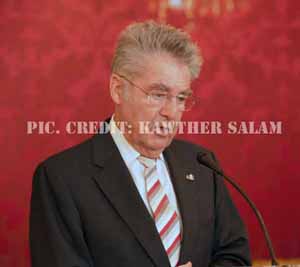 Austrian President Heinz Fischer deferred my question about the efforts of this country to host Palestinian – Israeli negotiations, posted to him during the joint press conference with President Abbas earlier today.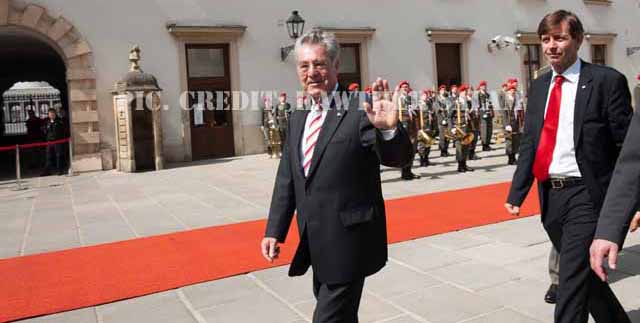

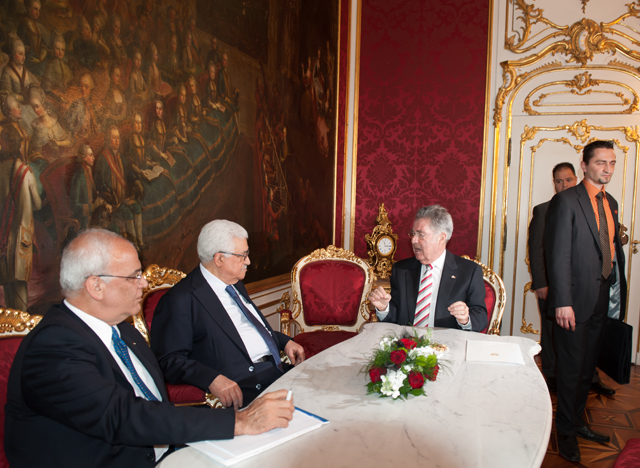
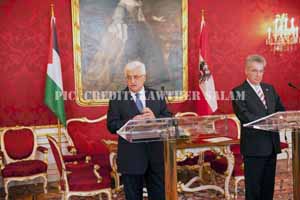 Vienna – Kawther Salam – Palestinian President Mahmoud Abbas thanked his Austrian counterpart Heinz Fischer for upgrading the status of the Palestinian representation in Austria from a general delegation to the level of a mission. President Abbas emphasized in his speech before Dr. Fischer the gratitude towards Austria for its historical positions of support for the Palestinian people, their rights, and for upgrading the status of the Palestinian representation in Austria during a joint press conference held today April 30, 2013 at the presidential offices at the Hofburg.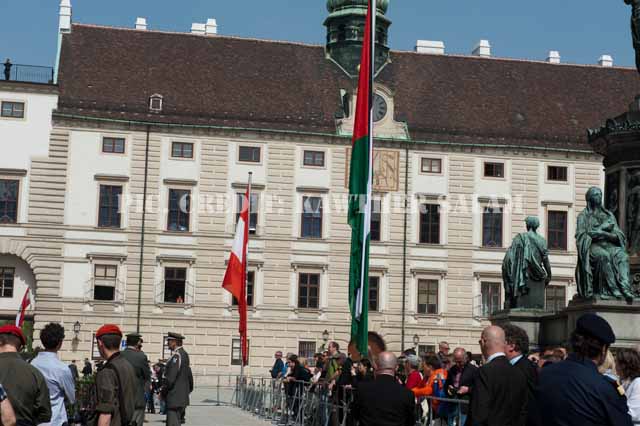
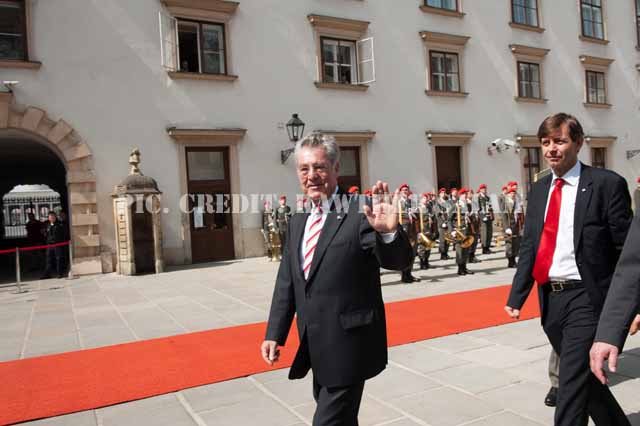
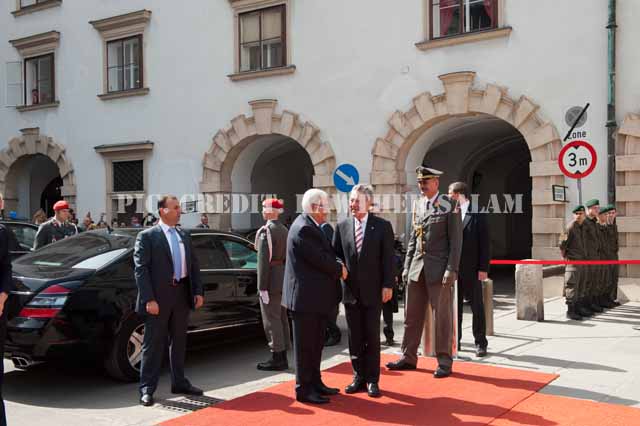
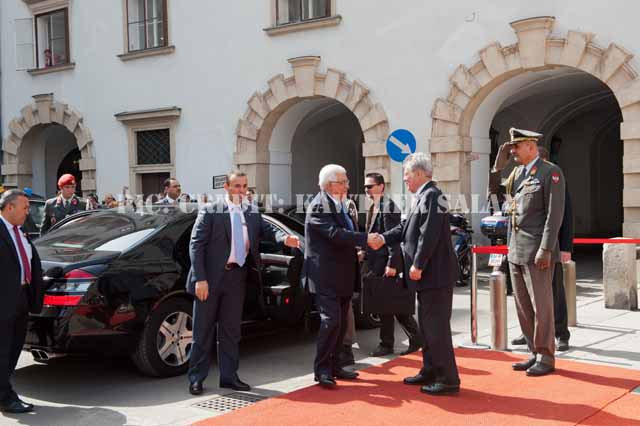
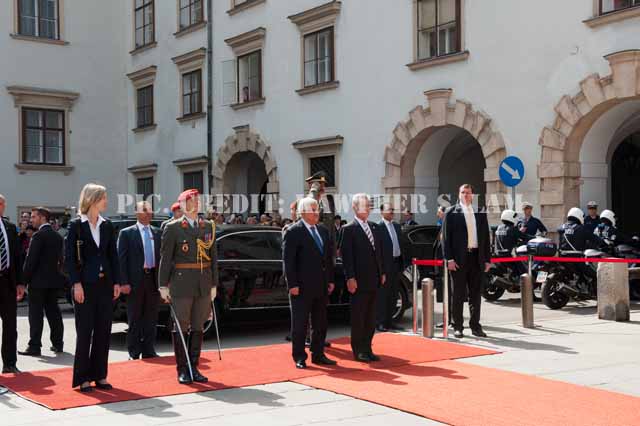
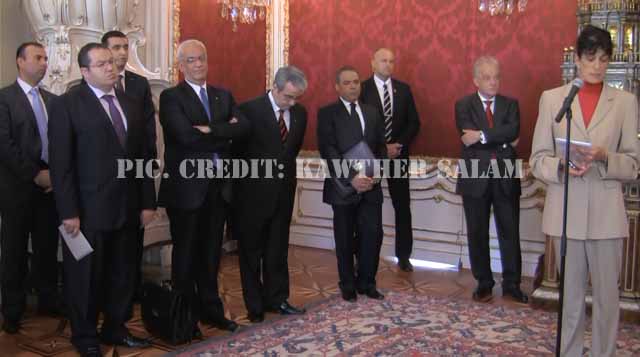
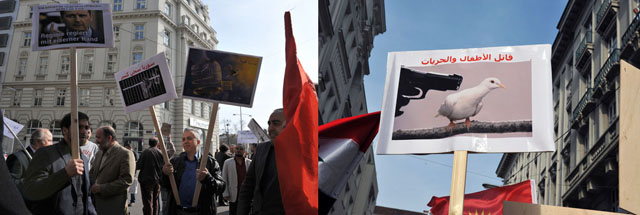
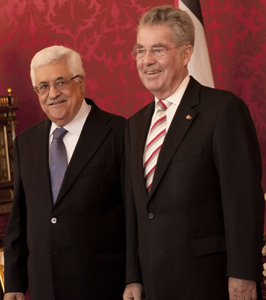 Palästinenser-Präsident Mahmoud Abbas (Abu Mazen) hielt sich Montag und Dienstag 29. und 30. April 2013, zu einem offiziellen Arbeitsbesuch in Österreich auf. Präsident Abbas hat sich mit den Botschaftern der arabischen Länder in Wien getroffen, Medien waren zu diesem Treffen nicht eingeladen.

