Peace to War 1919-1939 (these revision notes were posted by Redruth School, Cornwall, in 2006) The Peace settlements of 1919 Europe had been drawn up into two armed camps by the beginning of the second decade of the C.20th. Each great power in Europe sought to gain pre-eminence and this caused great tensions and jealousy. Throughout the period 1900-1914 there were a series of crises which could have sparked a major war, but it was only when the assassination of Archduke Franz-Ferdinand of Austria-Hungary by a Serb nationalist in Sarajevo in 1914 occurred that a major war broke out. The countries of the two armed camps pledged to support each other and Europe was plunged into a war. The two armed camps were: The Triple Alliance - Germany, Austria-Hungary and Italy The Triple Entente - France, Russia and Great Britain. Many other countries were involved, including Japan and the USA (after 1917). The Empires of the Great Powers were also involved in the conflict which caused the war to widen into a World War. The suffering of the participants in the Great War was so appalling, that when the war came to an end in November 1918, many hoped never to repeat such an experience again, and a mood of pacifism grew in the 1920s. France had suffered particularly badly in the war, so when the diplomats met at the Paris Peace Conference in 1919, their representatives, led by Prime Minister Georges Clemenceau, pledged to make Germany pay. Britain, led by Prime Minister David Lloyd-George, was more sympathetic to Germany. Lloyd-George realised that if Germany was harshly punished this would cause great resentment amongst the Germans and could cause tensions in the future. He also believed that a strong Germany would be a good trading partner for Britain, and that a healthy German economy would prevent the rise of extremist parties either Communists or Fascists. On the other hand Lloyd-George had to listen to British public opinion which was calling for Germany to be 'squeezed until the pips squeak!' The other great victorious power was the USA. Led by President Woodrow Wilson, the Americans had no great desire to punish the Germans. In January 1918 Wilson had proposed his Fourteen Points, which was a blueprint for a fair peace settlement at the end of the war. One of its main points was the idea of a League of Nations which would try to prevent major wars through negotiation. Wilson did not wish to punish the Germans, but at the Peace Conference he was overruled by Clemenceau and Lloyd-George. The Treaty of Versailles was the peace settlement with Germany, it was very harsh. In effect Germany had to: - accept blame for starting the war - lose all of its colonies - lose most of its army, navy and all its airforce - lose huge territories in Europe - pay reparations of £6.6 billion. The Germans hated the Treaty of Versailles and throughout the 1920s and 1930s her politicians tried to reverse the terms of the treaty. In the 1920s Hitler and the Nazis gained support as they promised to reverse the treaty. In the 1930s when the Nazis were in power, Hitler set about reversing these terms. Britain believed that Hitler should be allowed to do this and this policy of letting the Germans take back their lands and building their armed services was called Appeasement. Britain also appeased Italy and Japan. Italy joined Britain and France in 1915 after territorial gains were promised to the Italians if they fought against the Germans. In 1919 Italy gained very little and felt snubbed. Japan had fought alongside Britain in the First World War but was snubbed by the Great Powers in 1919. Both Italy and Japan faced economic problems in the 1920s and were dominated by right-wing extreme governments. To solve their problems both countries set about creating empires. Britain and France let them get away with this as they were not prepared to start a major war. This was appeasement. Summary of Versailles and the other peace treaties Treaty | Result | Treaty of Versailles – Germany | Severely punished (see notes for details) | Treaty of St. Germain – Austria | Austria-Hungary split. Loss of territory to new countries e.g. Poland, Czechoslovakia and Yugoslavia | Treaty of Trianon – Hungary | Treaty of Neuilly – Bulgaria | Loss of territory | Treaty of Sevres – Turkey | Loss of Ottoman Empire |
In Central and Eastern Europe, the consequences of the First World War were much more dramatic than they were in the West. Imperial power was swept away in Austria-Hungary, Russia and the Ottoman Empire. Austria-Hungary collapsed by 1918 and the map of Europe was re-drawn with the creation of new states from the remains of the old. The successor states were Austria, Poland, Hungary, Yugoslavia and Czechoslovakia. Each national group was determined to achieve independence from imperial interference. This was known as the right of National Self-Determination. However, in each of the new countries minorities felt that their rights were not recognised properly. For example, in Czechoslovakia there were Czechs, Slovaks, Ruthenes, Poles, Hungarians, Germans, Jews, Gypsies, Romanians etc.. The Ottoman Empire was destroyed. By the treaty of Sevres 1920, Turkey was cut back to 300,000 square miles and its territory in the Middle East was given as mandates to Britain and France. Greece declared war in 1921 to gain land from Turkey, but was beaten. In 1922 Mustapha Kemal (Ataturk) became President of the Turkish Republic and abolished the Sultanate (Ottoman Emperors). By the treaty of Lausanne 1923 Turkey agreed to give up its North African territories and its Arabian kingdoms. One and half million Greeks and Turks were swapped between Greece and Turkey. (Today this would be called ethnic cleansing). Russia’s losses were the greatest. Russia had surrendered to Germany in 1917 and lost huge territories by the Treaty of Brest-Litovsk 1918. In November 1917, the Bolsheviks seized power in Russia. The Bolsheviks were communists, committed to the creation of a classless society. Russia was not invited to the Paris Peace Conference because the other Great Powers feared communism and because Russia continued to fight a civil war until 1921. The treaty of Versailles punished Germany harshly. The other treaties were even more severe to Austria-Hungary, Turkey and Bulgaria. Russia lost a great deal while communism was being established. Britain and France were weakened by the war and had to borrow money from the USA to help rebuild. The USA emerged as the strongest country from the First World War. Tip: Compare this map of Europe in 1914, with the one in 1919. Make sure you are familiar with these territorial changes. A good knowledge of these maps will help you greatly. 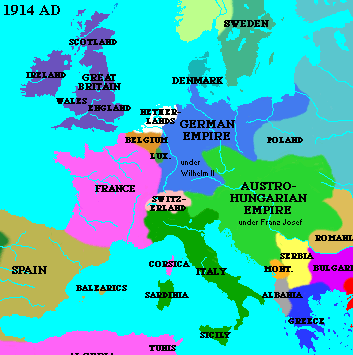

The League of Nations The concept of a League of Nations to deal with international problems was the brainchild of Woodrow Wilson. In February 1918 he had put forward a proposal for peace known as the Fourteen Points. Wilson’s Fourteen Points proposed a fair deal for Germany and the establishment of a League of Nations. When Germany signed the Armstice in 1918, they believed that the peace deal would be based on the Fourteen points. As you will know Germany and Austria-Hungary were dealt with severely. However, the League of Nations did come into existence. The League of Nations was established so that the Great Powers and other member countries could discuss issues rather than resort to war. The League also had other responsibilities e.g. a world health programme and an international court of justice. But, the League had a number of fatal weaknesses. First, three important countries were not part of the League: USA, USSR and Germany. It may seem surprising that the USA was not in the League, but although Wilson wanted American membership, many leading American politicians wanted to keep out of international affairs. This policy of keeping to themselves was known as isolationism. In fact Wilson had had a lot of trouble getting the USA into the War in 1917; President Roosevelt faced a similar problem between 1939-1941. The USSR was not allowed to join until 1934 because its Bolshevik government was not recognised by the other Great Powers. Germany was not allowed to join initially as one of the punishments imposed by the Treaty of Versailles. (Germany was a member from 1926-1933). Japan left in 1933 and Italy in 1937. A second fatal weakness was the fact that the League of Nations did not have an army. If a conflict arose, member states had to supply forces at their own expense. All were reluctant to do so, especially Britain and France who were effectively the only strong countries in the League. How could the League enforce its will? Economic sanctions were one method of control, but these were usually ineffective if non-League countries could supply goods instead. A third weakness was to do with organisation. Each of the member countries sent delegates to the Assembly, but real power was concentrated in the hands of the Council, made up of permanent members Britain, France, Italy and Japan in 1920. Each member of the council had the right of veto, which meant that one vote against could stop action being agreed. Successes It is very easy to blame the blame the League for the failure of the Second World War, but it did achieve some successes. In 1920 the League successfully dealt with a feud between Sweden and Finland over the Aaland Isalnds and between Greece and Bulgaria in 1925. Nevertheless these were disputes between small and weak countries. When the Great Powers were involved e.g. Manchuria 1931 (Japan and China) and Abyssinia 1935 (Italy and Abyssinia), the League failed because the aggressor members did not want the League to prevent their actions. Failures The Manchurian Crisis 1931 In many ways Japan was a new nation in the early Twentieth Century. For three hundred years Japan had remained isolated and had resisted foreign intervention. Then in 1853 Japan was opened up by Commodore Perry on the behalf of the USA. The Japanese had no desire to become a Western colony and so modernised rapidly to catch up with the Great Powers. By the turn of the century Japan had fought successful wars with both China and Russia and had made it plain that Japan sought a sphere of influence in the Far East. Japan fought with France, Britain and the USA in the First World War, but she felt poorly rewarded by the peace settlements of 1919. During the 1920s Japan faced considerable problems e.g. a rapidly growing population and a lack of land. Japan had long had an economic interest in Manchuria, a part of Northern China. China was a complete mess by the 1920s; it was a country torn apart by warlords and extremist politicians. In 1931 the Japanese stage-managed an attack on the Japanese owned Manchurian railway by "Chinese bandits." To protect their interests the Japanese army took control of the whole region. Both China and Japan appealed to the League of Nations to arbitrate. The significance of the Manchurian Incident is that it was the first real test of the League of Nation’s principle of collective security. Theoretically the League should have placed economic and military sanctions upon Japan as the aggressive member state. The problem was that the League was seriously weakened by the non-membership of the USA and Russia. In effect the League was comprised of only two Great Powers, Britain and France, and a host of lesser nations. Any act of collective security would call for the leadership of Britain and France, but this was virtually impossible as both countries were in depression. The result was that Japan was appeased and got away with adding Manchuria (later called Manchukuo) to its empire. The League appeared to take action over the Manchurian Incident by sending Lord Lytton to the region. Lytton took a year to report back to the League. As each day passed the Japanese became increasingly entrenched in Manchuria. Perhaps this appeasement is understandable under the circumstances; it is very unlikely that the general public in Britain and France would have had the stomach for a major war with Japan in the Far East, literally thousands of miles from Europe, a region which meant very little to ordinary people. It is unlikely that the navies of Britain and France would have felt comfortable with or even have afforded such a conflict. The consequences of failure meant not only a loss of prestige, but also involved a direct threat to European colonies e.g. Singapore, in the Far East. Japan left the League in 1933, and thus lost a powerful member state. This heighlighted the fact that the League could do nothing when dealing with a powerful country. Japan acted as a role model for other aggressive nations e.g. Germany and Italy in the 1930s. After the Manchurian Incident, the threats of Britain and France through the League or otherwise, in relation to a whole series of crises in the 1930s, were perceived to be hollow indeed. The Abyssinian Crisis 1935 Benito Mussolini was born the son of a village blacksmith and schoolmistress in 1883. He fled to Switzerland in 1902 to evade military service. His dramatically varied early career included activity as manual labourer, a teacher, and a journalist, before he finally served and was wounded in the First World War. In 1919 he founded the ‘fascisti di combattimento’, which in 1921 became the Italian Fascist party. Its backing and Mussolini's own tactics accounted for his rise to power between 1919 and 1922, when King Victor Emmanuel III appointed him Prime Minister. Mussolini was the first fascist dictator to emerge in Europe after the First World War, and was a model for others, most notably Hitler who greatly admired him in the 1930s. Mussolini called himself ‘Il Duce’, the Duke, and had grand ambitions to make Italy great again. Mussolini liked to see himself as an heir to the Roman Emperors, like them he wished to build and maintain an Empire in the Mediterranean. Italy gained some lands from Austria-Hungary in 1919, but generally the Italians felt snubbed at Versailles and were not treated as a Great Power as they had expected. The Italians were encouraged to think of themselves as a Great Power and yet their track record in military terms was poor. They had been defeated by native troops in Abyssinia (Ethiopia) in 1896 and had suffered severe losses during the First World War. The Italian image of themselves did not match up to the reality. The crisis over Abyssinia came to a head in the Autumn of 1935. Mussolini demanded extensive territories in Abyssinia. Emperor Haile Selassie of Abyssinia appealed to the League of Nations for help. Through the League of Nations Britain gave the impression that it would stand up to any Italian aggression. Italy invaded Abyssinia and all eyes turned to the British, as a leading member of the League, to make good their promises of punishing Italy. But Britain had no intention of going to war with Italy over Abyssinia, after all they could hardly prevent Italy’s aggression in Abyssinia. Unfortunately, the British public did not see it that way; all they saw was the British government giving in to aggression when only a few months before was upholding the League’s principle of collective security against aggressors. The League of Nations was seriously undermined by Britain’s unwillingness to get tough, Britain continued to support sanctions against Italy until July 1936, by which time Mussolini was thoroughly annoyed by Britain and the League which Italy, left in 1937. Mussolini completed the conquest of Abyssinia despite Britain and the League, but most seriously Mussolini began to lean towards an alliance with Hitler British policy in 1935 should have been either to go to war with Mussolini and to have brought him down or to have agreed to Mussolini’s claims and brought Italy into an alliance with Britain and France. Neither policy was properly followed and disaster was the result. The Road to War Hitler’s foreign policy aims Hitler aimed to make Germany into a great power again and this he hoped to achieve by: • destroying the hated Versailles settlement, • building up the army, • recovering lost territory such as the Saar and the Polish Corridor, and • bringing all Germans within the Reich. This last aim would involve the annexation of Austria and the acquisition of territory from Czechoslovakia and Poland, both of which had large German minorities as a result of Versailles. There is some disagreement about what, if anything, Hitler intended beyond these aims. Most historians believe that the annexation of Austria and parts of Czechoslovakia and Poland was only a beginning, to be followed by the seizure of the rest of Czechoslovakia and Poland and by the conquest and permanent occupation of Russia as far east as the Ural Mountains. This would give him what the Germans called lebensraum (living space) which would provide food for the German people and an area, in which the excess German population could settle and colonise. An additional advantage was that communism would be destroyed. However, not all historians agree about these further aims; A.J.P. Taylor, for example, claims that Hitler never intended a major war and at most was prepared for only a limited war against Poland. Whatever the truth about his long-term intentions, Hitler began his foreign policy with a series of brilliant successes (one of the main reasons for his popularity in Germany). By the end of 1938 almost every one of Hitler’s aims had been achieved, without war and with the approval of Britain. Only the Germans of Poland remained to be brought within the Reich. Unfortunately, it was when he failed to achieve this by peaceful means that Hitler took his fateful decision to invade Poland. 1933 | Hitler promises to get back all that was lost by the Treaty of Versailles. He promises to make Germany powerful and to gain lebensraum (living space) for the Aryan master-race. | 1934 | Hitler introduces conscription for the army. He orders the build up of submarines, tanks and an airforce. Thisrearmament was strictly forbidden by the Treaty of Versailles. Hitler backs a Nazi coup in Austria, but it fails when Mussolini mobilizes Italian troops on the Austrian border. Hitler realises he will need Mussolini’s support if he is to complete an Anschluss with Austria. | 1935 | Germany regains the Saar after 15 years under international rule. Hitler claims the credit. Hitler announces the existence of the Luftwaffe (airforce). Britain and Germany sign the Anglo-German Naval Agreement. The German navy was limited to 35% of Britain’s. Mussolini attacks Abyssinia and falls out with Britain and France. League of Nations seriously weakened. | 1936 | Hitler remilitarises the Rhineland. Hitler and Mussolini sign the Rome-Berlin Axis. Mussolini promises not to intervene in Austria. Germany and Italy support Franco in the Spanish Civil War. | 1937 | Anti-Comintern Pact signed by Germany, Italy and Japan. Each pledges to support the others in conflicts against communism. | 1938 | Hitler forces the Anschluss with Austria. Britain let Hitler do this. Nobody in Britain wanted a war with Germany. In September 1938 Hitler forces Czechoslovakia to give up the Sudetenland. Britain’s Prime Minister, Neville Chamberlain, agrees to Hitler’s demands. Chamberlain believed that if Hitler got what he wanted, Britain could avoid war with Germany.This was called appeasement. | 1939 | In March 1939, Hitler invades the rest of Czechoslovakia. Hitler and Mussolini sign the Pact of Steel. In August 1939 Hitler and Stalin sign the Nazi-Soviet Pact. Hitler invades Poland. The Second World War begins. |
Hitler, Aryan supremacy and lebensraum Hitler wanted to make Germany self-sufficient – that is, the country should be able to produce its own food and raw materials so that it did not have to depend upon other countries. This policy was known as autarky. Hitler drew up a Four Year Plan in 1936 with the aim of making Germany sel-sufficient. More raw materials, such as coal, oil, iron and other metals were produced and synthetic raw materials, such as rubber, fuel and textiles were developed. The Four Year Plan was expensive and had not made Germany self-sufficient by 1939, over a third of raw materials were still having to be imported. When it was obvious that Germany could not achieve self-sufficiency, the Nazis decided to take over or dominate countries with the raw materials and food it needed e.g. Norway – iron ore, Czechoslovakia – metals, Ukraine – wheat, Romania – oil. This was the policy of lebensraum (living space). This economic ‘need’ to attack other countries matched up conveniently with long held Nazi beliefs about German superiority. Hitler promised to look for lebensraum in Eastern Europe in Mein Kampf. He justified German aggression by claiming racial supremacy over the Slavs (slaves) and Jews. By taking control of Eastern European countries Hitler was expanding German power and prestige, gaining access to cheap or free raw materials, gaining territory for the Germans and gaining an opportunity to exterminate Slavs and Jews. Hitler’s 1941 attack on the USSR was also a product of the long term Nazi hatred of communism. Rearmament 1934-1939 After the appalling casualties of the First World War a view developed that the most effective way to avoid war in the future would be to reduce weapons through a monitored system of world disarmament. But no country was willing to give up its arms if other countries were not going to follow suit. In fact, none of the Great Powers disarmed although they all agreed to it in principle. As Germany was still militarily weak in 1933, Hitler had to move cautiously at first. He withdrew from the Disarmament Conference and the League of Nations on the grounds that France would not agree to German equality of armaments. Hitler insisted that Germany was willing to disarm if other states agreed to do the same, and that he wanted only peace. Germany was forced to disarm by the Treaty of Versailles, but France did not disarm at the same time, and this caused tensions between the two countries. The Germans resented the French and feared military interference. For instance, France was able to simply walk unopposed into the Ruhr in 1923 to secure reparations payments. The Saar 1935 The Saar was returned to Germany (January 1935) after a plebiscite resulting in a 90% vote in favour. Though the plebiscite had been provided for at Versailles, Nazi propaganda made the most of the success, and Hitler announced that now all causes of grievance between France and Germany had been removed. The Rhineland 1936 Encouraged by Mussolini’s fall out with Britain and France, Hitler took the risk of sending troops into the demilitarised zone of the Rhineland in March 1936. Though the troops had orders to withdraw at the first sign of French opposition, no resistance was offered beyond the usual protests. This was a vital step in rebuilding German power. Strong fortifications and forces here would stop France coming to the help of her East European allies. Why did Britain and France not intervene? France and Britain did nothing to prevent the remilitarisation of the Rhineland. The French were nervous of going to war without Britain’s backing. Many British politicians felt that Hitler should be allowed to go "into his own back garden". The British public did not yet see Hitler as a threat, rather he seemed a strong potential ally against Bolshevik Russia. The Spanish Civil War 1936-1939 The Spanish Civil War was a conflict between Right-wing/Fascist army rebels, lead by General Franco, against the Left wing Republican government, backed by armed workers' militias. What transformed the conflict was the European/international dimension: Franco looked to Fascist German and Italy for help; the Republicans to Britain, France, then Soviet Russia. Hitler was quick to see the opportunity and respond. He provided aircraft and 6,000 German troops. So the Republican side in Spain was forced to appeal to Soviet Russia. Stalin agreed, sending to Spain hundreds of military advisers and equipment. The Moscow-based international Communist organisation the "Communist International" ("Comintern") put out an appeal to all countries to volunteer to fight on the Republican side in International Brigades. Stalin was anxious to deprive Fascism of an easy victory; such an outcome could only strengthen Nazi Germany, Russia's potential enemy. The Spanish Civil War ended in a Fascist victory for General Franco in 1939. Hitler had supported Franco, most notably by the bombing of the Basque town of Guernica by the German Condor Legion. Austria 1938 In July 1934 Hitler suffered a setback to his ambitions of an Anschluss (union) between Germany and Austria. The Austrian Nazis, encouraged by Hitler, staged a revolt and murdered the Chancellor, Egelbert Dollfuss. However, when Mussolini moved Italian troops to the Austrian frontier and warned the Germans off, the revolt collapsed; Hitler, taken aback, had to accept that Germany was not yet strong enough to force the issue and disclaimed responsibility for the actions of the Austrian Nazis. In October 1936 Hitler and Mussolini signed agreements known as the Rome-Berlin Axis. This clinched Mussolini's drift into the arms of Hitler. They described it as "an axis around which can revolve all those European states with a will to collaboration and peace." In reality it gave Hitler the ally he had lacked so far (as well as ending any Italian objections to a future German move on Austria). Hitler seemed at the centre of a new alliance, potentially global in scope and ambition; a cause of concern to Britain, France, Russia, even the USA. The Anschluss with Austria (March 1938) was Hitler’s greatest success to date. Matters came to a head when the Austrian Nazis staged huge demonstrations in Vienna, Graz and Linz, which Chancellor Schuschnigg’s government could not control. Realising that this could be the prelude to a German invasion, Schuschnigg announced a plebiscite about whether or not Austria should remain independent. Hitler decided to act before this took place, in case the vote went against union; German troops moved in and Austria became part of the Third Reich. In a plebiscite organised by Hilter after the Anschluss, 99.75% of Austrians supported the union with Germany. It was a triumph for Germany, Britain and France again did no more than protest, and it dealt a severe strategic blow at Czechoslovakia which could now be attacked from the south as well as from the west and north. All was ready for the beginning of Hitler’s campaign to acquire the German-speaking Sudetenland, a campaign which ended in triumph at the Munich Conference in September 1938. Appeasement and Chamberlain Appeasement was the policy of giving in to some of the demands of dictators like Hitler and Mussolini in the hope that they would be satisfied and not ask for more. This policy has been most closely identified with British and French foreign policy in the 1930s. The leading figure in Britain was Neville Chamberlain. British politicians traditionally held the view that Eastern Europe fell under Germany's sphere of influence; Chamberlain wanted to turn Germany eastwards to act as a bulwark against Communist Russia. After 1919 the British policy towards Germany was to recognise that there were a number of German speaking peoples outside Germany who would one day want to be part of the Reich. Appeasement aimed to achieve German reunification peacefully. Britain would and could not effectively defend the new countries of Eastern Europe e.g. Poland, Czechoslovakia, and therefore encouraged these states to make concessions to Germany in a peaceful way. Chamberlain's mistake was the failure to recognise that Britain was declining in power and prestige and he also failed to recognise that Fascism and Nazism were unappeasable. Appeasement was a very popular part of British foreign policy. No one wanted a repeat of the First World War. Chamberlain had total faith in the policy of appeasement and believed that eventually Hitler could be controlled. His hopes deceived him as he admitted with the outbreak of hostilities: ‘Everything that I have worked for, everything that I have hoped for, everything I have believed in during my public life, has crashed into ruins.’ Weakness of France During the 1930s French governments followed Britain’s lead. The French were very nervous of further German aggression and attempted to weaken Germany as far as possible. The French put their faith in a series of alliances with the new Eastern European states, these were known as the Little Ententes. Militarily the French established a huge network of military defences on the German border known as the Maginot Line. Between 1917-1940 France’s democracy produced 44 governments under 20 different Prime Ministers. This rapid change of governments left France weak and divided. There were deep divisions between left and right wing parties. This decline deprived Britain of the one strong ally who could have helped to stand up to Germany. French weakness was one of the main reasons why Britain and France did not stand up to Germany in the mid 1930s. Sudetenland and the Munich Agreement 1938 After the Anschluss Hitler turned his attention to Czechoslovakia and the three million Sudeten Germans. The region was now bordered by Germany on 3 sides. In April 1938 Chamberlain and Halifax made it clear to Daladier that they would not guarantee France or Czechoslovakia if the latter were attacked. Britain and France put pressure on Benes, the Czech President to give in to Germany. Chamberlain tried to convince Hitler that he could have what he wanted without resorting to war. The Issues Czechoslovakia was a new country, born out of the collapse of the Austro-Hungarian Empire. The new state was set up as part of theTreaty of St. Germain (the treaty which had dealt with Austria-Hungary in 1919.) Ethnically Czechoslovakia was diverse with large numbers of Czechs, Slovaks, Poles and Hungarians. One of the largest minority groups was the Sudeten Germans who lived in the mountainous region of western Czechoslovakia. This region was relatively wealthy compared to the rest of the country and contained all the major industrial complexes such as Skoda. Hitler detested Czechoslovakia for its Slav peoples, especially as they had control over ethnic Germans; he also disliked the fact that Czechoslovakia was a successful democracy. In fact in 1938 it was the last democracy in eastern Europe. Hitler encouraged and supported the Sudeten Germans’ claim for self-determination. In the middle of the 1930s Konrad Henlein had come to prominence as the leader of Sudeten German nationalism. Hitler fuelled Henlein’s political agitation and there were a number of riots and marches led by Henlein in opposition to Czech control of the region. Hitler provoked problems in the region by mobilising German troops and the Czechs did the same in retaliation. Under pressure from Britain and France, Benes, the Czech President offered Henlein virtually everything he had been calling for. Henlein refused because Hitler wanted an excuse for invasion. In an effort to calm things down, Chamberlain flew to meet Hitler in a series of three meetings. Chamberlain It is at this moment that appeasement reached its most notorious point. Chamberlain met Hitler on three occasions before a peace deal could be thrashed out: Berchtesgaden – 15th September 1938 Godesberg – 22nd September 1938 Munich – 29th September 1938
At Berchtesgaden Chamberlain made it clear to Hitler that Britain would accept self-determination for the Sudetenland. But Hitler wanted more than this, secretly he was looking for an excuse to invade Czechoslovkia and not just the Sudetenland. A week later Chamberlain flew to meet Hitler at Bad Godesberg to finalise the agreement made at Berchtesgaden. When he arrived he found that Hitler was not just asking for the Sudetenland’s right of self-determination, but was asking for the withdrawal of Czech troops from the Sudetenland and was also demanding territories on behalf of Poland and Hungary. Hitler had won the support of two countries who might otherwise have allied with Czechoslovakia against German aggression. Britain and France were reluctant to agree to these demands and so Chamberlain returned to London to prepare for war. For the next week tension built as each country began to mobilise. Then Mussolini stepped in with the proposal for a four-power conference in Munich on the 29th September. Chamberlain flew to meet Hitler, Mussolini and Daladier (of France) at Munich. Here Chamberlain gave into German claims for the Sudetenland. The Czechs were completely ignored by this decision, as were the Russians. For a brief moment Chamberlain was triumphant. He returned to Britain with his ‘piece of paper’ which had averted war and which promised peace between Germany and Britain in the future. On October 1st Germany took the Sudetenland, and Poland and Hungary gained the territories they had been seeking. As the weeks passed the gloss on Chamberlain’s success began to fade and when Hitler invaded the rest of Czechoslovakia in March 1939, the policy of appeasement was seen to have failed. Conclusion of the Sudeten Crisis What are the conclusions one can draw from this episode? Hitler became increasingly popular in Germany, he had achieved victory without a war and it encouraged him to look for other foreign policy successes i.e. Poland. Czechoslovakia was destroyed. A small, but strong democracy had been abandoned by the Great Powers. Russia had not been included in the Munich Agreement and Stalin felt compelled to come his own arrangement with Germany (Nazi-Soviet Pact 1939). It can be argued that Munich saw appeasement fail, that Hitler could not be trusted. However it has been argued that Chamberlain bought time at Munich, time in which Britain could rearm for conflicts in the future.
Czechoslovakia March 1939 In March 1939, Hitler completed his conquest of Czechoslovakia, as he had wanted all along. Hitler took direct control of the western Czech lands, and a puppet state was set up in Slovakia. It was clear that Hitler could not be trusted from now on. Growing tensions and relationship with the USSR In the late spring and summer of 1939, Britain and Germany prepared for war. After the March annexation of Czechoslovakia, it was clear that Hitler could no longer be appeased. Reluctantly British diplomats began to put out feelers towards the USSR as a potential ally against Hitler’s Germany. An alliance with a communist state went against all British instincts, despite the looming spectre of conflict the British government was in no rush to sign an alliance. Stalin was also nervous. He suspected that Hitler would attack the USSR at some point, but he was not ready for war. Hitler wanted to attack Poland, but he did not want to fight the USSR. Stalin was not ready for war and was happy to let Hitler attack Poland, as long as the USSR gained something from it. The stage was set for the most unlikely agreement of the 1930s! The Nazi-Soviet Pact 1939 Despite their political differences, both Germany and the USSR needed each other’s co-operation in the autumn of 1939. As Hitler prepared to take back the Polish Corridor, he did not want to get embroiled in a war with the USSR. Stalin was well aware of German ambitions in the USSR, but saw this pact as an opportunity to give time in order to further prepare defences and for the USSR to control an even greater buffer zone against Germany. The Pact was totally cynical on both sides. Hitler and Stalin knew they would go to war with each other eventually, but neither were ready for a war over Poland in 1939. The Nazi-Soviet Pact solved this. Hitler and Stalin agreed to divide Poland between them! The Nazi-Soviet Pact was a disaster for Britain. They had now lost a potential ally. The USSR was the only country that could have helped Britain stop a German invasion of Poland. In fact, maverick MP Winston Churchill had urged Britain to sign an agreement with the USSR all through the summer of 1939, despite his own suspicions of communism. Britain did not hurry the negotiations with the USSR believing that there was still time to spare. Chamberlain was wrong, Hitler had already signed a deal with Stalin. Poland and war Like Czechoslovakia, modern Poland was born out of the Paris Peace Treaties of 1919. Historically there had been a Polish kingdom, but both Germany and Russia had swallowed this up in the Eighteenth Century. The Paris Peace Treaties gave the ethnic Poles their own country again. Hitler disliked Poland, especially as it drove a wedge between Germany proper and East Prussia. This Polish Corridor gave Poland access to the sea at Danzig (Gdansk). There were many ethnic Germans living in the Polish Corridor. Hitler claimed that these people had the right to live in Germany. In Mein Kampf Hitler promised his readers that he would restore this land, taken by the Treaty of Versailles, to Germany. Hitler started to make moves against Poland in March 1939 just as Germany invaded the rest of Czechoslovakia. Control of Czechoslovakia gave Hitler a southern border with Poland. Anti-Polish propaganda was published in Germany; this claimed that the Poles were mistreating Germans living in the Polish Corridor. Hitler wanted to use this as an excuse to ‘rescue his people’. Britain promised to support Poland if it was attacked. This was intended as a warning to Hitler that appeasement had gone far enough. Chamberlain knew that Britain could never effectively help Poland. Poland was too far away for Britain to defend from Germany. Chamberlain hoped that he could still appease Hitler and avoid a major war. Tension mounted when Mussolini, supported by Hitler, invaded Albania in April 1939, and in May 1939, Italy and Germany signed a military alliance known as the Pact of Steel. As Hitler prepared himself for war with Poland, he began to offer Chamberlain the hope of negotiation and appeasement. Hitler believed that Britain would withdraw its guarantee to Poland, just as it had done with Czechoslovakia. Many British politicians, including Chamberlain, believed that Hitler’s claims to the Polish Corridor were only fair and reasonable. Hitler offered to ‘protect’ the British Empire. He said that Poland was the ‘last problem’ and that once it had been solved he would retire and return to his true vocation as an artist! Chamberlain was prepared to appease Hitler, but public opinion by then was turning against Chamberlain and appeasement. On August 31st Hitler ordered some SS soldiers to dress up as Polish soldiers. These men crossed into Poland secretly and attacked a German radio station on the border. This gave Hitler the excuse to declare war on Poland. On September 3rd 1939 both Britain and France issued an ultimatum to Hitler to end his attack on Poland. It was ignored. The Second World War had begun. A few days after the German invasion of Poland, Russia invaded from the East. Faced with two enemies and a lack of modern weapons, Poland was torn apart. | 


 Based on the archives of the famous and powerful French Grand Orient Lodge, captured in June 1940 and later made public by the Russians, JüriLina details in a 600-page the true history of how Freemasonry has conspired for world domination and orchestrated all major revolutions and wars to create a one world Government.
 Based on the archives of the famous and powerful French Grand Orient Lodge, captured in June 1940 and later made public by the Russians, JüriLina details in a 600-page the true history of how Freemasonry has conspired for world domination and orchestrated all major revolutions and wars to create a one world Government.


