All copyrighted sources are quoted and used for comment and education in accord with the nonprofit provisions of: Title 17 U.S.C., Section 107 for "Fair Use."
From: http://www.traditio.com/stjohn.htm
 | Society of St. John the ApostleSt. John the Apostle Oratory
Offering the Only Fully Traditional Pre-Vatican II
|
CELEBRATING IN 2013 OUR TWENTY-FIRST YEAR
OF OFFERING THE ONLY FULLY TRADITIONAL PRE-VATICAN II LATIN MASS AND CHANT
IN THE SAN FRANCISCO BAY AREA
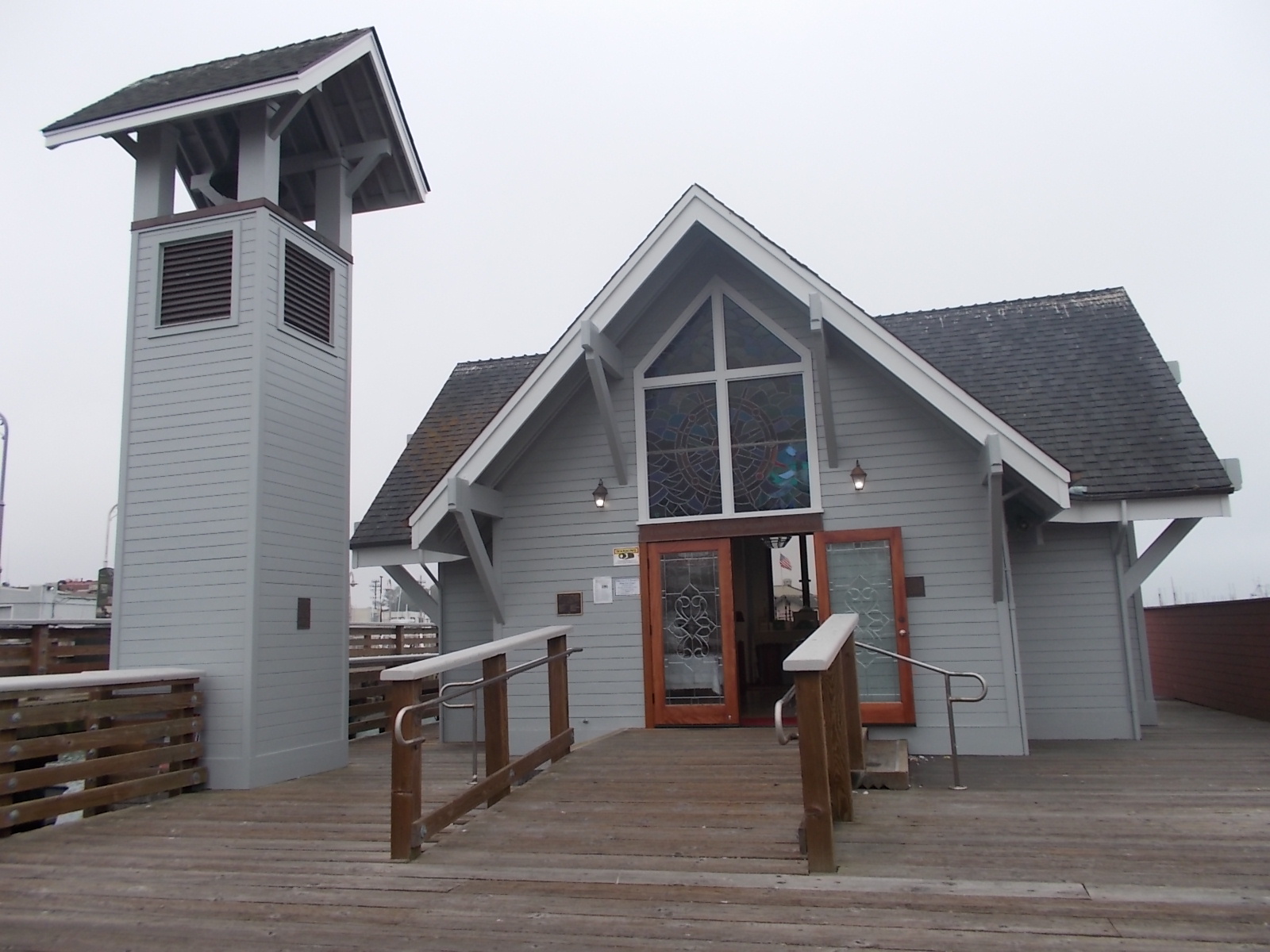
St. John's Oratory
At the Historic Fishermen's & Seamen's Memorial Chapel
And Its Campanile (Bell-tower)
The Bells Are Rung Traditionally for the Angelus of the Blessed Virgin Mary
And for the Consecration of Holy Mass
NOT THE NEW ORDER SERVICE OF 1969
NOT THE HALF NEW ORDER VATICAN II SERVICE OF 1962+
BUT THE FULLY TRADITIONAL ROMAN CATHOLIC LATIN MASS (1950)
"Some Things in Life Should Never Change"
St. John's Oratory did not come only recently to this Apostolate, but has offered, with experience, knowledge, and commitment, the Traditional Latin Mass and Divine Office every Sunday and Holyday since 1992. St. John's Oratory is also known as a center for promoting the traditional Latin Gregorian chant of the traditional Roman rite. Gregorian chant is sung every Sunday and Holyday by the St. John Gregorian Schola of San Francisco.
For general information about the times and nature of the Society's services, click on Services at the Oratory.
For the Society's current schedule of fully Traditional Latin Masses and other traditional services, click on Current Mass Schedule Bulletin. (Be sure that you have the Adobe Reader [PDF] plug-in installed for your internet browser.)
For general information about traditional Roman Catholicism, click Traditional Roman Catholicism.
If you wish to receive our weekly E-mail bulletin containing information on Oratory schedules and activities, please send your name, mailing address, and E-mail address to the Society. If you have any questions, you may send them as well.
Amateurs Wanted to Sing Gregorian Chant
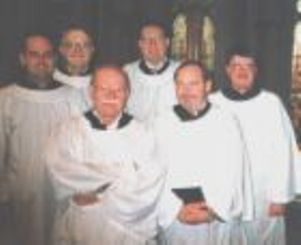
For sixteen years our group has been chanting in the intimate setting of St. John's Oratory at the historic Fishermen's & Seamen's Memorial Chapel at Fishermen's Wharf in San Francisco. We practice 9:00-9:30 a.m. Sundays and then chant the traditional Catholic Hour of Terce 9:30-10:00 a.m and chant monthly for the only fully traditional Missae Cantatae (Sung Masses) in the Bay Area.
We are currently producing live recordings of our chant for the ChantCD label. You will receive a free copy for family and friends of any CD in which you participate. We make no pretense to being anything but amateurs (lovers of the chant) and to demonstrating merely what is achievable over time by an amateur small chant choir.
For further information about the St. John Schola for Gregorian Chant, click on St. John Schola for Gregorian Chant. If you have any questions, you may address them to the Society.
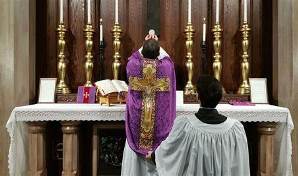
Altar Server Needed for Traditional Latin Mass
Newest Gregorian Chant CD Issued in Our St. John Schola Series
Volume X: Feast of the Precious Blood, Issued January 2013
Support This Effort by Making Each Volume of This Unique Traditional Set Part of Your Personal CD Library
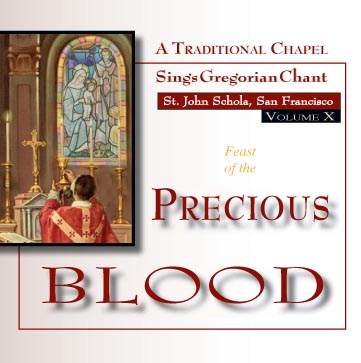
The Hour of Terce of the Divine Office is the third Hour of the day, the one traditionally appointed to be chanted immediately before Holy Mass. The majority of this recording covers the Mass for the Feast of the Most Precious Blood of Our Lord Jesus Christ. This feast, assigned to July 1, celebrates the redemptive power of the Blood of Christ shed upon the Cross for mankind. The Ordinary chants here are taken entirely from Mass VIII De Angelis of the Kyriale, supplemented by three traditional motets: one Gregorian, one by the sublime polyphonist Palestrina, and one by St. Thomas Aquinas. The ancient French melody Christus Vincit constitutes the recessional. The recording is 57 minutes long. The beauty of the devotional images on the cover artwork of these CDs, designed by a leading traditional Catholic graphic artist, is stunning and makes owning the CDs a treasure for the cover images alone.
Our St. John Schola is recording this CD series entitled A Traditional Chapel Sings Gregorian Chant. For descriptive and ordering information on our CD series and to hear excerpts of our Gregorian chant, click on St. John Schola for Gregorian Chant.
Donations to the Society
Society's Visitor Counter
Since July 8, 2001, the Society's ninth anniversary, you are site visitor number:25,821
Copyright © 1991-2013. Publication of any material from this site without explicit written permission is strictly prohibited. The Society of St. John the Apostle operates independently of any diocese or other religious society. The information and materials contained in this web site are provided "as is" without warranty of any kind, either express or implied, including without limitation any warranty of accuracy, adequacy, or completeness of the information and materials, title, non-infringement, merchantability, fitness for a particular purpose and freedom from computer viruses.
St. John the Apostle Oratory (Fishermen's & Seamen's Memorial Chapel)
From: http://www.traditio.com/stjohn/memorial.htm
St. John the Apostle Oratory
(Fishermen's & Seamen's Memorial Chapel)
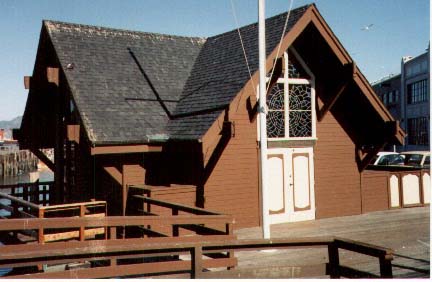
The Chapel before Installation of the Campanile
The Chapel with Campanile Installed October 1, 2006
The History of the Chapel
Since the early centuries of Christianity, it has been common for a community, or a wealthy local family, to fund a fishermen's chapel. Here a priest would conduct services for the repose of the souls of the deceased fishermen. Well-known chapels of this type are to be found in Boston, Massachusetts, a favorite of Richard Cardinal Cushing, chaplain to the Kennedys; on Jersey in the British Channel Islands; and at Grimbsy, Lincolnshire, in the U.K.Here in San Francisco, nestled between the inner harbor and Pier 45 among the piers and boats, is the Fishermen's and Seamen's Memorial Chapel, a small wood-framed chapel, brown and unimposing from a distance, but close up displaying beautiful glass windows. Built in 1979 and dedicated on May 21, 1981, as a memorial to the memory of fishermen who have lost their lives at sea, the modest building honors with memorial plaques about 200 fishermen who died while pursuing their ancient trade in the predominantly Catholic fishing community.
The memorial chapel was built on the site of the old Coast Guard building, from which rescue missions to foundering vessels were dispatched. The chapel together with its campanile, or bell-tower, built in 2006, are the only wharf buildings added since 1950. It stands as a vibrant structure that will weather with time, as the fishermen themselves, reminding and inspiring San Franciscans and visitors alike of the rich legacy the fishermen have given us.
On July 29, 1989, the Italian American Community of Northern California was honored by the visit of Salvatore Cardinal Pappalardo, Archbishop of Palermo, Italy, to San Francisco. During his visit the cardinal blessed this chapel and participated in a memorial service in memory of those who lost their lives at sea.
Since August 1992 the chapel has been the home of St. John's Oratory of the Society of St. John the Apostle, a traditional Roman Catholic organization that offers the Traditional Roman Catholic Latin Mass, Divine Office, and Gregorian Chant, and other traditional services on Sundays and Holydays.

The Antique Banner of the Madonna del Lume
Patron Saint of Fishermen
Hangs above the Chapel Altar
Ever since, the Madonna del Lume has been regarded as the patron Saint of fishermen and Sicilians have gathered every October to pay homage to her and to honor the lives of fishermen who were lost at sea. This Catholic tradition was brought to San Francisco's North Beach by Sicilian immigrants, who arrived in the Bay Area in droves, beginning in the mid 1800s. In 1935 the Madonna del Lume Society was organized, and the first official Madonna del Lume celebration took place in 1936.
On the first Saturday in October, the day before Rosary Sunday, in a ritual practiced since mediæval times, the words of the Blessing of Ships are intoned over the boats of San Francisco's fishing fleet, as they process out the Golden Gate:
No comments:
Post a Comment